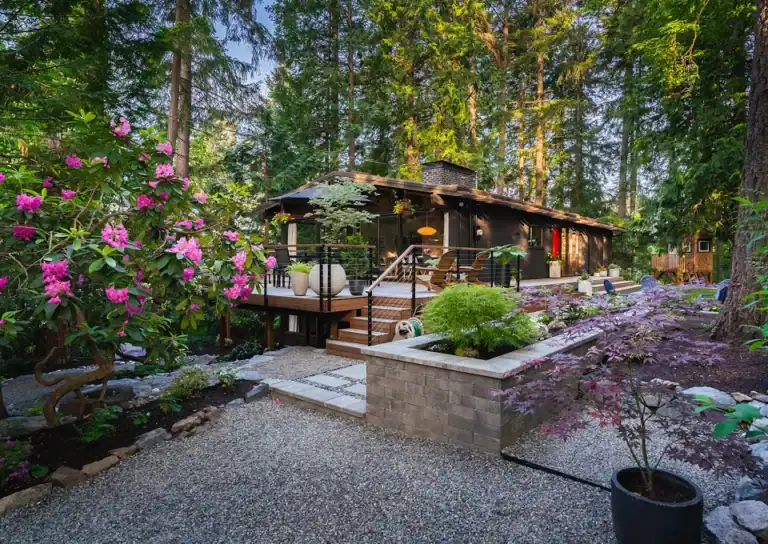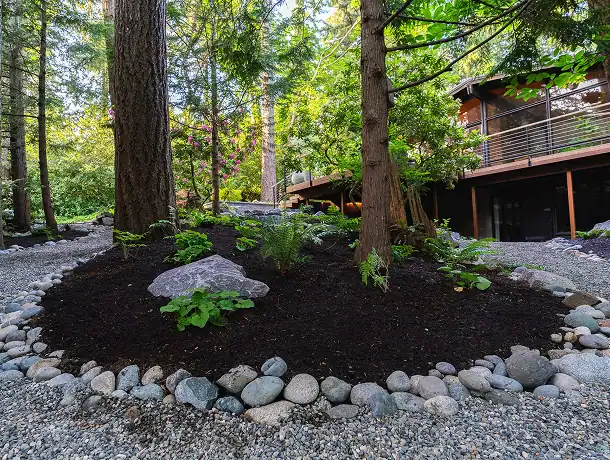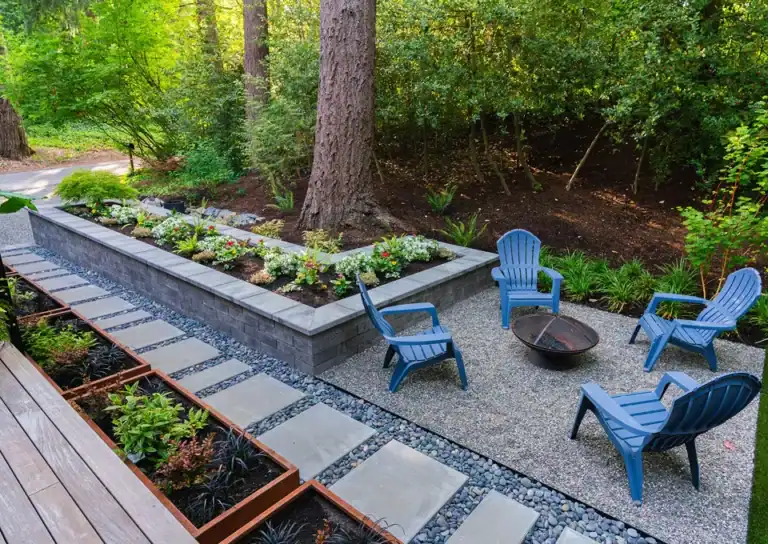
- Custom landscaping integrates every element — grading, planting, hardscape, irrigation, lighting, carpentry, water features, retaining walls, accent features, and lawns — into one harmonious outdoor space.
- The alternative is volume work — specialists efficient at one element but unable to manage the connections between elements that make a property feel composed.
- The cohesion produced by custom design is what makes a yard feel finished rather than assembled — beauty that comes from every detail relating to every other detail.
- Custom landscapes typically require less maintenance over time because every element was sited to thrive without constant compensation.
- Peace of mind comes from working with one team that holds the whole vision through design, build, and ongoing care — a single point of accountability rather than coordinating five contractors.
- The upfront cost premium of 30-50 percent narrows to 15-20 percent over ten years once volume-work remediation costs are factored in.
- Single simple replacements don't need custom thinking; anything involving two or more elements of the outdoor space does.
A custom landscape is one where every element — grading, planting, hardscape, irrigation, lighting, carpentry, water features, retaining walls, and lawn — is designed to work together as a single harmonious outdoor space, adapted to how you want to live and what you want the yard to feel like. The alternative is volume work: specialized companies that build patios efficiently, install lawns efficiently, or handle a single element well, but never see the whole property. Custom is what produces the cohesion that makes a yard feel finished instead of assembled — the kind of beauty that comes from every detail relating to every other detail. Across Greater Seattle, custom is the standard for homeowners who want their outdoor space to feel like a considered place, hold its beauty over decades, and stay easy to maintain rather than constantly needing fixes for problems that should have been solved at the design stage.
What does custom landscaping actually mean in practice?
Custom landscape design starts with a question that volume work never asks: what do you want the property to feel like? A custom designer wants to understand how you’ll use the space — the morning coffee spot, the place you host dinners, the corner the dog claims, the view from the kitchen window in February. Then the entire property gets composed around that vision.
That composition pulls together every element of an outdoor space:
- Grading — how the land moves under the design, so water flows where it should and the yard feels like it sits naturally on the lot
- Hardscape — patios, walkways, walls, steps, and edges that organize how you move through the space
- Retaining walls — built to do their structural job while also looking like they belong to the design, not bolted onto it
- Planting — every plant chosen for its role in the whole composition: the structure plant, the seasonal interest, the foundation backdrop, the focal point at the end of the path
- Lawn — sized and shaped to belong to the broader design, not just the leftover space after everything else
- Irrigation — invisible but coordinated, so the watering needs of one zone don’t dictate the planting palette of another
- Lighting — designed at the same time as everything else, so the yard looks composed at night as well as in daylight
- Carpentry — pergolas, arbors, gates, fences, deck transitions — built into the design from the start, not added on later
- Water features — sized and sited to be the focal point they should be, with sound that carries to the spaces where you’ll actually hear it
- Accent features — fire pits, sculpture niches, garden art locations — placed because the design called for them, not dropped in afterward
The result of pulling all of those elements together with one design vision is the cohesion that distinguishes a custom landscape from a property that’s had work done. The custom landscape feels like one thing. The collection-of-separate-projects yard always feels like several things stitched together.
What's the alternative to custom — and where does volume work fall short?
Volume landscape companies are efficient. A specialist that does nothing but paver patios can install one in two days. A lawn installation company can roll out 5,000 square feet of sod before lunch. There’s a real place for that efficiency when the scope is genuinely a single element in isolation — replacing a patio that’s separate from everything else, putting down a new lawn in a yard that won’t be touched anywhere else.
The volume model breaks down when the yard is a whole property rather than a single transaction. The paver crew installs a patio that sits at the wrong height relative to the planting beds, so water runs the wrong way and the bed soil washes onto the stone. The lawn company installs turf where deep shade will eventually kill it, because the species selection was based on what was on the truck rather than what would thrive on that site. The lighting subcontractor places fixtures that work in isolation but don’t reveal anything specific about the planting or hardscape they’re aimed at.
None of those companies are dishonest about what they do. They’re specialists at one element, and they do that element efficiently. The gap is in the spaces between elements — the relationships that custom design exists to manage.
A custom landscape is the answer to “I don’t want to coordinate five contractors, hope they all show up at the right times, and end up with a yard that doesn’t quite hang together at the end.” It’s one team holding the whole vision from the first walk through the property to the last plant in the ground.
How does custom design create beauty and cohesion?
The beauty in a custom landscape isn’t accidental — it’s the visible result of every element relating to every other element. A custom designer thinks about questions a volume specialist never gets asked to consider:
Visual rhythm through the seasons. What does the front yard look like in February when most of the plantings are bare? In May during peak bloom? In October when fall color is doing its work? A custom design considers what’s visible in every season, so the yard is interesting twelve months a year, not just three.
Color and texture stories. The bronze foliage of Heuchera ‘Palace Purple’ picks up the bronze in a stone wall. The blue-green of Festuca glauca echoes the slate gray of a patio. Polystichum munitum (Western sword fern) repeats across shaded zones to create rhythm rather than spotting. None of those choices happen by accident.
How spaces flow into one another. A patio doesn’t end abruptly at a lawn — it transitions through a planted edge or a low wall or a step that signals the change. A path doesn’t dead-end at a fence — it leads to a focal point or a turn that gives you somewhere to go. The design holds together because the connections were thought through.
Light at night. The patio gets warm path lighting. The specimen tree gets up-lighting that reveals its branch structure against the night sky. The water feature gets soft lighting that catches the movement of water without overwhelming the rest of the scene. By day the property looks composed in one way; by night it looks composed in a completely different way — both intentional.
The view from inside the house. A custom designer considers what you see from the kitchen window, the family room slider, the bedroom upstairs. The plantings outside those windows aren’t an afterthought — they’re sited specifically to be seen from those interior views.
The cumulative effect of all of those decisions is the feeling people describe when they visit a custom landscape: something feels right here, even before I can put my finger on what. That feeling is the cohesion. It’s what custom delivers.
Why does custom usually mean less maintenance over time?
The counterintuitive truth about custom landscaping: it’s typically lower-maintenance than volume work, not higher. The reason is straightforward — every element was placed where it can thrive without constant compensation.
Plants in a custom design are chosen for the spots they’re in. The plant that wants morning sun is on the east side. The plant that wants deep shade is under the fir canopy. The plant that needs sharp drainage is in the raised bed. None of them are being asked to survive conditions they weren’t built for, which means they don’t decline, don’t need replacement every few years, and don’t require disproportionate care.
Irrigation in a custom design is zoned around plant water needs, not around hose convenience. The drought-tolerant beds get watered less; the lawn gets its own schedule; the new plantings get an establishment zone they outgrow within two years. Water bills come down. Plant stress comes down. Replacement costs come down.
Hardscape in a custom design sits on a sub-base prepared for the specific soil it’s resting on. Custom patios don’t develop the settling that volume installs do because the base depths were matched to the conditions. Walkways don’t crack at the predictable failure points because the joints were planned around expected movement.
Drainage in a custom design was handled before anything else got installed — so the planting beds don’t fill with water in November, the patio doesn’t pool after every storm, and the crawl space stays dry. The single most common maintenance call we receive on volume-installed landscapes is some version of “water is showing up where it shouldn’t.” That call almost never comes from a custom-installed property.
The compound result over ten years is a yard that ages into maturity rather than declining out of it. The custom-installed property at year ten often looks better than it did at year three because the planting has grown into the design intent. The volume-installed property at year ten usually needs significant remediation to address the problems that started showing up at year four.
When is custom worth the additional investment?
Custom isn’t required for every situation. There are projects where simpler scope makes sense:
- Replacing one or two failed plants with the same species in the same location
- Refreshing mulch in established beds
- Replacing a single section of fence or one short walkway in a yard you’re not otherwise touching
- A modest lawn renovation in a yard with no other current work
For anything more ambitious, custom becomes the right approach. The simplest test is whether the project involves more than one element. A new patio that requires drainage adjustment is two elements. A planting refresh that needs lighting integration is two elements. A retaining wall that has to coordinate with the planting on either side is two elements.
Once you’re touching two or more elements at once, custom design pays for itself by managing the relationships between them. Trying to coordinate volume specialists across multiple elements is where homeowners end up frustrated — the patio crew finishes before the irrigation crew can run lines, the lighting subcontractor wires through soil the planting crew was about to amend, the timing falls apart, and the result is the patchwork yard that custom design exists to avoid.
The honest signal we use across our Landscape Enhancements work: if the project involves more than one element of the outdoor space, custom is the appropriate approach. If the homeowner cares about how the yard looks and feels as a whole, custom is the appropriate approach. The difference shows up in year one and compounds for decades.
How much more does custom landscaping cost — and what's the value over time?
Custom typically runs 30 to 50 percent more than volume work upfront. The premium pays for the design time, the coordination, the plant sourcing flexibility, and the additional care during installation that custom requires.
The cost picture over five to ten years tells a different story:
A volume-installed backyard at $25,000 often costs another $5,000-$10,000 in remediation by year five: replaced plants that didn’t fit the site, drainage corrections, hardscape settling repair, irrigation reworks. The yard never looks quite the way the homeowner imagined, because nothing was designed to be looked at as a whole.
A custom-installed backyard at $35,000 typically holds without significant remediation for ten-plus years. The plants establish, the hardscape stays sound, the drainage works, and the design ages into maturity. Maintenance costs are lower because every element is in a position to thrive.
Over a ten-year horizon, the cost difference narrows to roughly 15-20 percent — and the homeowner spent the decade enjoying a yard that worked, instead of fielding a stream of small problems.
The other value that’s harder to put a dollar figure on is peace of mind. A custom landscape designed and installed by one team gives you a single phone number for anything that comes up. You’re not coordinating between five contractors when something needs attention. The same crew that installed the lighting handled the planting and the patio and knows how everything was meant to function together. That continuity has real value over the life of the property.
What separates Classic's approach from volume work?
Three operating principles shape how Classic Landscaping handles custom work:
The design team holds the whole project. The designer who walks your property at the start is involved through construction and present at the maintenance handoff. There’s no telephone game between separate companies. The vision that gets developed in the first consultation is the vision that gets installed.
Every element is internal. Classic is design-build, not designer-and-separate-contractor, which means designers, install crews, hardscape leads, irrigation, lighting, and maintenance are all part of the same company. When the install crew encounters something that needs a design adjustment, the designer is reachable. When the maintenance team takes over the new install, they were part of the conversation about how the design was meant to function. The continuity isn’t theoretical — it’s how the work actually gets done.
Plant decisions pass through a horticulturist. Classic started in 1985 as a nursery. We no longer operate the retail nursery, but a Certified Professional Horticulturist reviews every plant specification before it gets installed. The plant that gets specified is one that will actually thrive in that exact bed, not whatever was readily available at a wholesale yard.
The broader approach is documented at the Classic Experience hub — the operating principles that shape how custom work gets done from first call through the years that follow.
Should you choose custom landscape work?
The decision becomes clear when you ask yourself two questions:
Do you want the yard to feel like one place, or are you fine with it feeling like several projects? If the answer is one place, custom is the path that gets you there.
Are you planning to stay in the home long enough to enjoy the yard as it matures? Custom landscapes pay back over five to ten years — through both the cohesion that holds up over time and the lower maintenance and remediation costs. If you’re staying, the math works. If you’re moving soon, simpler scope may be the right answer.
If you answer yes to both, the next step is a conversation about what you want the property to feel like. We start with a walk through the yard with one of our designers — no proposal until we’ve actually seen the property and understood the vision. From there, the design process develops the cohesion that custom delivers.