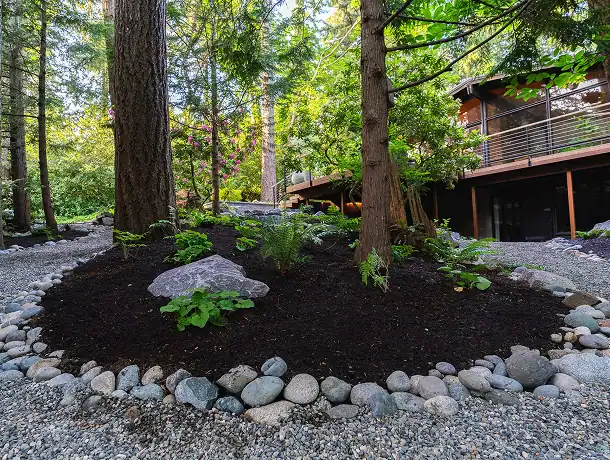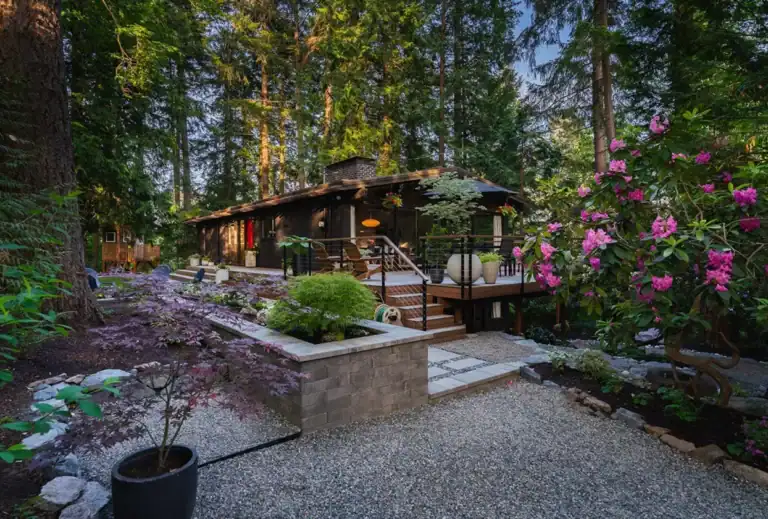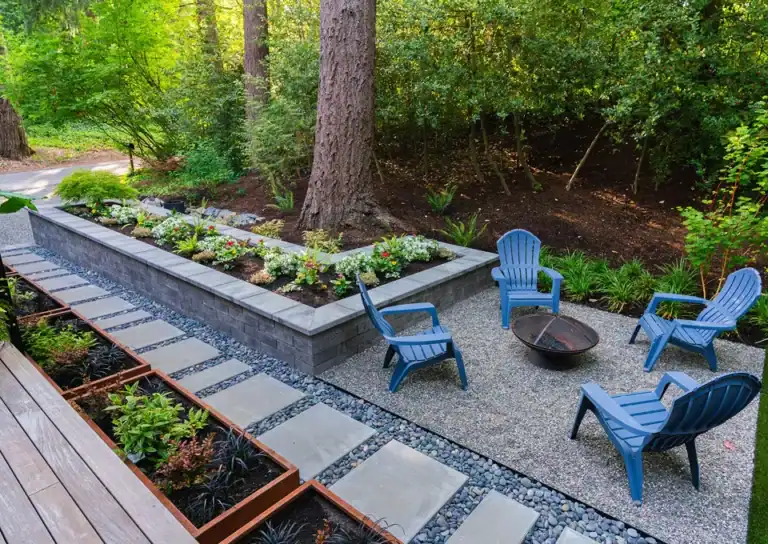
- We price most jobs as a fixed quote, so the risk of a cost overrun sits with us. Only rare small requests and irrigation repairs are quoted on time and materials.
- Access, slope and distance to suppliers decide how long a job takes. A flat front yard near our suppliers costs less than a sloped backyard across town.
- Changes made after work starts are the most wasteful cost, and planning prevents most of them.
- Material cost is quality, quantity and the chance something has to be redone. Durable materials and the plants your designer recommends keep that chance low.
- Permits and design add cost on larger projects. Smaller projects often need neither.
Picture two patios, the same size, built from the same stone. One goes into a flat front yard a short drive from our suppliers. The other sits behind a narrow side gate, on a sloped backyard across town.
The second one costs more. Nobody padded the quote. The job just takes longer, and almost everything in landscape pricing comes back to that: the time a job takes and the materials it uses
First, how we price it
We price most jobs as a fixed quote, so the risk of a cost overrun sits with us, not you, and you can plan around a number that holds. If the dig takes longer than we thought, that’s our problem to absorb.
There are two exceptions, both quoted on time and materials. The first is the odd small request we rarely do. Someone once asked us to put together a trampoline. We don’t do it often enough to know how to price it, but it’s a small job and a convenience for the client, so we simply track the time. The second is irrigation repair. Nobody knows what’s waiting underground until the digging starts, so a fixed number would be a guess.
To build that fixed number, we work out the hours and the materials behind it. The hours aren’t all the same: a laborer, a crew leader and a project manager each cost differently, so the quote counts whose time the job needs, not just how much. Your estimate is organized by area and by phase, so you can see what each part of the yard costs.
Why does a sloped backyard cost more than a flat front yard?
Because nearly every hour on it runs slower. Three things do most of the slowing.
Getting in. That narrow side gate means the skid steer stays on the street, and the gravel, soil and stone come through by the bucket. Same patio, many more trips.
The slope. A steep yard is slower to work for the obvious reason, and for a less obvious one: safety. People and loads move carefully on a hillside, and they should.
The drive. We usually pick materials up from our suppliers and take them straight to your site, rather than through our own yard. The farther the site is from the supplier network, the more of the day goes to hauling instead of building.
Our front-yard patio has none of those problems. The backyard one has all three.
Why don't you just have everything delivered?
Delivery has its own cost, and it gives up something we care about more: choosing what arrives. A supplier doesn’t know your project. Ask a stone quarry for boulders and it will send whatever comes next in the pile.
We’d rather stand in the quarry and pick the rock for your wall face or your steps ourselves. That trip is in the quote on purpose.
The most expensive hour is the one spent changing course
Every change after work starts costs time. It doesn’t matter whether it comes from the homeowner, our project manager or something we find in the ground: the crew stops, the plan gets redrawn, materials get re-ordered, and the job starts again.
It’s the worst kind of waste, because planning could have prevented it and it rarely makes the finished yard any better. That’s why we plan the project, and design it when it needs design, before anyone picks up a shovel.
What makes materials cost more, and the cost a quote doesn't show
The visible part is simple. Better materials cost more, and more of them costs more.
The hidden part is the chance something has to be redone. We call it the probability of warranty. We lean toward durable materials that can take a few years of kids, dogs and Pacific Northwest winters, because they’re the ones that don’t come back.
Plants are where this shows up most. Every designer on our team holds a degree in landscape design or landscape architecture, so the plants in your design are chosen to hold up here. Some varieties, often delicate non-native ones, are better left to master gardeners.
The plants we install are guaranteed for one year, as long as a working irrigation system waters them. If your palette leans toward the delicate end, the quote has to allow for replacing some of those plants, labor and sourcing included.
That’s why going with the materials your designer and project manager recommend usually pays off twice: a lower quote, and fewer return visits. Nobody enjoys warranty visits, homeowners included. A few too many and a finished yard starts to feel like it never quite finished. We call that construction fatigue.
Do permits and design add to the cost?
On bigger projects, usually. On smaller ones, often not at all.
We know which work needs a permit, and we design within permit-free limits when that serves your project. Sometimes the permit-free version just isn’t the yard you want. Then there’s a design, a permit and a round of revisions before work starts, and that time and those fees are part of the price.
So, what will yours cost?
It depends, and now you know on what. Our flat front yard, near the suppliers, built from durable materials, with the plan settled before we start, sits at one end. The sloped backyard behind the side gate, far from the suppliers, with a delicate plant palette and a plan still changing, sits at the other. Most yards land somewhere between.
We talk ranges on the first call and the details at your first site visit, so the money conversation happens before any design begins. If the full plan is more than you want to take on at once, we split it into phases that build in the right order.