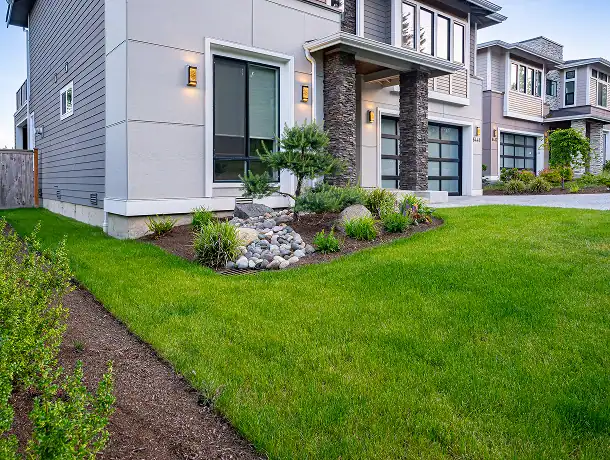
- Front yard transformation cost in Seattle ranges from $15,000 to $80,000+, with the primary variables being grade/slope, hardscape material selection, planting maturity, and whether the project involves structural work like retaining walls or driveway replacement.
- The front yard consistently delivers the highest landscape ROI because curb appeal is the one feature that every visitor, every buyer, and every neighbor sees — the National Association of Realtors ranks it among the top factors influencing buyer willingness to pay a premium.
- Most Eastside homeowners land in the $30,000–$55,000 range for a comprehensive front yard redesign that includes new hardscape, full planting design, lighting, and drainage corrections — the level where the transformation is unmistakable from the street.
- Slope is the single biggest cost variable on Eastside properties — a flat front yard with curb access is a fundamentally different project than one that rises four feet from the street with mature tree root zones and drainage challenges.
- Underinvesting in plant maturity is the most common front yard mistake — unlike the backyard, the front yard's "just planted" phase is visible to everyone for years, making the case for larger specimen plants stronger here than anywhere else on the property.
- Classic's design-build model is particularly well-suited to front yards because the approach sequence, architectural integration, and street presence require the design team and construction team to be the same team — any gap between vision and execution is visible to everyone.
How Much Does a Front Yard Transformation Actually Cost in Seattle?
Front yard projects span a wide range because “front yard transformation” can mean fundamentally different things. In Classic’s experience working across Kirkland, Bellevue, Redmond, Sammamish, and the broader Eastside, residential front yard transformations tend to fall into three investment tiers:
### $15,000–$30,000: Targeted Front Yard Enhancement
This level addresses the most impactful elements without reimagining the entire front yard. Typical scope includes:
- New walkway or entry path — replacing a cracked concrete walk with natural stone or pavers
- Foundation planting refresh — removing overgrown, dated shrubs and installing a layered planting design with year-round interest
- Defined planting beds with proper edging, amended soil, and mulch
- Basic landscape lighting along the walkway and at the entry
- Irrigation for new plantings
At this tier, the structure of the front yard — the driveway, the general grade, the lawn area — stays largely intact. The transformation is real but focused: better materials, better plants, better first impression.
### $30,000–$55,000: Comprehensive Front Yard Redesign
This is where the front yard gets rethought as a complete composition. The scope typically includes everything in the first tier plus:
- New hardscape throughout — entry walkway, front patio or landing area, retaining walls if grade requires them
- Full planting design — not just foundation plantings but the entire front yard conceived as a unified design with layered heights, seasonal progression, and year-round structure
- Mature or specimen plantings — larger-caliper trees or established shrubs that give the landscape immediate presence rather than a “just planted” look
- Comprehensive lighting design — architectural uplighting, path lighting, and accent lighting that transforms the property’s nighttime presence
- Drainage and grading corrections — addressing water that pools near the foundation or runs across the walkway
Most Eastside homeowners who have been thinking about their front yard for years — the ones who drive up to their house and feel a disconnect between the interior they’ve invested in and the exterior they haven’t — land in this range. This is where the transformation is unmistakable from the street.
### $55,000–$80,000+: Full Front Yard Design-Build
At this level, the front yard is treated as a complete design-build project with significant structural work. The scope may include:
- Driveway replacement or reconfiguration — new pavers, permeable paving, widened or reshaped approach
- Significant retaining walls — managing grade changes of two feet or more, creating terraced planting areas, or addressing structural slope issues
- Covered entry or portico elements — extending the home’s architecture into the landscape
- Custom stonework — seat walls, pillar features, or integrated mailbox structures
- Full irrigation and drainage infrastructure — not patching existing systems but designing from scratch
- Permitting — projects involving walls over four feet, work in critical areas, or significant grading changes in cities like Kirkland, Bellevue, and Sammamish often require municipal permits
These projects are less common, but they’re the ones that fundamentally change how a property presents itself. On Eastside properties where the front yard has significant slope, mature trees with protected root zones, or decades of deferred work, this level of investment reflects what the site actually demands — not luxury add-ons.
What Drives Front Yard Costs Up or Down on the Eastside?
Two front yards on the same street in Kirkland can require investments that differ by tens of thousands of dollars. The primary drivers:
### Site Conditions and Grade
Slope is the single biggest variable in front yard work on the Eastside. A flat lot with a straightforward path from sidewalk to front door is a fundamentally different project from a lot that rises four feet from the street, requires retaining walls, needs engineered drainage, and has mature trees whose root zones constrain where you can build. In Classic’s experience, the work you can’t see — grading, drainage, structural reinforcement — is often where the real cost lives.
Access matters too. A front yard where equipment can pull up to the curb and work directly is less expensive to build than one where materials must be hand-carried up a slope or through a narrow side yard.
### Hardscape Material Selection
The material gap in front yard hardscape is substantial:
- Concrete walkway: Functional, lowest cost, but limited aesthetic range
- Interlocking pavers: Mid-range cost, wide design flexibility, good durability in Seattle’s freeze-thaw cycles
- Natural stone (flagstone, basalt, granite): Highest material cost, longest lifespan, most distinctive appearance
The choice between pavers and natural stone alone can shift a front yard project by $5,000–$15,000 depending on the square footage involved. Classic’s approach is to present material options within a homeowner’s investment range and explain the real trade-offs — not just the price difference but the maintenance requirements, the aging characteristics, and how each material performs through Seattle’s wet winters.
### Planting Scope and Maturity
A front yard planted with 1-gallon perennials and 5-gallon shrubs will cost significantly less than one planted with 15-gallon trees, 7-gallon specimen shrubs, and ornamental grasses in 3-gallon containers. The difference is not just the plant cost — it’s the installation labor, the soil amendment volume, and the irrigation design required.
Mature plantings deliver immediate impact, which matters enormously in the front yard. A backyard planting can grow in over a few seasons and no one sees the process. A front yard that looks sparse on day one broadcasts “just planted” to the entire neighborhood for years. Many homeowners choose to invest more heavily in front yard plant maturity for exactly this reason.
### Existing Infrastructure
What’s already in the ground affects cost significantly. Removing a concrete driveway costs more than working around one. Rerouting irrigation that runs under an existing walkway adds complexity. Working around utility lines, existing drainage systems, or root zones of protected trees all constrain what can be done and how efficiently it can be built.
Why Does the Front Yard Deliver the Highest ROI?
The return on front yard investment is disproportionate to its share of the overall landscape budget for several reasons that compound:
### Curb Appeal Is the Only Landscape Feature That’s Always Visible
Your backyard is private. Your side yard is functional. Your front yard is public — it’s what the neighborhood sees, what guests experience first, what real estate agents photograph, and what forms the initial impression of your property’s value and care. The National Association of Realtors consistently finds that curb appeal ranks among the top factors influencing buyer perception and willingness to pay a premium.
In Seattle’s competitive real estate market, where Eastside properties routinely sell above asking price, the front yard sets the tone before a buyer ever opens the front door. A property with a thoughtfully designed front landscape signals care, investment, and quality — and buyers respond to that signal with higher offers.
### First Impression Anchors Perception of the Entire Property
Behavioral research in real estate consistently shows that buyers form lasting impressions within the first few seconds of seeing a property. The front yard is that first impression. A compelling entry sequence — a well-proportioned walkway, layered plantings that frame the approach, lighting that creates warmth — establishes an expectation of quality that carries through the entire home tour.
This isn’t abstract psychology. In Classic’s experience working with homeowners preparing properties for sale, front yard improvements consistently generate the strongest agent feedback and the most measurable impact on showing traffic.
### The Compounding Effect of Daily Experience
ROI isn’t only measured at resale. Homeowners who invest in their front yard report something that doesn’t show up in the numbers: they enjoy coming home more. The daily experience of pulling into a driveway that feels intentional, walking a path that’s well-proportioned and well-lit, seeing a planting design that changes with the seasons — that’s a quality-of-life return that compounds every single day.
For Buyer #1 — the homeowner who has been thinking about this for years — the front yard transformation often resolves a frustration that has quietly accumulated every time they’ve walked to their front door. For Buyer #3 — the homeowner whose life stage has shifted and the outdoor space suddenly matters — the front yard is where that shift becomes visible to the world.
How Does Front Yard ROI Compare to Backyard Investment?
This is a question Classic’s designers hear regularly, and the honest answer is: they serve different purposes.
A backyard transformation is about how you live. An outdoor living space, a patio for entertaining, a play area for children — these are lifestyle investments that improve how you use your property day to day. The ROI is real but harder to quantify because much of it is experiential.
A front yard transformation is about how your property presents itself. It’s simultaneously a lifestyle investment (you see it every day, your guests experience it first) and a financial investment (it directly affects property value, buyer perception, and neighborhood standing). The ROI is more measurable because curb appeal has a documented, quantifiable impact on property value.
In practice, many homeowners who engage Classic for a front yard transformation have already invested in their backyard — or plan to. The front yard is often the last piece, the one that’s been deferred because “no one sees the front yard but us.” But everyone sees it. And that visibility is precisely what makes the investment return so strong.
If you’re weighing a front yard project against a backyard renovation, understanding the full cost picture for backyard work helps frame the comparison.
When Should You Invest in the Front Yard vs. the Back?
There’s no universal answer, but Classic’s experience suggests a framework:
Start with the front yard when:
- You’re planning to sell within 2–5 years and want to maximize resale value
- The front yard has functional problems — a crumbling walkway, drainage issues near the foundation, safety concerns with steps or lighting
- The disconnect between your home’s interior quality and exterior presentation bothers you
- You want the highest-visibility impact for your investment
Start with the backyard when:
- You want to create usable outdoor living space for your family now
- The backyard has urgent functional issues — drainage problems affecting the foundation, a failing retaining wall, unusable slope
- You entertain frequently and the backyard is where that happens
- Privacy is a higher priority than curb appeal
Do both in a phased approach when:
- The property needs comprehensive work and doing it all at once isn’t in the budget
- You want design continuity — one team designing both spaces ensures the front and back feel like they belong to the same property
- Phasing a larger project allows you to spread the investment across two construction seasons while maintaining a cohesive design vision
What Does Classic's Front Yard Process Look Like?
Classic Landscaping approaches front yard projects with the same design-build methodology used for any landscape project, but with heightened attention to two factors that are unique to front yards:
Street presence and approach sequence. The front yard is experienced in motion — approaching from the street, walking the path, arriving at the entry. Classic’s designers study the approach from multiple vantage points: from the street, from the sidewalk, from the driveway, from the front door looking out. The design must work from all of them.
Architectural integration. The front yard is visually connected to the home’s facade in a way the backyard is not. Material choices, scale, and style must complement the architecture — not compete with it and not ignore it. A Craftsman home in Kirkland calls for a different palette than a contemporary home in Bellevue.
The process follows Classic’s standard design-build sequence:
- Site assessment — documenting grade, drainage, utilities, root zones, sun exposure, and any municipal requirements specific to the property’s city
- Design development — translating the homeowner’s goals and the site’s conditions into a design that works from every vantage point
- Material specification — selecting hardscape, plantings, and lighting that perform in Eastside conditions and complement the home’s architecture
- Construction — building the project under one contract, one timeline, one point of accountability
The front yard is where Classic’s design-build model delivers its clearest advantage: the team that designs the approach sequence is the same team that builds it. There’s no gap between what was envisioned and what gets installed — which matters enormously when the result is the first thing everyone sees.
What Cost Mistakes Do Homeowners Make with Front Yard Projects?
In Classic’s experience across 2,000+ Eastside landscapes, the most common front yard cost mistakes are:
Underinvesting in plant maturity. A front yard planted with small nursery stock looks sparse for years. Unlike the backyard, where you can watch plants grow in over time, the front yard’s “just planted” phase is visible to everyone. Allocating a meaningful portion of the budget to larger specimen plants — even if it means simplifying the hardscape slightly — typically produces a stronger result on day one.
Ignoring drainage. Water that pools on a front walkway, runs across the driveway, or saturates foundation plantings will undermine even the most beautiful design. Drainage and grading work isn’t the exciting part of a front yard project, but skipping it to save budget is the most common source of problems Classic sees when evaluating front yards that were built by other companies.
Treating the front yard as separate from the property. The front yard doesn’t exist in isolation. It connects to the driveway, the side yard, the foundation, and the home’s architecture. A front yard designed without considering these connections can feel like a stage set — impressive in isolation but disconnected from the property it belongs to.
Choosing materials based on cost alone. The front yard endures more foot traffic, more exposure to weather, and more visual scrutiny than any other landscape zone. Economy materials that might serve adequately in a side yard or utility area will show their limitations faster in the front yard. In Classic’s experience, investing in durable, age-gracefully materials for the front yard and being more economical in less visible areas produces a better long-term result at a similar total investment.