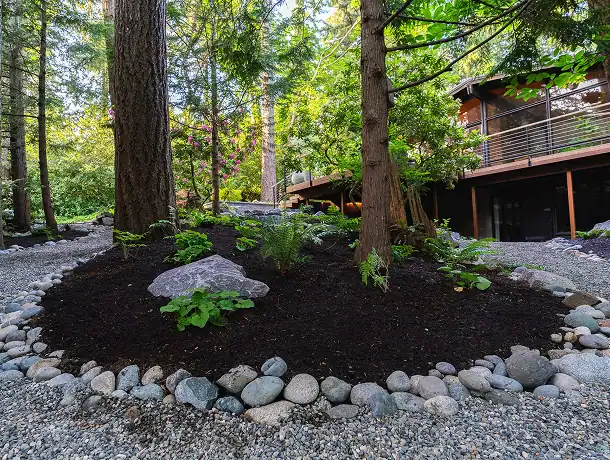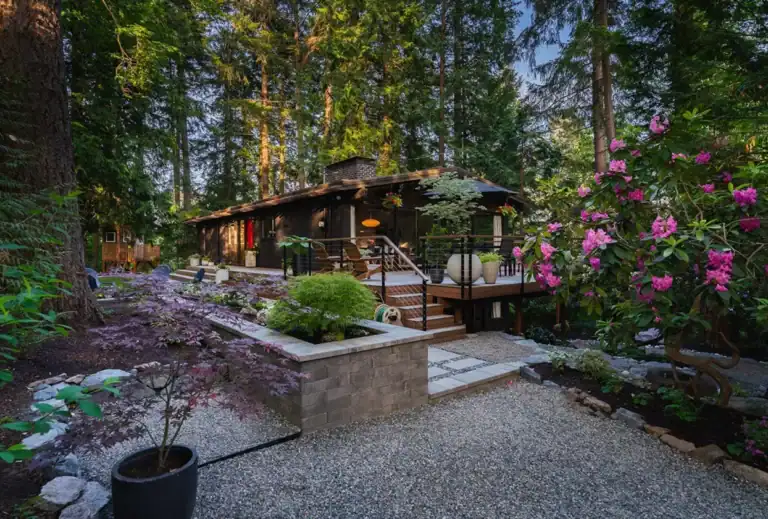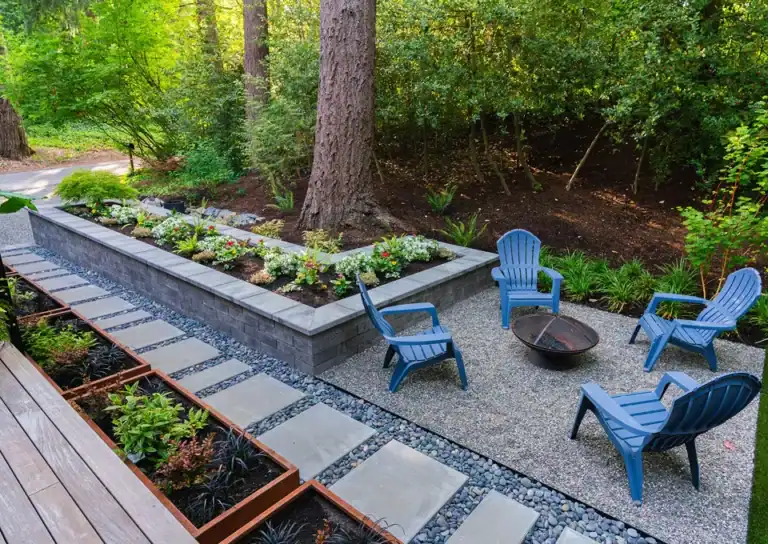
- Ecological training shapes practical design decisions — plant placement, soil preparation, drainage, and long-term maintenance load — not just aesthetics.
- Landscapes designed with ecological principles tend to require less irrigation, less fertilizer, and less corrective maintenance after the first two years because they build self-sustaining soil biology.
- Rain gardens and bioswales are not just environmental gestures — they solve real drainage problems on Eastside properties while reducing the load on municipal stormwater systems.
- Native and climate-adapted plant communities planted in compatible groupings establish faster and support each other through shared root networks and complementary canopy layers.
- Classic's Certified EcoPRO credential and ecological restoration training translate directly into how we spec soil amendments, design planting beds, and select plant palettes for residential sites.
- Ecological design does not mean "wild-looking." It means a designed landscape that works with Seattle's natural systems instead of fighting them — and that distinction saves homeowners real money and effort over time.
How Does Ecological Training Change What Happens on a Residential Project?
Most homeowners will never hear the word “permaculture” during a consultation with Classic. They will not be given a lecture on mycorrhizal networks or forest succession theory. What they will notice is that the design conversation goes deeper than they expected — into how water moves across the property during a November storm, what the soil is actually doing beneath the existing lawn, which direction the prevailing wind comes from and what that means for plant placement, and whether the mature Douglas firs along the property line are assets to design around or problems that need management.
That depth comes from training. When a designer has studied how natural plant communities assemble themselves — how a Pacific Northwest forest floor builds soil through leaf litter, how understory shrubs create microclimates that protect more sensitive species, how root systems of compatible plants share resources — they bring a different lens to residential design. The questions they ask during a site assessment are different. The plant palettes they specify are different. The way they think about what the landscape will look like in year seven, not just at installation, is fundamentally different.
In our experience across 2,000+ Seattle-area landscapes, the projects that age most gracefully are the ones where the initial design worked with the site’s natural tendencies rather than overriding them. Ecological training is what makes that approach systematic rather than accidental.
What Does "Working With Natural Systems" Actually Mean for a Seattle Yard?
This is where the concept stops being abstract and becomes specific to the conditions west of the Cascades.
### Soil biology, not just soil amendment
A conventional landscape installation treats soil as a structural medium — amend it enough to support root growth, add fertilizer to compensate for what’s missing, and move on. An ecologically informed approach treats soil as a living system. The goal is to establish the microbial communities, fungal networks, and organic matter cycles that allow the soil to feed the plants on its own over time.
For Eastside properties, this means specifying compost blends that introduce beneficial microbiology — not just organic matter for drainage improvement. It means mulching strategies that mimic the leaf litter layer of a Pacific Northwest forest floor, feeding soil organisms that in turn feed plant roots. It means understanding that the glacial till and clay common across Woodinville, Kirkland, and Redmond is not “bad soil” — it is soil with specific biological characteristics that can be worked with rather than replaced wholesale.
The practical payoff: landscapes where soil biology is established correctly during installation typically need significantly less supplemental fertilization after the first two growing seasons. The soil starts doing the work that chemical inputs were doing. That is less cost, less maintenance time, and a healthier root environment for the long term.
### Stormwater as a resource, not a problem
Seattle’s Eastside receives roughly 35 to 50 inches of rain annually, most of it concentrated between October and April. On a typical residential lot, conventional landscaping sends a large percentage of that water into storm drains — off the roof, across hardscape, down the driveway, and gone. An ecologically designed landscape captures, slows, and infiltrates that water on site.
Rain gardens, bioswales, and strategic grading direct stormwater into planted areas where it percolates through root zones, recharges groundwater, and feeds plants instead of overwhelming the municipal system. This is not a decorative feature. On properties with drainage issues — and in our experience, drainage is a factor on the majority of Eastside sites we assess — a well-designed rain garden or bioswale can solve the problem more effectively and more attractively than a French drain alone.
King County and many Eastside municipalities actively encourage on-site stormwater management. Some jurisdictions offer stormwater credits for properties that manage runoff through landscape-based solutions. The ecological approach aligns with where regulatory requirements are heading — which means a landscape designed this way today is better positioned for code changes tomorrow.
### Plant communities, not plant collections
This is one of the most visible differences ecological training produces. A conventional planting plan selects individual plants for individual spots — this tree here for shade, this shrub there for screening, these perennials along the border for color. An ecologically informed plan designs plant communities — groups of species that naturally occur together and support each other’s growth.
In the Pacific Northwest, that means understanding which understory shrubs thrive beneath the canopy of native conifers, which groundcovers suppress weeds while building soil, which perennials attract the specific pollinators that also service the fruit trees or berry bushes elsewhere in the landscape, and which root structures complement rather than compete with each other.
The result is a planting scheme where every plant has a functional relationship with its neighbors. Tall canopy species shelter shade-loving understory. Nitrogen-fixing plants improve soil for neighboring species that need it. Deep-rooted plants break up compacted subsoil while shallow-rooted groundcovers protect the surface from erosion. The design looks intentional and layered — because it is — but the layers serve ecological functions, not just visual ones.
For the homeowner, this means plantings that establish faster, compete against weeds more effectively, and require less individual plant replacement over time. In our experience, ecologically designed plant communities reach a self-sustaining state — where they need pruning and editing rather than constant replanting and gap-filling — roughly two to three years sooner than conventional planting schemes on comparable sites.
Does Ecological Design Mean the Yard Will Look Wild or Unkempt?
This is the most common concern homeowners raise, and it is worth addressing directly: no.
Ecological design and formal or contemporary design are not opposites. The ecological principles operate below the surface — in soil preparation, plant selection logic, water management strategy, and long-term maintenance planning. The visual expression of those principles is a design choice, and it can range from highly naturalistic to clean and structured.
A rain garden does not have to look like a wetland. It can be planted with ornamental grasses and flowering perennials that read as a designed garden feature — because it is one. Native plant communities do not have to look like a vacant lot growing wild. Sword fern, salal, Oregon grape, and red huckleberry can be planted in deliberate compositions that are as structured as any conventional border.
What ecological training gives the designer is more options, not fewer. A designer who understands plant communities can create a formal composition that also functions ecologically — plants that look structured and intentional while simultaneously building soil, managing water, and supporting wildlife. The homeowner gets the aesthetic they want and the performance benefits of ecological design. Those are not competing goals.
What Does This Mean for Wildlife and Habitat?
Most homeowners who invest in a residential landscape want birds. They want butterflies. They want the yard to feel alive, not just decorated. Ecological design delivers this deliberately rather than hoping it happens.
Designing for habitat means including plants that provide food sources at different times of year — early-blooming species for pollinators emerging in February, berry-producing shrubs that feed birds through winter, host plants for specific butterfly species native to the Puget Sound region. It means including structural diversity — canopy layers, understory density, ground-level cover — that provides nesting sites, shelter, and foraging habitat.
On Eastside properties, we commonly work ecological habitat features into landscapes that homeowners experience as “the garden feels like it’s always buzzing with life.” That is not an accident. It is the result of selecting plants specifically for their ecological relationships with local wildlife — relationships that a designer trained in ecological restoration understands at a level that goes beyond “native plants attract birds.”
The practical benefit extends beyond wildlife. A landscape that supports a healthy pollinator population also supports better fruit set on any edible plants, more effective natural pest control through beneficial insect populations, and a more dynamic, seasonally interesting garden. The yard is not just a visual composition — it is a functioning ecosystem at a residential scale.
How Does Classic's Certified EcoPRO Credential Fit In?
The Certified EcoPRO designation is a professional credential focused on ecological practices in landscape management — soil health, integrated pest management, water conservation, and sustainable site practices. It is one piece of a broader ecological knowledge base that includes team members’ training in ecological restoration and permaculture principles.
In practical terms, the EcoPRO credential means Classic’s approach to site management is grounded in verified professional standards for ecological practice — not just general interest or marketing language. When we specify a soil amendment protocol, design a stormwater management feature, or develop a long-term maintenance plan that reduces chemical inputs over time, those recommendations are backed by formal training in the ecological science behind them.
This matters most in the long-term maintenance conversation. A landscape designed with ecological principles has different maintenance needs than a conventional landscape — less fertilizer, less irrigation after establishment, more selective pruning and editing, different pest management approaches. The EcoPRO training ensures that the maintenance recommendations we provide actually support the ecological systems the design established, rather than undermining them with conventional practices.
What Does Ecological Design Cost Compared to Conventional Landscaping?
Homeowners are right to ask this question, and the honest answer is: the installation cost is typically comparable, and the total cost of ownership over ten years is often lower.
Ecological design does not require exotic or expensive materials. Native and climate-adapted plants sourced through Pacific Northwest nurseries are generally priced similarly to conventional ornamental selections. Soil preparation for ecological function may involve different amendment specifications, but the labor and material cost is in the same range as conventional soil prep. Rain gardens and bioswales require grading and planting — but they often replace drainage infrastructure (French drains, catch basins, piping) that carries its own cost.
Where the economics shift is in years three through ten. A landscape with established soil biology needs less fertilization. A landscape with effective stormwater management has fewer drainage repair calls. Plantings designed as functional communities have lower replacement rates. A design-build approach that integrates ecological systems from the start avoids the cost of retrofitting them later.
In our experience, homeowners who invest in ecologically designed landscapes spend measurably less on maintenance inputs — fertilizer, irrigation, plant replacement, pest treatment — after the establishment period than homeowners with comparably sized conventional landscapes. The savings compound because the ecological systems improve over time rather than degrading.
How Does This Approach Evolve Over Time?
This may be the most important distinction between ecological and conventional landscape design, and it is the one that matters most to homeowners making a long-term investment.
A conventional landscape is at its peak the day it is installed. From that point forward, it requires constant inputs to maintain that condition — water, fertilizer, pruning, replacement plantings, pest management. The trajectory is decline managed by maintenance. The homeowner is essentially paying to hold the landscape at a fixed point against its natural tendency to change.
An ecologically designed landscape is at its simplest the day it is installed. From that point forward, it develops — soil biology matures, plant communities fill in and establish functional relationships, habitat value increases, the root systems of compatible plants interweave and stabilize slopes and soil structure. The trajectory is growth managed by editing. The maintenance conversation shifts from “what do we need to add” to “what do we need to guide.”
By year five, a well-designed ecological landscape on an Eastside property typically has a denser, more layered canopy structure than it did at installation. The understory has filled in. Groundcovers have knit together. The soil is darker, more friable, and holds moisture better. Seasonal interest is more varied because the plant community includes species at different points in their growth cycle. The landscape requires thoughtful maintenance — selective pruning, occasional editing of aggressive growers, monitoring of plant health — but the character of that maintenance is stewardship rather than life support.
For the homeowner, this means the landscape becomes more valuable and more interesting with each passing year. The investment appreciates in a way that conventional landscapes, fighting entropy from day one, simply do not.