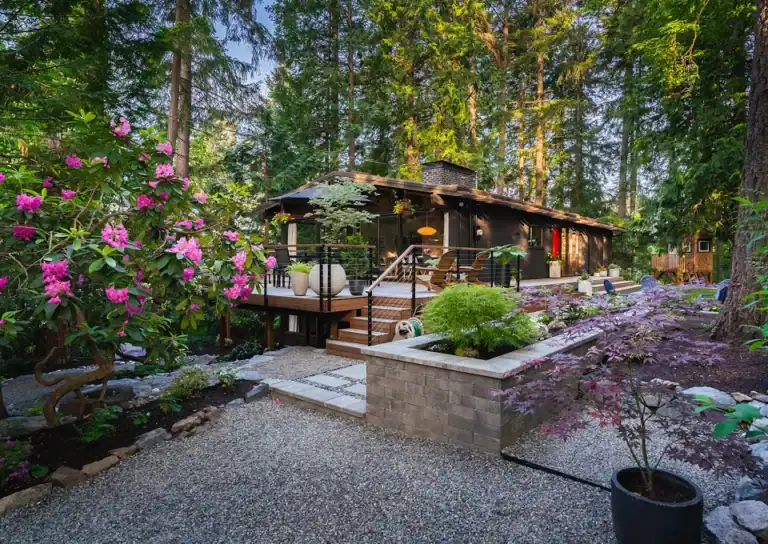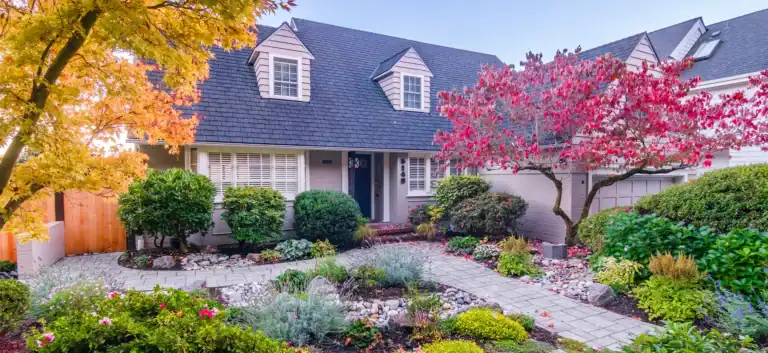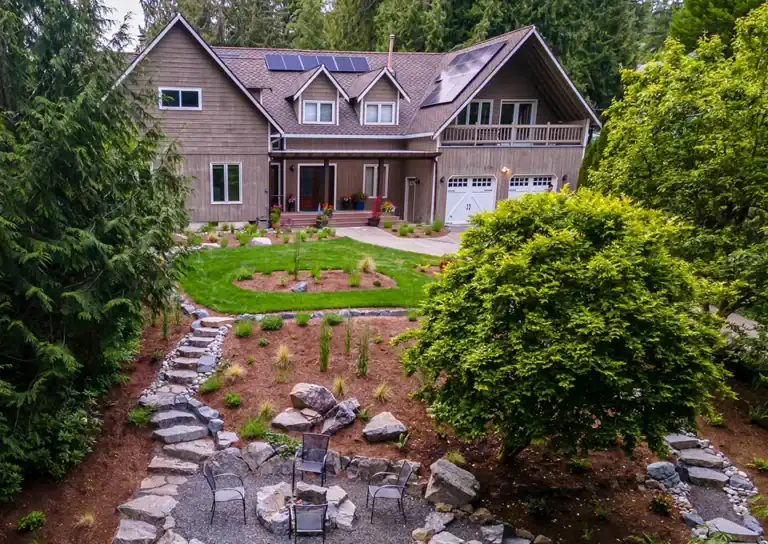
- Drainage and grading deliver the highest long-term ROI of any landscape investment — they protect foundations, prevent erosion, and eliminate conditions that destroy every other feature on the property. Skipping them to fund visible features is the most expensive mistake Seattle homeowners make.
- Structural hardscape — retaining walls, patios on proper base, well-built stairs — holds its value for 25 to 40+ years when engineered correctly for Seattle's freeze-thaw cycles and clay soils. A poorly built wall costs more to remove and rebuild than it would have cost to do right the first time.
- Quality plantings matched to your site's actual conditions (soil, light, moisture) outperform expensive specimen plants placed in the wrong spot — a $45 sword fern in the right location will look better in five years than a $350 Japanese maple planted where it gets afternoon scorch.
- Trend-driven features — built-in pizza ovens, elaborate water features, synthetic putting greens — rarely return their cost at resale and often become the item a future buyer asks to have removed. They add personal enjoyment but should be budgeted as consumption, not investment.
- The sequence of investment matters as much as the choice — building beautiful features on top of unresolved drainage, grading, or soil problems is the landscape equivalent of remodeling a kitchen in a house with a cracked foundation.
What Makes a Landscape Investment "Pay Off"?
Before the list, it is worth defining what “return” actually means in a landscape context, because it is not just about resale value.
A landscape investment pays off when it does one or more of the following: it increases the usable square footage of your property, it prevents damage that would cost more to repair later, it reduces ongoing maintenance costs, it materially improves the daily experience of the people who live there, or it increases the appraised or perceived value of the property at sale.
The investments that score highest tend to hit three or four of those categories simultaneously. Drainage work, for example, protects the foundation (damage prevention), makes more of the yard usable (square footage), reduces the need for constant replanting in waterlogged areas (maintenance reduction), and is a documented positive in home inspections (resale value).
The investments that disappoint tend to score on only one — personal enjoyment — while creating ongoing maintenance obligations that erode whatever pleasure they initially provided.
Which Landscape Investments Consistently Deliver?
### Drainage and Grading: The Invisible Foundation
This is not a glamorous category. No one posts their French drain on Instagram. But across four decades of work from Kirkland to Sammamish to Issaquah, no single category of landscape investment has proven more reliably valuable than getting water to move correctly across and away from a property.
In the Puget Sound lowlands, the combination of glacial till clay soils, moderate but persistent rainfall (37 inches annually in Seattle, higher on the Eastside), and increasingly intense storm events makes drainage the foundational layer of any landscape. According to King County’s stormwater management guidelines, unmanaged stormwater is one of the leading causes of property damage and environmental degradation in the region.
What Classic’s crews have consistently found: when homeowners skip or undersize drainage in favor of spending more on visible features, those visible features are the first things to fail. Retaining walls shift when hydrostatic pressure builds behind them. Patios heave when water saturates the base material and freezes. Plantings rot when their root zones sit in standing water from November through March.
The math is straightforward. A properly engineered drainage system on a typical Eastside residential lot — French drains, catch basins, grading corrections, downspout routing — might represent 8 to 15 percent of a total design-build budget. The cost of repairing a retaining wall that failed because drainage behind it was inadequate typically exceeds the cost of the original wall plus the drainage system combined.
This is why Classic’s design process starts with site hydrology before it gets to plant palettes and patio materials. The below-grade work is the single most important investment decision a homeowner makes — even though it is invisible the day after installation. For more on what happens when drainage is deferred, see why drainage and slope repairs get more expensive over time.
### Structural Hardscape: The 30-Year Assets
Retaining walls built to engineering standards, patios on properly compacted and drained bases, and well-constructed stairs and pathways are the structural bones of a landscape. When built correctly, they last 25 to 40 years or more with minimal maintenance.
The key phrase is “built correctly.” In Seattle’s soil and climate conditions, that means specific things. For retaining walls, it means geogrid reinforcement on walls over four feet, compacted drain rock behind the wall face, a perforated drain pipe at the base, and compaction in controlled lifts — not just stacking block and backfilling with native soil. For patios, it means excavating to 10 to 12 inches minimum, six or more inches of compacted base material, a screed layer, and edge restraint that prevents migration. In Seattle’s clay soils, cutting the base depth to save money is the single most common cause of patio failure Classic sees on properties where previous work was done by other companies.
The cost of a retaining wall in Seattle varies considerably depending on height, material, and engineering requirements. But regardless of the specific number, a properly built wall is a permanent asset. An improperly built wall is a liability — one that costs more to demolish and rebuild than it would have cost to build right the first time.
Structural hardscape also has strong resale performance. Appraisers and buyers can see and evaluate a stone patio, a well-built wall, and functional outdoor stairs. These features make a property feel finished and cared for in a way that directly influences perceived value.
### Quality Plantings in the Right Locations
This one requires a distinction that matters enormously: it is not about spending more on plants. It is about spending accurately.
A landscape that performs well for decades is not one filled with the most expensive specimens from the nursery. It is one where every plant is matched to the specific light, soil moisture, drainage, and exposure conditions of the spot where it is planted. A $25 Polystichum munitum (sword fern) planted in the dry shade under a mature Douglas fir will thrive for decades with zero supplemental irrigation. A $400 Acer palmatum ‘Bloodgood’ planted in the same spot — where it gets insufficient light and competing root pressure — will struggle, scorch, and decline.
Classic’s horticultural background, rooted in 40 years of nursery-trade experience, shows up most clearly in this category. Our certified horticulturist and certified arborist evaluate each planting zone for its actual conditions — not the conditions the homeowner hopes it has. That evaluation is the difference between a landscape that fills in beautifully over three to five years and one that requires constant replacement.
The WSU Extension’s plant selection guides for Western Washington reinforce what Classic’s field experience confirms: right plant, right place is not a slogan. It is the single most important variable in planting success, and it matters more than the size or cost of the plant at installation.
Well-chosen plantings also appreciate over time in a way that no other landscape element does. A properly sited Cornus kousa (Korean dogwood) that cost $180 as a 6-foot specimen becomes a 20-foot flowering tree worth substantially more to the property within a decade. Hardscape depreciates slowly. Plantings, when chosen and sited correctly, appreciate.
### Outdoor Living Space That Extends Usable Square Footage
A well-designed patio, deck, or outdoor room that genuinely adds usable living space to the home is a consistently strong investment — particularly in the Seattle market, where outdoor living has become a premium home feature.
The distinction is between a patio that people actually use and one that looks good from the kitchen window but sits empty. The difference is usually design: is the space the right size for how the household actually gathers? Is there shelter from the rain that falls eight months of the year? Is the lighting functional enough for evening use? Is the transition from interior to exterior comfortable, or does it require trudging across a wet lawn?
When these questions are addressed in the design phase, the resulting space effectively adds a room to the home — one that Seattle-area buyers increasingly expect and value. When they are not addressed, the result is an expensive surface that functions as a pass-through rather than a destination.
Which Landscape Investments Rarely Return Their Cost?
This section is not about bad products. Every item below can be a legitimate source of personal enjoyment. The point is that they should be budgeted as consumption — things you do for pleasure — rather than investment, because their resale recovery and long-term performance do not match their cost.
### Trend-Driven Outdoor Features
Built-in pizza ovens, elaborate outdoor kitchens, synthetic putting greens, and statement water features have surged in popularity over the past decade. They photograph beautifully. They are genuinely fun to use. And in Classic’s experience, they are among the features most likely to be mentioned as negatives in a home sale or requested for removal by a new owner.
The reason is specificity. A pizza oven is perfect for the household that makes pizza every weekend. For the next owner — who may not — it is a large, permanent, unmovable structure occupying prime patio space. A synthetic putting green is a joy for the golfer and a maintenance oddity for anyone else. An elaborate water feature requires consistent upkeep — pump maintenance, algae management, winterization — and when that upkeep lapses, it becomes the first thing visitors notice, and not in a good way.
None of this means “do not build them.” It means: budget them honestly. If a pizza oven brings your family joy, that is a perfectly valid reason to build one. But do not expect it to increase your home’s value by anything close to what it cost. Build it after the drainage, the structural hardscape, and the foundation plantings are handled — not instead of them.
### High-Maintenance Specialty Plantings
Formal rose gardens, extensive annual beds, topiary, and high-input lawns (heavily irrigated, fertilized, and chemically maintained) share a common characteristic: their beauty is contingent on ongoing, intensive care. The moment that care lapses — a busy season, a vacation, a change in household energy — they decline visibly and rapidly.
In Classic’s experience, the landscapes that deliver the best long-term satisfaction are those designed for a maintenance level the homeowner can realistically sustain over years, not just the first enthusiastic season. A property planted predominantly with well-adapted Pacific Northwest species — Mahonia, Vaccinium ovatum, Gaultheria shallon, Acer circinatum — will look better with less effort in year ten than a formal English garden that needed weekly attention it stopped receiving in year three.
This is a design decision, not a quality judgment. Some homeowners genuinely want and will sustain a high-maintenance garden — and for them, it is a worthwhile investment. But for the majority of busy Seattle-area homeowners Classic works with, designing for the maintenance reality rather than the maintenance aspiration produces dramatically better outcomes.
### Oversized or Overly Complex Water Features
A small, well-integrated water element — a bubbling basalt column, a simple spill bowl — can add meaningful sensory value to a garden space with minimal maintenance. A large pond, a multi-tier waterfall with recirculating pumps, or an elaborate stream feature is a different category entirely.
Complex water features require seasonal maintenance (spring cleaning, pump servicing, winterization), ongoing management (algae, debris, mosquito prevention), and eventual component replacement (pumps, liners, plumbing). In the Pacific Northwest, where organic debris loads are high — needle drop from conifers, leaf fall from deciduous trees — the maintenance demands are amplified compared to drier climates.
The homeowners who get the most satisfaction from water features are those who understood the maintenance commitment before installation and genuinely enjoy the upkeep as part of their garden routine. The ones who regret the investment are those who were sold on the visual without a candid conversation about what the feature requires to stay attractive.
Does the Sequence of Investment Matter?
Yes — and this is the point where many landscape projects go sideways.
The most common pattern Classic sees in properties where previous work has failed: visible features were installed before invisible infrastructure was resolved. A beautiful paver patio laid on a property with unresolved grading issues. A retaining wall built without adequate drainage behind it. Premium plantings installed in beds with compacted, poorly draining soil that was never amended.
In every case, the homeowner spent real money on quality materials and features. The materials were not the problem. The sequence was.
A sound investment sequence for most Seattle-area residential landscapes looks like this:
- Drainage and grading — Get water moving correctly. This is non-negotiable.
- Structural hardscape — Walls, stairs, and surfaces that define spaces and manage grade changes.
- Soil preparation — Amend beds, address compaction, ensure planting zones drain properly.
- Hardscape surfaces — Patios, pathways, outdoor living areas on properly prepared bases.
- Foundation plantings — Trees, shrubs, and groundcovers matched to site conditions.
- Lifestyle features — Lighting, fire features, outdoor kitchens, water elements, specialty gardens.
Items 1 through 3 are infrastructure. They protect everything that follows. Items 4 and 5 are the visible landscape. Item 6 is personal expression — valuable, enjoyable, but built last because it depends on everything beneath it.
When budget is limited, the strongest approach is to phase the project — completing the infrastructure layers properly now and adding lifestyle features in a subsequent phase, rather than compressing everything into one phase and cutting corners on the invisible work.
For a detailed look at how to structure a phased landscape budget, see how to budget for a backyard renovation in Seattle.
How Should Homeowners Think About Landscape ROI?
The most useful framework is not “what will I get back at resale?” — because that question, applied narrowly, would lead everyone to install the cheapest functional landscape possible and pocket the difference.
The better question is: “What combination of spending will give me the most reliable value — in daily use, in property protection, in long-term beauty, and in resale — for the total budget I have available?”
That question leads to a different set of decisions. It leads to spending appropriately on drainage even though no one will compliment your French drain at a dinner party. It leads to choosing a $65,000 landscape that performs beautifully for 20 years over a $65,000 landscape that looks more impressive in year one but requires $5,000 per year in maintenance and component replacement. It leads to plantings selected for longevity over instant impact.
None of this requires sacrificing beauty. The best-performing landscapes Classic has built over four decades are also the most beautiful — because they were designed in the right sequence, with the right materials, for the actual conditions of the site. Beauty that lasts is not a different category from smart investment. It is the same category.