- A full backyard renovation in the Seattle area runs $40,000–$100,000+, but scope varies enormously — a landscape refresh starts at $8,000 and a patio alone runs $15,000–$40,000. Start with your priorities, not a rule of thumb.
- The line items that surprise homeowners most — drainage, soil amendment, grading, tree removal, and access-related labor — can add $5,000–$15,000+ to a project on properties with clay soils and mature tree canopy.
- Budget a 10–15% contingency above your contracted amount for genuine unknowns. On a $60,000 project, that means setting aside $6,000–$9,000 you may not need.
- Phasing spreads cash outlay but typically adds 10–15% to total cost due to remobilization and reconnection. Design the full project upfront and build infrastructure first, features last.
- A detailed, line-item proposal from a company that has thoroughly analyzed your site is worth more than a low number from a company that hasn't. Transparency protects both sides.
- Classic Landscaping offers 12-month same-as-cash and 6.99% 5-year financing through EnerBank/Regions Bank — details at classiclandscaping.com/financing.
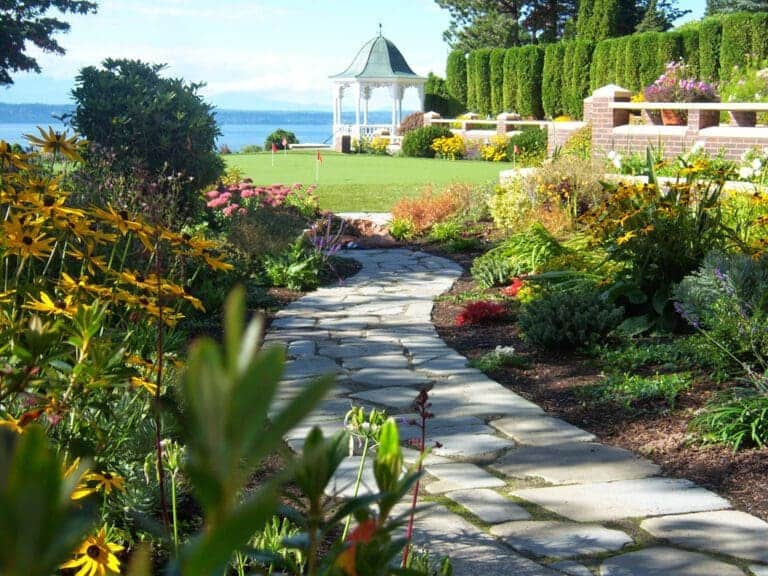
A backyard renovation in the Seattle area typically costs between $8,000 and $100,000+, depending on whether you’re refreshing plantings and adding a small patio or rebuilding the entire outdoor space from grade to finish. A landscape refresh — new plantings, amended soil, maybe a path or small feature — runs $8,000–$25,000. A patio project lands between $15,000 and $40,000. A full backyard renovation with hardscape, plantings, irrigation, drainage, and lighting typically falls in the $40,000–$100,000+ range. Add a retaining wall, and that’s another $5,000–$30,000+ depending on height and material.
Those numbers are only useful if you know what’s driving them — and where the surprises hide. After guiding hundreds of homeowners through this process across Bellevue, Kirkland, Redmond, Sammamish, and Seattle proper, the pattern is consistent: the homeowners who end up frustrated aren’t the ones who spent more than expected. They’re the ones who didn’t know why they were spending more. Here’s how to build a budget that holds.
Where does the money actually go in a backyard renovation?
Most homeowners think about the finished product — the patio, the plants, the fire pit. But a renovation budget breaks down into categories that aren’t always visible in the final result, and understanding this split prevents sticker shock when proposals arrive.
Here’s how a typical full backyard renovation budget breaks down:
| Category | % of Total Budget | What It Covers |
|---|---|---|
| Hardscape (patios, walls, walkways) | 40–60% | Materials, base prep, installation labor |
| Plantings & soil | 15–25% | Trees, shrubs, perennials, groundcovers, soil amendment, mulch |
| Design | 10–15% | Site survey, design development, revisions, construction documents |
| Irrigation & drainage | 10–15% | New irrigation zones, drainage lines, regrading, downspout routing |
| Lighting | 5–10% | Low-voltage path, accent, and feature lighting |
The ratio shifts with scope. A project that’s primarily a paver patio with some perimeter planting will lean 60%+ toward hardscape. A garden-focused renovation with minimal built structure might push plantings to 35–40% and hardscape down to 20%. Knowing where your priorities fall helps you understand why two proposals for the “same backyard” can differ by $20,000 — they’re weighting these categories differently.
Homeowners almost always expect planting to be the biggest line item — it’s what they visualize when they think about the finished project. But on a recent project, the client was surprised to see that the patio, retaining walls, and drainage accounted for over 60% of the total budget. The plantings they were focused on in the design meetings ended up being less than 20% of the cost. The structural and hardscape work that makes the space usable is what drives the investment — the planting is what makes it beautiful, but it’s built on top of the expensive part.
What are the surprise costs in Seattle backyard renovations?
This is where budgets break down. The finished patio, the beautiful plantings, the outdoor kitchen — those costs are relatively predictable. What catches homeowners off guard are the site conditions that don’t show up on Pinterest but show up on every Greater Seattle property.
Soil amendment and grading
West of the Cascades, most residential lots sit on glacial till — compacted clay that drains poorly and compacts unevenly. Before any hardscape gets installed, the grade often needs correction. Before any plantings go in, the soil usually needs amendment. On a typical Bellevue or Kirkland backyard, soil prep and grading can add $2,000–$8,000 to the project, depending on the severity and the square footage.
We see this consistently: homeowners assume the existing grade is “close enough” and the existing soil just needs some compost mixed in. The reality on most Greater Seattle properties is that years of settling, root growth from mature conifers, and poor original grading have created low spots where water pools and high spots where drainage runs toward the house rather than away from it.
Drainage
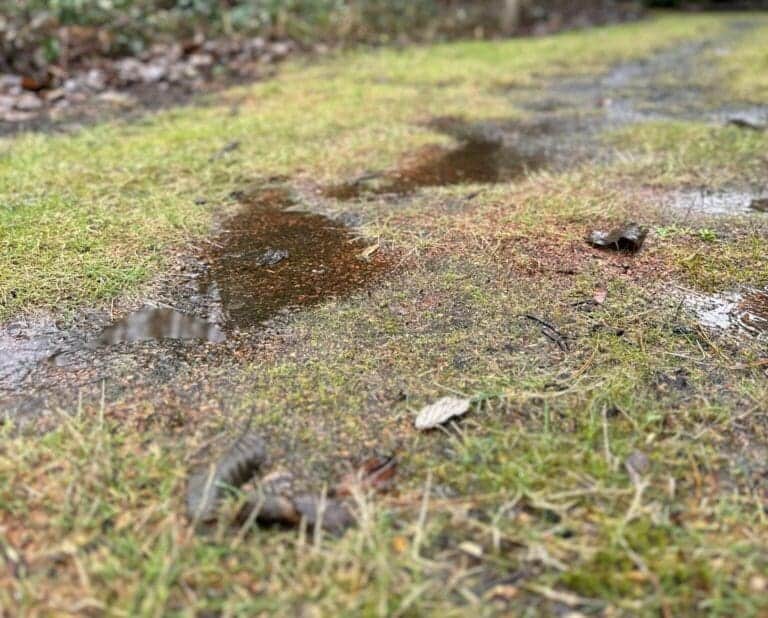
If your property has standing water, soggy lawn areas, or downspouts dumping into planting beds against the foundation, drainage work isn’t optional — it’s the foundation of everything else. A French drain system runs $3,000–$8,000 depending on length and discharge point. Rerouting downspouts and connecting to a storm drain or drywell adds $1,500–$4,000.
Skipping drainage to save budget is the single most common mistake we see. We’ve been called to properties in Redmond and Sammamish where a $60,000 renovation was done three years prior without addressing drainage — and the homeowner is now spending $15,000 to fix water damage to the hardscape and replace plantings that drowned in saturated soil.
Tree removal and root management
Mature Douglas fir, Western red cedar, and big-leaf maple are part of what makes Greater Seattle properties beautiful — but their roots and canopy create real constraints. Removing a 60-foot conifer costs $1,500–$5,000 depending on access and proximity to structures. Even if the tree stays, root zones limit where you can excavate for hardscape without damaging the tree. A certified arborist assessment ($300–$600) before design begins is money well spent — it identifies constraints early rather than mid-construction.
Permit fees and engineering
Many homeowners don’t realize their project may require permits. In Bellevue, Kirkland, Redmond, and most Greater Seattle jurisdictions:
- Retaining walls over 4 feet require a building permit and structural engineering ($3,000–$10,000 combined)
- Work within critical areas (steep slopes, wetland buffers, stream setbacks) requires environmental review
- Significant grading (moving more than 50 cubic yards of soil in some cities) triggers a grading permit
- Electrical for outdoor kitchens or hot tubs requires an electrical permit
Permit fees themselves are usually $500–$2,000, but the process adds 3–8 weeks to your timeline.
Access challenges
This one surprises people the most. If your backyard can only be reached through a 36-inch side yard gate, every cubic yard of gravel, every pallet of pavers, and every balled-and-burlapped tree has to be moved by wheelbarrow instead of skid steer. On a project we completed in Bellevue’s Bellevue Raised Patio project, the access constraints added measurable labor hours — and labor is the largest component of most landscape construction costs.
Slopes present a similar challenge. The Redmond Backyard Remodel involved significant grade changes that required engineered solutions. Properties with more than a few feet of grade change across the work area will see higher costs for retaining, terracing, and material handling.
Site access is one of the biggest variables in project cost that homeowners don’t see coming. We’ve had projects where the only access to the backyard was through a narrow side yard or a gate that couldn’t fit a wheelbarrow. When a machine can’t get to the work area, everything goes in and out by hand — gravel, pavers, soil, demo material. That can add meaningful labor cost to what would otherwise be a straightforward installation. Slopes compound it — on a steep lot, material has to move uphill or downhill in addition to getting there in the first place.
Utility relocation
Irrigation lines, drainage pipes, gas lines, electrical conduit, and cable runs often pass through the area being renovated. Relocating a gas line requires a licensed plumber ($500–$2,000). Rerouting electrical may need an electrician and permit. Even irrigation lines that seem simple to move can add half a day of labor if they run under the patio footprint. A pre-construction utility locate (call 811 — it’s free for public utilities) and a site walk to identify private utilities should happen before the budget is finalized.
- Retaining walls over 4 feet require a building permit and structural engineering ($3,000–$10,000 combined)
Is the "5-10% of home value" rule useful for landscape budgets?
You’ll see this cited everywhere: spend 5–10% of your home’s value on landscaping. With the median home price in Bellevue around $1.5 million and Seattle around $850,000, that translates to $42,500–$150,000 for Bellevue and $42,500–$85,000 for Seattle.
The range is so wide that it’s almost meaningless as a budgeting tool. Here’s what we’ve found more useful in our experience:
Start with your goals, not a percentage. A homeowner in Issaquah who wants a simple paver patio and some privacy plantings doesn’t need to spend $80,000 just because their home is worth $800,000. Conversely, a homeowner in Mercer Island with a steep lot, mature trees requiring management, and a desire for an outdoor kitchen with a covered dining area may need to invest $120,000+ regardless of what any rule of thumb suggests.
The percentage is more useful as a return-on-investment benchmark. Landscape improvements in the Seattle area typically return 50–80% of their cost at resale, with some high-impact projects (usable outdoor living space, curb appeal improvements) returning even more. If you’re spending within the 5–10% range, you’re likely making a sound investment. If you’re spending significantly above it, the return may not be dollar-for-dollar — though quality of life during the years you enjoy the space has real value that doesn’t show up on an appraisal.
How can phasing help manage a renovation budget?
Not everything needs to happen at once. Phasing a backyard renovation — building it in planned stages over one to three years — is a legitimate strategy that can make a $80,000 vision achievable at $25,000–$35,000 per phase.
The key word is planned. Phasing works when the entire project is designed upfront and the construction sequence is intentional. It fails when homeowners build one piece without considering what comes next, then discover that the patio they installed in Phase 1 is in the way of the drainage system they need in Phase 2.
What to build first
In our experience, the right sequence for most Greater Seattle properties is:
- Infrastructure first: Drainage, grading, retaining walls, irrigation mainline. These are underground or structural — they can’t be easily added later without tearing up finished work.
- Primary hardscape second: The main patio, primary walkways, steps. These define the spatial layout everything else connects to.
- Plantings and secondary hardscape third: Garden beds, secondary paths, borders. These can be added in stages without disrupting earlier phases.
- Features and refinements last: Lighting, fire pit, water features, outdoor kitchen components. These connect to existing infrastructure and don’t require excavation near finished work.
What phasing actually saves
Phasing spreads the cash outlay but doesn’t reduce the total project cost — in fact, it typically adds 10–15% compared to doing everything at once. Remobilization (bringing the crew and equipment back), reconnecting to existing work, and protecting finished surfaces during later phases all add cost. The trade-off is worth it when the alternative is financing the entire project at once or waiting years to start.
Ready to Talk Budget?
We provide transparent, detailed proposals so you know exactly what to expect.
Request a QuoteHow should I evaluate whether a bid is fair?
A low bid isn’t a good bid. A high bid isn’t necessarily a bad one. Here’s what to look for.
Detail and transparency
A credible proposal breaks down the project into line items or at minimum into clearly defined phases with scope descriptions. If a proposal gives you one lump number — “$45,000 for backyard renovation” — you have no way to understand what you’re paying for, what’s included, and what’s not.
At Classic Landscaping, our proposals specify materials (by product and quantity), labor scope, and allowances for items that require selection during the project (like specific plant varieties or stone color). This isn’t just about trust — it’s about protecting both sides when the inevitable mid-project question arises: “Is this included?”
For a deeper dive into reading proposals, see our guide on how to compare landscape proposals.
Site analysis before bidding
Any company that gives you a price without visiting the property — or that visits for 20 minutes and delivers a number the next day — is estimating, not pricing. A thorough site analysis includes:
- Measuring grades and identifying drainage patterns
- Assessing soil conditions
- Noting access constraints and utility locations
- Evaluating existing trees and structures that affect the scope
- Understanding the homeowner’s priorities and lifestyle (how you actually use the space)
This process takes time. At Classic, a design-build consultation typically runs 60–90 minutes on site, and the proposal follows after design development — not before.
The contingency question
Ask every contractor: “What happens if we hit something unexpected during construction — rock, an old septic line, buried debris, worse drainage than anticipated?”
A professional answer includes a contingency plan, not just reassurance. We recommend homeowners budget a 10–15% contingency above the contracted amount. On a $60,000 project, that’s $6,000–$9,000 set aside for genuine unknowns. You may not need it — but if your site turns up a buried oil tank or an underground spring (both of which we’ve encountered on Greater Seattle properties), you’ll be glad it’s there.
We’ve encountered enough surprises to always recommend that contingency buffer. On Greater Seattle properties, the most common unexpected finds are buried concrete from old foundations or structures that were demolished and left in place, root systems from trees that were removed years ago but never had the stumps ground out, and occasionally old drainage pipe or utility lines that aren’t on any survey. Each of these changes the scope of excavation and adds time. None of them are visible until you start digging.
What financing options exist for landscape projects in Seattle?
For homeowners who want to move forward now rather than phase over multiple years, financing can make a $50,000–$100,000+ project manageable.
Classic Landscaping offers two financing options through EnerBank/Regions Bank:
- 12-month same-as-cash: No interest if paid within 12 months. Works well for projects under $40,000 where the homeowner can pay down the balance within a year.
- 6.99% for 5 years: Fixed-rate installment loan. On a $60,000 project, that’s roughly $1,190/month for 60 months.
Details and application are available at classiclandscaping.com/financing.
Other options homeowners use:
- Home equity line of credit (HELOC): Often the lowest interest rate, but requires home equity and takes 2–6 weeks to set up.
- Cash-out refinance: Can make sense if you’re also refinancing for a better rate, but closing costs are significant.
- Personal savings + phasing: Combine what you have now with a phased plan to spread the remainder.
The right financing depends on the project size, your timeline, and your comfort with monthly payments. We’re happy to walk through the options during the design process — this is a normal part of how we help homeowners scope projects realistically.
How do I start building my backyard renovation budget?
Before you contact any contractor, spend 30 minutes on two things:
First, define your priorities — not your Pinterest board. “I want a patio” is a starting point, but “I want a space where our family of four can eat dinner outside three nights a week from May through September, and I’d like some privacy from the neighbors” gives a designer something to work with. The clearer your priorities, the more accurately any proposal will reflect what you actually want.
Second, get honest about your number. Most homeowners have a budget in mind but are reluctant to share it, worrying the contractor will spend every dollar. A reputable design-build firm uses your budget to design to — not to inflate. If you tell us your range is $40,000–$50,000, we’ll design a project that fits that range and tell you what that budget can realistically achieve. If your wish list exceeds it, we’ll show you where to prioritize and what can wait for a future phase.
The initial consultation at Classic Landscaping is complimentary. We visit the property, discuss your vision and budget, and give you an honest assessment of what’s realistic. If it’s a fit, we move into design. If it’s not — if your budget and goals are far apart, or if the project isn’t the right scope for our team — we’ll tell you that directly and point you toward someone who might be a better match.
For more on what to expect, see our pillar guide to landscaping costs in Seattle and our article on what happens during a landscape consultation.
The Bottom Line
Before you contact any contractor, spend 30 minutes on two things:
First, define your priorities — not your Pinterest board. “I want a patio” is a starting point, but “I want a space where our family of four can eat dinner outside three nights a week from May through September, and I’d like some privacy from the neighbors” gives a designer something to work with. The clearer your priorities, the more accurately any proposal will reflect what you actually want.
Second, get honest about your number. Most homeowners have a budget in mind but are reluctant to share it, worrying the contractor will spend every dollar. A reputable design-build firm uses your budget to design to — not to inflate. If you tell us your range is $40,000–$50,000, we’ll design a project that fits that range and tell you what that budget can realistically achieve. If your wish list exceeds it, we’ll show you where to prioritize and what can wait for a future phase.
The initial consultation at Classic Landscaping is complimentary. We visit the property, discuss your vision and budget, and give you an honest assessment of what’s realistic. If it’s a fit, we move into design. If it’s not — if your budget and goals are far apart, or if the project isn’t the right scope for our team — we’ll tell you that directly and point you toward someone who might be a better match.
For more on what to expect, see our pillar guide to landscaping costs in Seattle and our article on what happens during a landscape consultation.