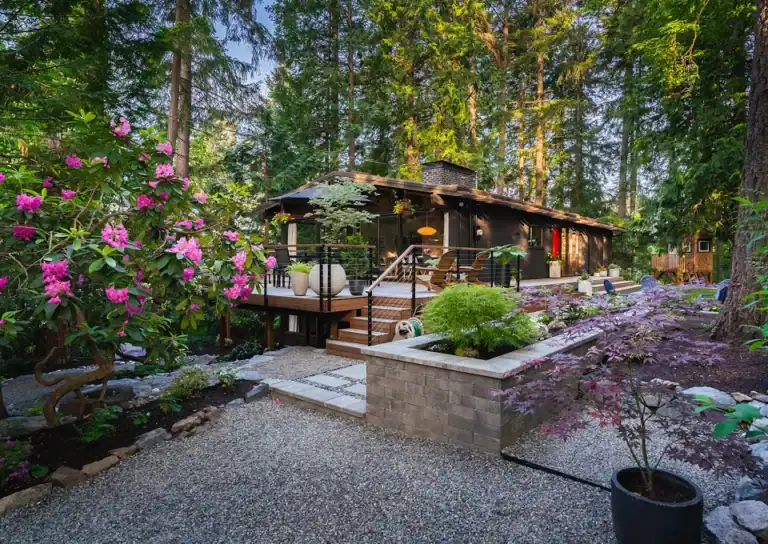
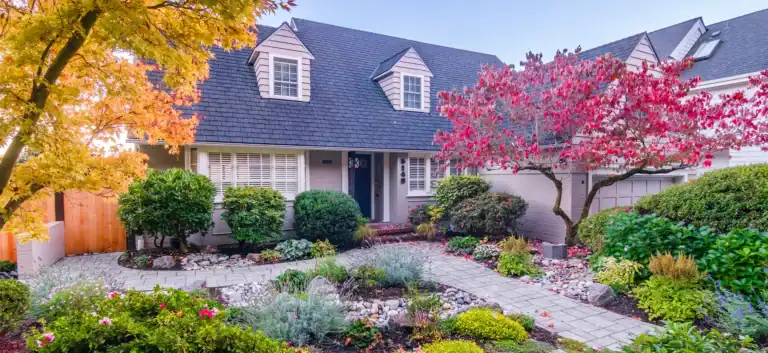
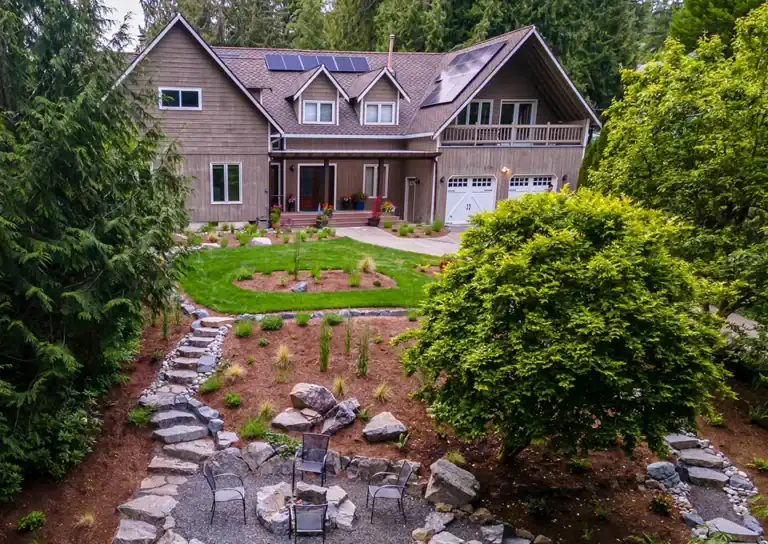
Incremental landscape improvements over five to ten years commonly cost as much or more than a single designed project of equivalent scope — once repeated mobilization, rework, and material inconsistency are factored in.
Each separate project carries its own overhead costs (mobilization, site protection, cleanup) that a comprehensive project pays only once — these can add 20 to 40 percent in cumulative overhead across multiple standalone projects.
Work frequently gets undone when later projects conflict with earlier ones — particularly on sloped Eastside properties where drainage and grading must be addressed holistically to avoid displacing existing improvements.
Phasing (designing everything, building in stages) typically adds 5 to 15 percent over building all at once — far less than the 20 to 40 percent premium of unplanned incremental work.
A cohesive designed landscape affects property value differently than a yard improved in visible stages — appraisers and buyers can see the difference between a unified investment and accumulated projects.
Adding up what you have already spent on individual fixes over the past decade is the single most clarifying exercise before deciding whether to continue the incremental path or invest in a comprehensive design.
Why Does the Incremental Path Feel Cheaper but Often Cost More?
The psychological pull of incremental improvement is straightforward: each individual project feels manageable. A $5,000 planting refresh is easier to approve than a $75,000 design-build contract. There is no single moment where the full investment feels overwhelming.
But cumulative math works differently than single-project math, and there are structural reasons the incremental path costs more per dollar of result.
### Each Separate Project Carries Its Own Overhead
Every time a contractor mobilizes to a property — delivering materials, protecting existing surfaces, setting up equipment, managing site access — there is a fixed cost that has nothing to do with the landscape itself. On a comprehensive project, those mobilization costs are paid once. When you hire contractors five or six separate times over a decade, you are paying that overhead repeatedly.
In our experience, mobilization and site preparation typically represent 8 to 15 percent of a project’s total cost. On a single $80,000 project, that is roughly $6,400 to $12,000 — absorbed once. Across six separate projects totaling the same amount, mobilization costs alone can add $15,000 to $30,000 in overhead that buys zero additional landscape value.
### Work Gets Undone and Redone
This is the cost most homeowners do not see coming. The patio you installed in year two sits at a grade that conflicts with the drainage system you need in year four. The plantings from year one get torn out during year three’s retaining wall project because the equipment access path runs right through them. The irrigation lines installed in year five have to route around hardscape that was never designed to accommodate them.
On Bellevue properties with significant grade changes — which describes a substantial share of Eastside lots — this rework pattern is especially common. Drainage and grading are foundational. When they are addressed after hardscape and planting are already in place, the correction often damages or displaces work you have already paid for.
### No Design Integration Means No Compound Value
A designed landscape is not a collection of individual features. It is a system where each element amplifies the others — where the retaining wall creates the level surface for the patio, the grading directs water away from the foundation and toward the rain garden, the lighting accentuates the stone work and the specimen plantings, and the circulation routes connect indoor living spaces to outdoor rooms in a way that feels natural.
When improvements happen in isolation, you get individual features that coexist but do not compound. The patio sits next to the plantings but does not relate to them. The lighting illuminates surfaces but does not create atmosphere. The result may be attractive in pieces but does not function — or feel — like a designed outdoor space.
What Does the Math Actually Look Like Over Ten Years?
Rather than presenting a single scenario, consider the cost categories that apply to any incremental approach and how they compare to a comprehensive project addressing equivalent scope.
### The Incremental Path: Where the Money Goes
Over a five-to-ten-year period, homeowners making incremental improvements typically encounter these cost categories:
Repeated mobilization and site prep — Each separate project carries its own delivery, access, protection, and cleanup costs. Over multiple projects, this overhead accumulates significantly beyond what a single project would require.
Rework and conflict resolution — Elements installed early that must be modified, relocated, or replaced when later projects require different grading, drainage routes, or access paths. On properties with slope — common across Bellevue, Sammamish, and Kirkland — this is not occasional. It is nearly inevitable.
Separate design fees (or no design at all) — Each standalone project either includes its own design cost or, more commonly, proceeds without formal design. The former adds expense; the latter creates the integration problems that trigger rework.
Material inconsistency — Pavers, stone, and plant palettes selected years apart rarely match. Manufacturers change product lines. Quarries change stone availability. Nurseries change cultivar stock. The result is a property that reads as assembled rather than designed, which affects both livability and resale perception.
Escalating material and labor costs — According to the Bureau of Labor Statistics Producer Price Index, construction material costs in the Pacific Northwest have trended upward year over year. Work deferred to year five or seven is priced at year-five or year-seven rates, not year-one rates. A comprehensive project locks in current pricing across the full scope.
### The Comprehensive Project: Where the Money Goes
A single design-build project addressing equivalent scope consolidates those costs:
One mobilization, one site prep cycle — Crew arrives, works through the full scope over weeks or months, and demobilizes once.
Design integration from the start — Every element is planned in relationship to every other element. The grading accounts for the future patio. The drainage routes around the planned retaining wall. The irrigation is designed for the final planting plan, not retrofitted around what already exists.
Materials sourced together — Stone, pavers, plants, and fixtures are selected as a cohesive palette. Bulk purchasing from the same suppliers at the same time often improves pricing and guarantees consistency.
One warranty period — Classic’s work is warranted as a single project, including a one-year plant guarantee. Incremental work from multiple contractors may carry separate, often shorter, warranties — or none at all.
What About Phasing — Can You Get the Design Without the Full Upfront Cost?
This is the question that bridges the two approaches, and it is worth addressing directly.
Phasing a landscape project means designing the entire property comprehensively — establishing the master plan that accounts for grading, drainage, hardscape, planting, and lighting as an integrated system — and then building it in deliberate stages based on priority and budget. The design fee is paid upfront. Construction happens over time.
Phasing is not the same as incremental improvement. The difference is the design. A phased project has a master plan. Every phase is built according to that plan, in a sequence that avoids rework and conflict. Phase one accounts for where phase three’s retaining wall will go. Phase two’s irrigation is designed for the final planting plan, not just what is being installed this season.
In our experience, phased projects typically cost 5 to 15 percent more than building everything at once — a modest premium for the flexibility of spreading the investment. Incremental work without a master plan routinely costs 20 to 40 percent more than a single designed project of equivalent scope, once rework, repeated mobilization, and material inconsistency are accounted for.
How Does This Affect What Your Property Is Actually Worth?
The financial comparison extends beyond what you spend to what you own afterward. A cohesive, professionally designed landscape reads differently to appraisers, to real estate agents, and to future buyers than a property that has been improved in visible stages.
The National Association of Realtors’ Remodeling Impact Report consistently ranks landscape improvements among the highest joy-score and cost-recovery projects. But the recovery depends on the result. A unified outdoor living space — where hardscape, planting, lighting, and grading work together — signals investment and care. A yard with mismatched materials, unresolved drainage issues, and plantings that were clearly installed in different decades signals deferred maintenance, even if the total spending was substantial.
On Seattle’s Eastside, where residential property values often support significant landscape investment, the gap between “spent $80,000 over ten years” and “invested $80,000 in a designed project” is visible — and it is reflected in how the property appraises, shows, and sells.
Who Is This Comparison Most Relevant For?
Two types of homeowners tend to find this math most clarifying.
The long-time homeowner who has been planning for years. You have lived in your home for a decade or more. You have made improvements along the way — some successful, some less so. You have always intended to do something more comprehensive, but the timing, the budget, or the disruption never aligned. If you add up what you have spent on landscaping over the past five to ten years, the total may surprise you — and it may reframe what a comprehensive project actually represents relative to what you have already invested.
The homeowner who fixes things as they break. You are practical and responsive. When the retaining wall leans, you fix the retaining wall. When the patio cracks, you replace the patio. Each decision is rational in isolation. But looked at cumulatively, the reactive approach has likely cost more than a proactive designed project — and delivered a fraction of the result. The good news is that a design-build approach starting now can incorporate and build upon the improvements you have already made, giving you credit for the investment rather than starting from zero.
Frequently Asked Questions
In Classic's experience across the Eastside, homeowners making reactive improvements over a five-to-ten-year period commonly spend $40,000 to $100,000 in cumulative landscape work — often without realizing the total until they add it up. The range depends on property size, slope, and what issues arise, but the pattern of spending $5,000 to $15,000 per year on individual fixes is common on Bellevue, Kirkland, and Sammamish properties.
Not necessarily in absolute terms — a comprehensive design-build project may have a similar or sometimes higher total price tag than what incremental work would have cost. The difference is in what you get for that money. The designed project delivers a cohesive, integrated result with one mobilization, one warranty, and no rework. The incremental path delivers disconnected improvements that often need modification when later work conflicts with earlier work.
Yes, and this is one of the most practical middle paths. A phased approach means investing in the full design upfront and then building in stages — typically two to four phases over one to three years. Every phase follows the master plan, so work done in phase one accounts for what is coming in phase three. The phasing premium is modest (5 to 15 percent over doing everything at once) compared to the significant cost penalty of unplanned incremental work.
Not at all. A design-build team can evaluate what exists on your property and incorporate viable elements into a comprehensive plan. Some improvements — mature plantings, well-built hardscape, functional drainage — become assets in the new design. Others may need modification. The point is not that past work was wrong but that going forward with a master plan prevents the compounding costs of continued reactive work.
The data suggests yes. The National Association of Realtors consistently ranks professional landscape projects among the highest cost-recovery improvements. But the impact depends on the result, not the spending. A unified outdoor space signals intentional investment. A yard with mismatched materials, varying ages of hardscape, and unresolved grading issues signals accumulated fixes — even if the total spent was equivalent.
Start by adding up what you have spent on landscape work over the past five to ten years — contractor invoices, materials for DIY projects, plant replacements, drainage fixes. Then compare that total to what a comprehensive project addressing your full property would cost. If the cumulative spend is within range of a designed project — and for many Eastside homeowners, it is — the math favors the comprehensive approach going forward.
Ready to Transform Your Landscape?
From design to installation, we create landscapes that make Greater Seattle homeowners proud.