- A pre-sale landscape refresh typically returns 2x–5x the investment in the Seattle market, and with 12-month same-as-cash financing, your effective out-of-pocket cost can be zero — the balance gets paid from sale proceeds at closing.
- The highest ROI comes from closing the gap between a home's interior quality and its exterior presentation — if the kitchen is remodeled but the yard looks neglected, landscaping is the most impactful dollar you can spend before listing.
- Design for universal taste, not personal expression — clean lines, neutral materials, mature plantings, and defined outdoor spaces appeal to the broadest buyer pool and avoid the risk of turning off a segment.
- Start the landscape refresh 3–6 months before listing to allow plants to establish and sod to root — last-minute installations look like last-minute installations in listing photos.
- Classic Landscaping's experience designing for production builders like MN Homes means we know how to maximize curb appeal per dollar spent without overinvesting in features that reflect one person's taste.
- PreQualification for financing is available without impacting your credit score — you can explore what's possible before committing to a scope.
A well-executed landscape refresh before selling your home can return 2x to 5x the investment — and in the Seattle market, where median home prices sit above $800K, even a modest $8K–$15K landscape upgrade can translate to $25K–$50K+ in perceived value at closing. The math gets even more compelling when you factor in financing: Classic Landscaping offers a 12-month same-as-cash loan through Regions Bank (EnerBank USA) that requires no payments for 365 days. If your home sells within that window, you pay the balance from proceeds at closing. Your effective out-of-pocket cost: close to zero. Your return on that zero: whatever the buyer was willing to pay for a property that looked move-in ready instead of “needs work.”
This isn’t theory. We’ve designed landscapes for production builders like MN Homes and smaller remodelers for years — projects engineered specifically to maximize buyer appeal without overinvesting in features that reflect one person’s taste. That same discipline applies when a homeowner is preparing to sell.
Why does landscaping matter so much when selling a home?
Buyers make judgments within seconds. The National Association of Realtors consistently reports that landscape improvements recover 100%+ of their cost at resale — one of the few home improvements that reliably breaks even or better. But in Greater Seattle, where outdoor living is part of the culture and buyers expect properties to look established, the effect is amplified.
Here’s what’s actually happening in the buyer’s mind:
Curb appeal sets the price anchor. Before a buyer walks through the front door, they’ve already formed an opinion about what the home is worth. A tired, overgrown, or neglected landscape signals deferred maintenance — and buyers mentally subtract not just the cost of fixing it, but a premium for the hassle. A clean, professionally designed landscape does the opposite: it signals a homeowner who cared about the property.
Outdoor space extends livable square footage. In the Seattle market, a usable patio, defined garden spaces, and functional outdoor areas aren’t luxuries — they’re expected at most price points above $600K. Buyers see an inviting backyard and mentally add it to the home’s living space. A neglected backyard is dead square footage.
First impressions drive showing traffic. Real estate agents will tell you: the listing photo is the ad. Homes with strong curb appeal get more showings, which drives competition, which drives price. A $10K landscape refresh can be the difference between 8 showings in the first weekend and 3.
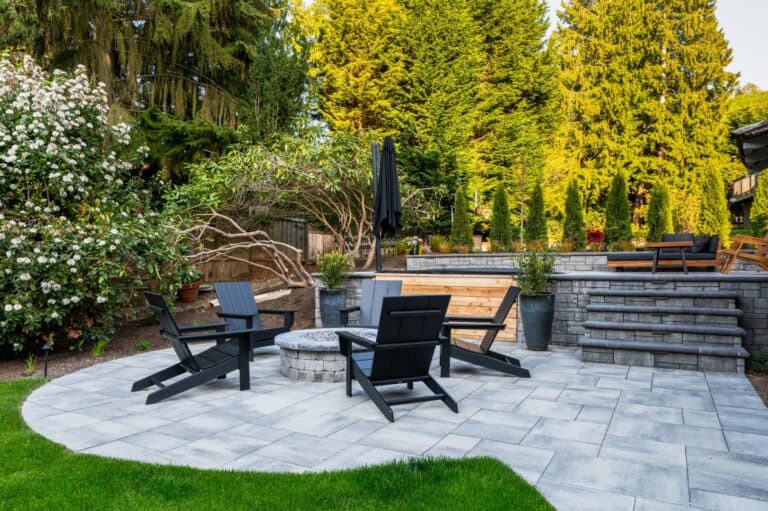
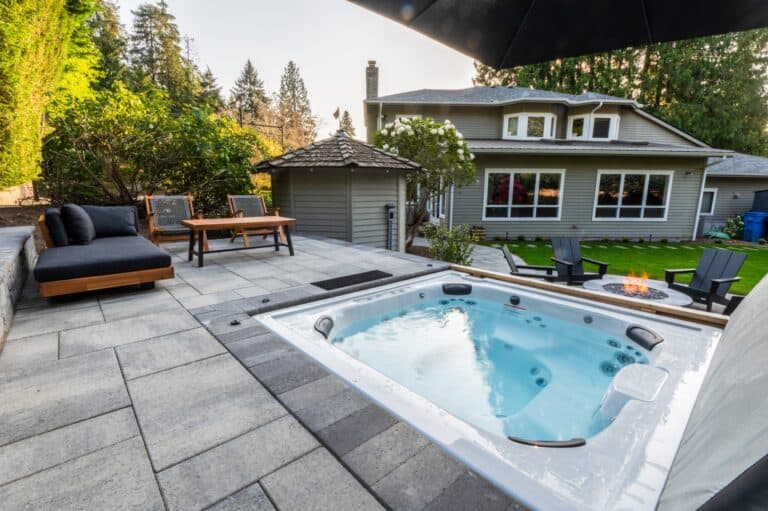
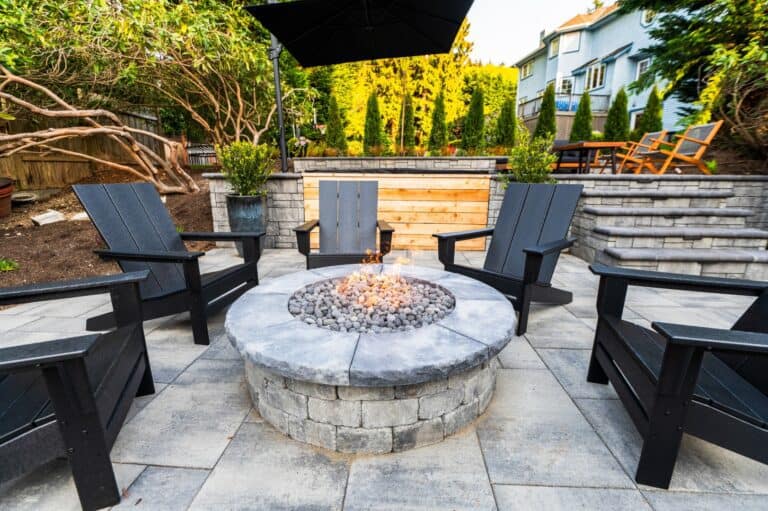
A homeowner in Kirkland came to us about six weeks before listing a 1990s-era home. The backyard was functional but dated — overgrown laurel hedges blocking the mountain view, a cracked concrete patio, and bark mulch beds that hadn’t been refreshed in years. We did a Tier 2 refresh: removed the overgrown hedges and replaced them with lower ornamental grasses that framed the view, installed a small paver patio extension with a fire pit, refreshed all beds with 3 inches of dark hemlock mulch, and added landscape lighting along the front walkway. Total investment was around $18,000. The home sold in 9 days — 4 days faster than the neighborhood average at the time — and the listing agent told us the backyard photos were the most-clicked images in the online listing. According to the National Association of Realtors’ 2023 Remodeling Impact Report, landscape maintenance and outdoor improvement projects recover 100% or more of their cost at resale — one of the highest ROI categories in home improvement.
What does a pre-sale landscape refresh actually include?
The scope depends on the property’s current condition and the target sale price. We generally see three tiers:
Tier 1: Curb appeal refresh ($3K–$8K)
For homes where the bones are decent but the landscape looks tired:
- Professional pruning of overgrown shrubs and trees (proper cuts, not hedge-trimmed into balls)
- Lawn renovation — overseeding, topdressing, or sod replacement for bare/patchy areas
- Fresh bark mulch in all planting beds (3-inch depth, consistent coverage)
- Edging — clean lines between lawn, beds, and hardscape
- Seasonal color — strategic placement of flowering plants at the entry and visible from the street
- Pressure washing walkways, driveway, and patio surfaces
This level of work transforms how a property photographs. It’s often the highest-ROI tier because the investment is small and the visual impact is immediate.
Tier 2: Targeted landscape upgrade ($8K–$25K)
For homes that need more than cleanup — maybe the front foundation planting is dated, the backyard has no defined outdoor living area, or the lawn is beyond rescue:
- Everything in Tier 1, plus:
- New foundation plantings (front of house) with mature-sized shrubs for instant impact
- Defined patio or seating area in the backyard (pavers, gravel, or flagstone)
- Landscape lighting along the front walkway and at key focal points
- Irrigation repairs or installation (buyers notice brown patches in July listing photos)
- Removal of dated or overgrown plantings that make the yard feel smaller
Tier 3: Full landscape transformation ($25K–$80K+)
For higher-value homes where the landscape is significantly below the neighborhood standard, or where creating outdoor living space will meaningfully move the sale price:
- Complete front and back landscape redesign
- Hardscape installation: patio, retaining walls, pathways
- Mature tree and shrub installation for an established look
- Outdoor living features: fire pit, built-in seating, pergola
- Professional irrigation system
- Full sod installation
At this level, we’re applying the same discipline we use when designing for homebuilders: create a landscape that appeals to the broadest possible buyer pool.
What does "universal taste" design mean — and why does it matter for resale?
This is where our experience with production builders directly applies. When we design landscapes for MN Homes or other builders, the goal isn’t to express anyone’s personal style — it’s to create a space that feels polished, inviting, and complete without committing to features that might turn off a segment of buyers.
What universal taste looks like:
- Clean, defined spaces with clear circulation (people should intuitively know where to walk)
- A balanced mix of evergreen structure and seasonal interest (the yard looks good in January listing photos and July showings)
- Neutral hardscape materials — natural stone tones, gray/charcoal pavers, concrete — that complement any home style
- Mature but not overgrown plantings that frame the home rather than hide it
- Low-maintenance design signals (buyers don’t want to inherit a high-maintenance garden)
What to avoid when designing for resale:
- Highly personal features: Japanese-style gardens, extensive edible gardens, ornamental grass meadows — these appeal strongly to some buyers and not at all to others
- Artificial turf — polarizing in the Seattle market
- Water features — beautiful when maintained, a liability when perceived as maintenance-intensive
- Oversized structures (large pergolas, elaborate outdoor kitchens) that may not match the next owner’s vision
When we work with builders on spec homes and new construction, the design philosophy shifts from “what does this homeowner want?” to “what will the broadest range of buyers respond to?” The principles that guide these projects: clean lines over fussy detail (pavers in a running bond pattern rather than complex circles), evergreen structure over seasonal color (so the property looks polished in any month a buyer might visit), and a defined outdoor living area that photographs well from the listing angle. Plant selection leans on proven performers — Sarcococca for fragrance near entries, Hakonechloa macra ‘Aureola’ for texture in shade, and ornamental grasses like Calamagrostis ‘Karl Foerster’ for year-round vertical structure. We avoid anything that requires explanation (“that’s a Japanese snowbell — it’ll bloom in June”) because buyers need to see a finished landscape, not a promise. Materials follow the same logic: charcoal-toned pavers pair with both contemporary and traditional architecture, and natural stone accents at the front entry read as premium without committing to a specific design style.
The goal is to present a blank canvas that feels finished — not empty, but not so personalized that buyers are already planning what they’d rip out.
How does the financing work — and why is it effectively zero out of pocket?
Classic Landscaping offers two financing plans through Regions Bank (EnerBank USA):
Ready to Talk Budget?
We provide transparent, detailed proposals so you know exactly what to expect.
Request a Quote12-Month Same-As-Cash (the pre-sale play)
- How it works: You finance the project and pay zero for 365 days. If you repay the full balance within that 12-month window, you pay no interest at all.
- APR if not repaid in 12 months: 19.99% fixed, with repayment terms from 24 to 132 months
- First payment due: 365 days after the funds are disbursed
- Maximum funding: The lesser of 50% of project cost or $50,000
- PreQualification: Available without impacting your credit score
The pre-sale math: You invest $15K in a landscape refresh. Your home sells 6 months later for $30K more than comparable homes with neglected yards. At closing, you pay $15K to the bank from proceeds. Net gain: $15K. Out-of-pocket cost during the process: $0.
If you’re planning to list within 12 months, this is effectively a zero-cost investment with a positive return. The financing carries the project until the sale closes.
6.99% APR 5-Year Loan (the "enjoy it first" option)
- How it works: Fixed rate, 60-month term, $19.80 per month per $1,000 borrowed
- Minimum monthly payment: $50
- First payment due: 30 days after disbursement
The hybrid play: If you’re thinking about selling in 2–3 years rather than 12 months, the 5-year loan lets you improve your property now, enjoy the upgraded outdoor space for a couple of seasons, and still sell at a higher price point. You’ll make payments during that time, but you’re simultaneously living in a better home and building equity through the improvement.
A $20K landscape upgrade at 6.99% costs roughly $396/month. If that upgrade adds $40K+ in value when you sell in year 2 or 3, you’ve paid $9,500–$14,000 in total payments and gained $40K — still a strong return, plus two years of enjoying the space.
It happens more often than you’d expect. A couple in Sammamish reached out about a front yard refresh before listing — they’d already had the home appraised and were ready to move. We did the curb appeal work, then they asked us to quote the backyard “just to see what it would cost.” Once we showed them what the backyard could become — a terraced patio with a fire pit, privacy plantings along the property line, and a play area for their kids — they decided to invest in the full project and stay. Their reasoning: the improvements they wanted in a new home would have cost more than renovating what they already had, especially after factoring in Eastside real estate transaction costs (roughly 8-10% of sale price when you add agent commissions, excise tax, and closing costs on both sides). We see this roughly once or twice a year — homeowners who planned to sell, invest in the landscape refresh, fall in love with the result, and take the house off the market.
When should you start the landscape refresh relative to listing?
Timing matters more than most sellers realize:
3–6 months before listing is the sweet spot. This gives time for:
- Design and planning (2–4 weeks)
- Construction/installation (1–4 weeks depending on scope)
- Plant establishment — new plantings need at least 4–8 weeks to settle in and look natural
- Sod needs 3–4 weeks to root and handle foot traffic
- A few mowing cycles to get the lawn looking consistent
Don’t wait until 2 weeks before the photographer comes. Fresh sod that hasn’t rooted looks obvious. New plantings that haven’t filled in look sparse. Bark mulch laid yesterday looks like bark mulch laid yesterday — it needs a rain cycle or two to settle.
Spring and early summer listings benefit from fall or winter landscape work. If you’re listing in April–June (Seattle’s peak real estate season), the ideal time to do the landscape refresh is October–February. Plants installed in fall establish root systems over winter and look lush by spring. This also avoids the spring rush when landscape companies are at peak demand and scheduling is tighter.
What ROI can you realistically expect in the Seattle market?
ROI depends on the gap between your current landscape and the neighborhood standard. The wider the gap, the higher the return:
| Scenario | Investment | Estimated Value Added | ROI | |———-|———–|———————-|—–| | Neglected yard → clean and maintained | $3K–$8K | $10K–$25K | 200–400% | | Dated landscape → modern, defined spaces | $10K–$25K | $25K–$60K | 150–300% | | No outdoor living → functional patio + plantings | $20K–$50K | $40K–$100K+ | 100–250% | | Builder-grade flat yard → designed landscape | $30K–$80K | $50K–$120K+ | 80–200% |
These ranges reflect what we observe in the Greater Seattle market, where buyers across Bellevue, Kirkland, Redmond, Sammamish, and Mercer Island expect properties at higher price points to have intentional, professionally designed outdoor spaces. A $1.2M home with a $1.2M interior and a $0 landscape is leaving money on the table.
The neighborhoods where we’ve seen landscape investment move the needle most are the ones where buyers have the highest expectations and the most options. On Mercer Island and in Bellevue’s west-side neighborhoods (Vuecrest, Enatai, Somerset), homes above $1.5M compete directly with each other — and buyers at that price point notice an outdated landscape the way they’d notice an unrenovated kitchen. A $25K–$40K landscape investment on a $2M Mercer Island listing is proportionally small but visually transformative. In newer Sammamish developments (Klahanie, Plateau), builder-grade landscaping is the norm — so even a Tier 1 refresh ($3K–$8K) that replaces the generic arborvitae row with layered native plantings and adds pathway lighting makes a listing stand out against identical-looking neighbors. At the other end, in established Kirkland and Woodinville neighborhoods where mature trees and gardens are expected, a neglected landscape is more damaging to perceived value than in a newer development — buyers read it as deferred maintenance across the entire property.
The critical insight: Landscaping ROI is highest when it closes the gap between the home’s interior quality and its exterior presentation. If the kitchen has been remodeled and the bathrooms are updated but the yard looks like 2005, the landscape refresh will have an outsized impact because it brings the exterior up to the standard the interior has already set.
What about homes that just need maintenance, not a redesign?
Not every pre-sale property needs a landscape redesign. Some just need professional maintenance — the kind of care that makes an existing landscape look its best:
- Professional pruning that opens up views, lets light in, and shows the home’s architecture
- Lawn care that eliminates bare patches, moss, and weeds
- Seasonal color at the front entry
- Clean hardscape — pressure-washed patios, walkways, driveways
Classic Landscaping’s maintenance team can assess whether your property needs a refresh, a redesign, or simply a few months of professional care before listing. Sometimes the highest-ROI move is a $2K–$4K maintenance blitz rather than a full redesign.
The Bottom Line
Not every pre-sale property needs a landscape redesign. Some just need professional maintenance — the kind of care that makes an existing landscape look its best:
- Professional pruning that opens up views, lets light in, and shows the home’s architecture
- Lawn care that eliminates bare patches, moss, and weeds
- Seasonal color at the front entry
- Clean hardscape — pressure-washed patios, walkways, driveways
Classic Landscaping’s maintenance team can assess whether your property needs a refresh, a redesign, or simply a few months of professional care before listing. Sometimes the highest-ROI move is a $2K–$4K maintenance blitz rather than a full redesign.