- A $3,000–$5,000 drainage fix in year one can become a $15,000–$50,000 foundation and landscape reconstruction by year three — water damage compounds every rainy season in Seattle's climate.
- Retaining walls fail gradually, then catastrophically. Early repair (leaning, cracking) runs $5,000–$12,000; full reconstruction after collapse starts at $20,000 and often exceeds $50,000 once engineering, permitting, and collateral damage are included.
- Slope erosion follows the same escalation: $5,000–$15,000 for early stabilization versus $40,000–$100,000+ for severe remediation requiring civil engineering.
- The best diagnostic tool costs nothing — walk your property during a heavy rain and observe where water collects, flows, and exits.
- King County requires engineered plans for retaining walls over 4 feet, adding $3,000–$8,000 in engineering fees and 4–8 weeks to the timeline — budget for this upfront rather than discovering it during construction.
- Every wet season (October–April) that passes without addressing these issues adds to the repair cost. The problem never stays the same size — it grows.
Delaying a landscape repair in Seattle rarely saves money. It almost always costs more — sometimes dramatically more. A drainage issue that could be resolved for $3,000–$5,000 in year one can become a $15,000–$25,000 foundation and grading problem by year three. A retaining wall showing early signs of failure at $8,000–$12,000 to repair can collapse into a $30,000–$50,000 reconstruction that also takes out the plantings, irrigation, and patio above it. These aren’t hypothetical numbers. They come from projects we’ve taken on across Bellevue, Kirkland, Redmond, and Sammamish where the homeowner waited — usually because the problem didn’t seem urgent enough to act on.
Here’s what actually happens to the three most common structural landscape issues in western Washington when they’re left unaddressed, and what the delay costs in real dollars.
What happens when you ignore drainage problems in Seattle?
Water is the most patient destructive force your property faces. In the greater Seattle area, we receive roughly 37 inches of rain per year, most of it between October and April. That water has to go somewhere. When drainage systems fail or were never properly installed, the water finds its own path — and it’s rarely the path you’d choose.
The first year: inconvenience
The symptoms start small. Puddles that linger for days in planting beds. A section of lawn that stays soggy well into May. Water pooling against the foundation after a heavy rain. Moss colonizing the patio surface faster than you can clean it.
At this stage, the fix is usually straightforward: rerouting a downspout, installing a French drain line, regrading a section of the yard to direct water away from the house. Typical cost: $2,500–$6,000 depending on the linear footage and whether the work ties into an existing storm drain connection.
Years two and three: damage begins
Left alone, standing water saturates the soil around your foundation. In the clay soils that dominate Kirkland, Bellevue, and much of the Eastside, saturated soil expands when wet and contracts when it dries — a cycle that pushes against foundation walls with surprising force. We’ve seen this create hairline cracks in concrete foundations that widen each season.
Meanwhile, planting beds with chronic drainage problems start losing plants. Rhododendrons — the signature shrub of the Pacific Northwest — are particularly vulnerable. Their shallow root systems rot in saturated soil, and by the time the leaves start yellowing and dropping, the root damage is irreversible. The same is true for most conifers, Japanese maples, and broadleaf evergreens that make up the backbone of Eastside landscapes.
At this stage, the fix now includes the drainage work that should have been done originally, plus replacement of dead plantings, possible soil amendment, and potentially foundation waterproofing. Typical cost: $8,000–$18,000.
Years four and beyond: structural consequences
This is where delay becomes genuinely expensive. Chronic water infiltration can compromise foundation integrity, requiring structural repair that starts at $15,000 and can exceed $50,000 depending on the extent of the damage. Saturated slopes begin to creep — the slow, gravity-driven movement of soil downhill that can undermine retaining walls, shift patios, and destabilize trees.
We’ve worked on properties in Sammamish and Issaquah where a $4,000 French drain installed during the original landscape construction would have prevented $40,000+ in damage to the foundation, retaining wall, and surrounding landscape. The math is brutal, but it’s consistent.
What happens when you delay retaining wall repairs?
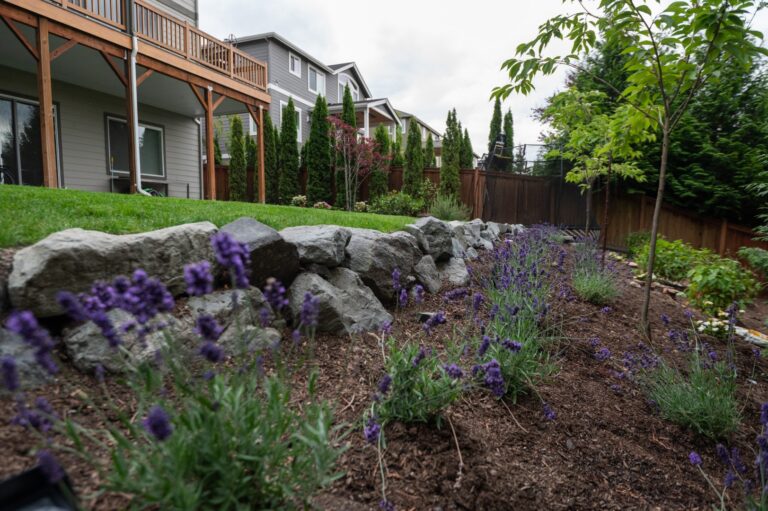
Retaining walls are structural elements, not decorative features. They hold soil in place against gravity and manage the lateral pressure of water-saturated earth. When a retaining wall begins to fail in western Washington’s wet climate, the failure accelerates each season.
Early warning signs (repair cost: $3,000–$12,000)
- Leaning: The wall tilts forward even slightly — more than 1 inch per 10 feet of height indicates structural movement
- Cracking: Horizontal cracks in block walls or separating joints in stone walls
- Bulging: A section of the wall face pushing outward
- Soil washing through: Gaps developing between blocks or stones where soil is migrating through
- Water weeping from the face: Indicates the drainage system behind the wall (weep holes, drain pipe, gravel backfill) has failed or was never installed
At this stage, repairs often involve reinforcing the wall, improving the drainage behind it, and possibly rebuilding a section. The existing wall face can usually be preserved. For a typical 3-foot-tall, 30-foot-long residential wall on the Eastside, repair costs at this stage run $5,000–$12,000.
At this stage, repairs often involve reinforcing the wall, improving the drainage behind it, and possibly rebuilding a section. The existing wall face can usually be preserved. For a typical 3-foot-tall, 30-foot-long residential wall on the Eastside, repair costs at this stage run $5,000–$12,000.
What happens when you wait
Retaining walls don’t fail gradually and then stop. They fail gradually and then catastrophically. The physics are straightforward: water accumulates behind the wall, adding hydrostatic pressure to the soil’s natural lateral pressure. In clay soils, wet soil can weigh 20-30% more than dry soil. That additional weight builds each rainy season.
Eventually, the wall reaches a tipping point — literally. A section gives way, and the soil behind it follows. On sloped properties, this can trigger a cascade: the soil movement undermines whatever sits above the wall (patio, plantings, irrigation lines, sometimes a portion of the lawn), and the debris damages whatever sits below.
Reconstruction costs: $20,000–$60,000+
A collapsed retaining wall can’t be repaired — it must be reconstructed. And reconstruction includes more than just the wall itself:
- Engineering: King County and most Eastside cities require engineered plans for walls over 4 feet. Geotechnical and structural engineering fees run $3,000–$8,000.
- Permitting: Permit fees plus the time added to the project timeline (4–8 weeks in most jurisdictions).
- Excavation and site prep: The failed material and displaced soil must be removed before new construction begins.
- The wall itself: Materials, drainage system (gravel backfill, perforated pipe, filter fabric), and construction labor.
- Collateral damage: Replacing the plantings, irrigation, patio sections, or lawn areas damaged during the failure and reconstruction.
For our Kenmore lakeview project, the engineered retaining wall was designed correctly from the start — with King County permitting, geotechnical review, and proper drainage. That upfront investment in doing it right is always less than the cost of doing it twice.
What happens when you ignore slope erosion?
Slopes are inherently unstable. Gravity is constantly pulling soil downhill, and water accelerates the process. In the Seattle area, where many residential lots in Kirkland, Woodinville, Bothell, and Sammamish sit on hillsides, slope management isn’t optional — it’s the price of the view.
Planning a Project This Year?
The earlier you start the conversation, the more scheduling options you'll have.
Start Planning NowMinor erosion (stabilization cost: $5,000–$15,000)
Surface erosion — sheet wash, small rills, soil creeping downhill — is the earliest sign that a slope needs attention. At this stage, solutions include:
- Establishing deep-rooted ground cover plantings (kinnikinnick, salal, sword fern) that bind the soil
- Installing erosion control blankets during establishment
- Adding terracing with low retaining walls to break the slope into manageable sections
- Improving surface drainage to redirect water before it gains velocity
These are straightforward landscape projects that most experienced crews can handle in a week or less.
Moderate erosion (repair cost: $15,000–$35,000)
When surface erosion goes unaddressed, it deepens into gullies. The soil structure breaks down. Root systems of existing trees and shrubs become exposed, weakening their hold on the slope. In the worst cases, mature trees begin to lean — not from wind, but because the soil beneath them is moving.
At this stage, the fix requires more significant grading, possibly a retaining wall system, and replanting with a deliberate stabilization strategy. The existing vegetation may need to be removed and replaced, and temporary erosion control measures are needed during construction to prevent the problem from worsening while it’s being fixed.
Severe erosion / landslide risk (remediation cost: $40,000–$100,000+)
Western Washington sees mudslides and landslides regularly during heavy rain events. The geology — glacial deposits over clay layers — creates natural slip planes, especially on slopes steeper than 40%. Properties in known landslide hazard areas (mapped by King County and the Washington Department of Natural Resources) face additional regulatory requirements and engineering costs.
At this stage, you’re no longer in landscape territory — you’re in civil engineering. Soldier pile walls, soil nails, tieback anchors, and engineered drainage systems are typical solutions. The costs are an order of magnitude higher than what the original slope stabilization would have required.
Why do homeowners wait?
After seeing the cost escalation in hundreds of projects, we’ve noticed a pattern. Homeowners delay for three predictable reasons:
1. The problem isn’t visible enough. Drainage issues happen underground. Retaining walls fail slowly. Erosion is gradual. By the time the symptoms are obvious, the underlying problem has been building for years.
2. The timing feels wrong. “We’ll deal with it next spring.” But Seattle’s wet season — when drainage and slope problems accelerate — runs from October through April. By the time spring arrives, another season of damage has compounded.
3. The cost feels discretionary. Unlike a leaking roof, which feels urgent, a soggy corner of the yard or a slight lean in a retaining wall feels like something that can wait. But structural landscape issues don’t hold steady — they compound.
How to assess what you're dealing with
If you suspect a drainage, slope, or structural issue on your property, here’s a practical starting point:
Walk your property after a heavy rain — not the next day, but during the rain. Watch where water collects, where it flows, and where it exits your property. Stand at the bottom of any slopes and look uphill for rills or bare soil. Check retaining walls for the warning signs listed above. Look at the soil line against your foundation — is it graded away from the house, or does it slope toward it?
This 20-minute walk will tell you more than a dry-weather site visit ever could. If you see standing water against the foundation, active erosion, or a retaining wall showing signs of movement, those are conditions that will cost more to fix next year than this year. That’s not a sales pitch — it’s physics.
If what you find concerns you, we’re happy to walk the property with you and give you an honest assessment of what’s happening and what it will take to address it.
The Bottom Line
If you suspect a drainage, slope, or structural issue on your property, here’s a practical starting point:
Walk your property after a heavy rain — not the next day, but during the rain. Watch where water collects, where it flows, and where it exits your property. Stand at the bottom of any slopes and look uphill for rills or bare soil. Check retaining walls for the warning signs listed above. Look at the soil line against your foundation — is it graded away from the house, or does it slope toward it?
This 20-minute walk will tell you more than a dry-weather site visit ever could. If you see standing water against the foundation, active erosion, or a retaining wall showing signs of movement, those are conditions that will cost more to fix next year than this year. That’s not a sales pitch — it’s physics.
If what you find concerns you, we’re happy to walk the property with you and give you an honest assessment of what’s happening and what it will take to address it.