- Landscape problems in Seattle's wet climate do not stabilize on their own — they compound. Water, gravity, and freeze-thaw cycles are working on your property twelve months a year, and each season of inaction adds scope to the eventual repair.
- A drainage issue addressed early is typically a contained project. The same drainage issue after two wet seasons often involves soil remediation, hardscape repair, and plant replacement that together cost three to five times the original fix.
- Retaining walls that show early signs of displacement — leaning, cracking mortar joints, soil washing through gaps — are repairable. Once a wall moves past a certain threshold, repair is no longer structurally viable and full replacement is the only responsible option.
- Overgrown or declining plantings are not just an aesthetic issue. Root systems that go unmanaged compromise drainage infrastructure, lift hardscape, and create moisture conditions against foundations that lead to structural concerns.
- The Pacific Northwest's wet season is not a pause button — it is an accelerant. Problems that look the same in September as they did in April have almost certainly gotten worse underground where you cannot see them.
- Acting in fall or winter, when most homeowners are not thinking about their landscapes, gives you better scheduling access, more design time, and the ability to plant during the optimal root-establishment window.
How Does Water Damage Compound on Seattle Properties?
Water is the primary driver of landscape deterioration west of the Cascades, and it is relentless. Between October and April, the greater Seattle area receives roughly 30 to 37 inches of rain — the exact amount varies by microclimate, but every property from Bellevue to Woodinville to Issaquah gets enough to test whatever drainage system exists. The question is whether that system is still doing its job.
Stage 1: Surface Water Misbehavior
The first sign is usually subtle. Water pooling where it did not pool before. A soggy patch in the lawn that takes days to dry after rain. Runoff cutting a small channel across a path or patio edge. At this stage, the fix is often straightforward — regrading a swale, extending a downspout, adding a French drain segment, or correcting the grade along a foundation. These are contained projects. Classic’s crews handle work like this regularly across Greater Seattle, and the scope stays manageable when the underlying soil and hardscape are still intact.
Stage 2: Soil Saturation and Movement
When surface water problems persist through a full wet season without correction, the issue moves underground. Heavy clay and glacial till are notoriously slow to drain. Sustained saturation weakens soil structure, increases hydrostatic pressure against retaining walls and foundations, and begins to shift material. You may notice a slight settlement in a patio, a new crack in a walkway, or a retaining wall that looks like it has leaned slightly. These are not cosmetic issues. They are evidence that the ground beneath your hardscape has moved — and once soil moves under load, it rarely settles back to where it was.
The cost difference between Stage 1 and Stage 2 is significant. A drainage correction at Stage 1 is a focused project. At Stage 2, the drainage work still needs to happen, but now the scope includes soil stabilization, potential hardscape releveling or partial reconstruction, and often a reassessment of the entire water management system for that area of the property.
Stage 3: Structural Compromise
A third wet season without intervention is where Classic most often encounters projects that have crossed from repair territory into rebuild territory. Retaining walls that were leaning slightly are now visibly displaced. Patios have settled unevenly enough that water ponds on the surface — which accelerates further settlement. Slopes that were creeping are now actively eroding. Foundation drainage that was sluggish is now failing, and moisture is reaching places it was never intended to reach.
At this stage, the original drainage problem is no longer the project. The project is now reconstructing the landscape infrastructure that the unmanaged water destroyed. In Classic’s experience, work at this stage typically involves removing and rebuilding hardscape, regrading and stabilizing soil, installing or replacing drainage systems, and replanting areas where root systems failed in saturated conditions.
What Happens When a Retaining Wall Problem Goes Unaddressed?
Retaining walls are among the most common deferred-maintenance items we see across Greater Seattle, and they are also among the most consequential. A retaining wall is a structural system. It holds back soil, manages water pressure, and protects everything downslope — including patios, plantings, walkways, driveways, and in some cases, foundations. When a wall begins to show signs of failure, the timeline for action matters enormously.
Early Signs — Repairable Window
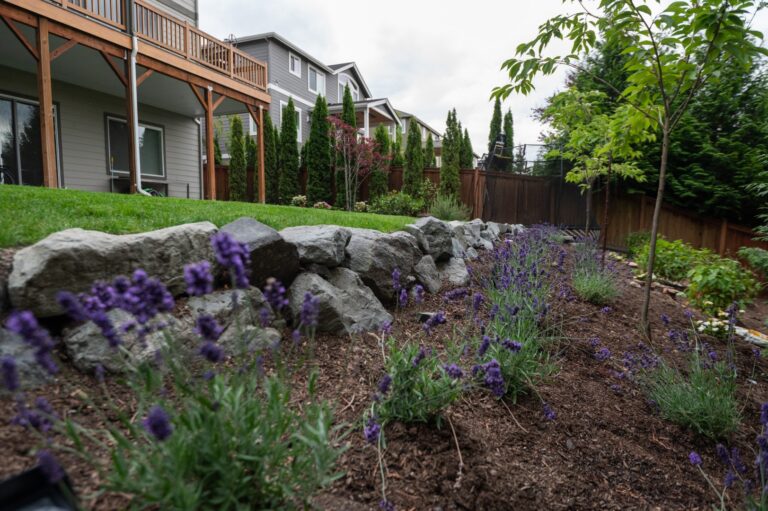
Hairline cracks in mortar joints. A slight lean that was not there before. Soil washing through small gaps between blocks or stones. Weep holes that have stopped draining. These are signals, not emergencies — but they are signals with a shelf life. During this window, targeted repairs are often viable: repointing mortar, adding or clearing drainage behind the wall, reinforcing tiebacks, or rebuilding a section while the rest of the wall remains structurally sound.
After Another Wet Season — The Math Changes
Once a wall has moved through a full wet season with active displacement, the structural calculation changes. Hydrostatic pressure behind a compromised wall increases with every rain event. The soil that was being retained shifts into the space the wall vacated, putting more lateral force on the remaining structure. Frost heave during cold snaps — common enough in the Seattle area from December through February — pushes displaced sections further out of alignment.
At this point, a contractor evaluating the wall has to answer a different question. It is no longer “can we repair this section?” It is “is the wall’s structural integrity sufficient to justify repair, or has the failure progressed to the point where partial repair would leave a compromised system that continues to move?” In Classic’s experience, walls that have been actively leaning for more than one wet season most often require full replacement rather than repair. That is not an upsell — it is a structural reality that any responsible contractor will confirm.
The cost difference is not trivial. A targeted repair on a wall showing early distress is a fraction of what full wall replacement costs, particularly when replacement requires excavation, soil re-engineering, new drainage infrastructure, and the re-establishment of everything that was downslope of the original wall.
How Do Neglected Plantings Create Larger Problems?
Plants are not decoration. On a well-designed Seattle-area landscape, plantings serve structural and functional roles — slope stabilization, stormwater management, privacy screening, microclimate regulation. When plantings decline or grow out of control without proper management, the consequences go well beyond aesthetics.
Overgrowth and Root Damage
Trees and large shrubs that go unpruned for several years do not just look unkempt. Their root systems expand into drainage lines, crack retaining walls from behind, lift paver patios, and compress irrigation systems. In Classic’s experience, root intrusion into French drains and perforated drainage pipes is one of the most common — and most preventable — causes of drainage system failure on established Greater Seattle properties. The drain was installed correctly. It worked for years. Then a nearby tree or hedge grew unchecked, and its roots found the water source they were looking for.
Removing root intrusion from drainage infrastructure is significantly more involved than the original drain installation. It often requires excavation, pipe replacement, root barrier installation, and sometimes the removal or relocation of the plant itself.
Plant Loss and Slope Instability
On the other end of the spectrum, plantings that have been declining — from disease, poor drainage, shade encroachment, or simple neglect — eventually die. When they die, their root systems stop holding soil. On flat ground, this is a replanting project. On slopes, it is a stability problem.
Greater Seattle has no shortage of sloped properties. Bellevue, Kirkland, Sammamish, Issaquah — the topography is hilly, and many residential lots rely on vegetation to hold slopes that would otherwise be engineered with retaining structures. When the plants that were doing that job die, the slope begins to move. Not dramatically at first — just enough creep that by the next spring, the grade has shifted, drainage patterns have changed, and the scope of the replanting has expanded to include soil stabilization or a retaining solution that was not previously necessary.
Moisture Against Foundations
Plantings installed too close to a home’s foundation — or plantings that have grown to the point where their canopy traps moisture against the structure — create conditions that no homeowner wants. Persistent moisture against a foundation promotes mold growth, deteriorates siding and trim materials, and in worst cases, contributes to water intrusion into crawl spaces and basements. The plant is rarely the cause of a foundation issue on its own, but it creates the moisture environment that allows small vulnerabilities to become real problems over successive wet seasons.
Why Does One More Season Feel Like No Big Deal — But the Math Says Otherwise?
This is the psychology that drives most deferred landscape work, and it is understandable. The yard looked roughly the same last April as it does this April. Nothing catastrophic happened. The wall did not fall over. The patio did not sink into the ground. The drainage problem did not flood the house. So the mental conclusion is: it held another year, it will hold another year.
The problem with this reasoning is that most landscape deterioration happens below grade — in the soil, behind walls, inside drainage runs, at root zones — where it is invisible until it produces a surface symptom that is significantly worse than what you were monitoring. The wall that “looked the same” last April may have moved another inch behind the visible face. The soil behind it may have saturated and consolidated in ways that doubled the hydrostatic pressure on the structure. The drainage pipe that was slow last year may now have root intrusion that has reduced its capacity by half.
Classic’s project managers see this pattern repeatedly. A homeowner calls about what they describe as a “small retaining wall issue” or a “drainage thing that’s been going on for a while.” The site visit reveals that the scope has expanded well beyond the original problem — not because the homeowner was negligent, but because the compounding happened where they could not see it.
The honest framing is this: every season of inaction in Seattle’s wet climate is not neutral. It is additive. The question is not whether the problem will get worse — in this climate, with these soils, it will. The question is whether you address it while the scope is still contained, or after the next wet season has expanded it into adjacent systems.
What Does Acting Now Actually Look Like?
Acting does not necessarily mean starting construction tomorrow. It means starting the conversation — which is a different thing entirely, and one that most homeowners underestimate.
A landscape project in Greater Seattle moves through design, permitting, material procurement, and construction scheduling before anyone breaks ground. That process takes time even under ideal conditions. Starting the conversation in fall or winter — when most homeowners are not thinking about their landscapes — gives you several concrete advantages:
More design time. Designers carry fewer concurrent projects between October and January. Your project gets more attention, more iteration, and a more thoughtful plan than one rushed through in the spring crunch.
Better scheduling access. Construction crews book months in advance. Fall and winter conversations translate to spring and early summer build slots — the best weather window in the Seattle area.
Optimal planting windows. Fall is the best time to plant in the Pacific Northwest. Root systems establish through the mild, wet winter months and emerge in spring with a full season’s head start over spring-planted material.
Contained scope. Every month of inaction risks expanding the scope of work. Addressing problems before they compound through another wet season means the project you planned is the project you build — not a larger one you did not budget for.
If your property has drainage that is misbehaving, walls that are showing movement, plantings that have outgrown their space or declined past recovery, or hardscape that has settled or cracked — the most expensive decision is almost always the one that feels like no decision at all: waiting another season.