- Read the existing site before designing. Driveway material, porch material, architecture scale, and seasonal sun angle all dictate what works at the entry.
- Layered plantings beat uniform rows at every budget level. Three strata — anchor, mid, edge — reads as designed; one row of identical shrubs reads as filler.
- Plan for winter, not just summer. Evergreen structure plus winter-blooming plants like hellebores carries the entry through our long gray season.
- Pathway lighting should be low-voltage LED, not solar, in our climate. Solar dims through PNW winters when entry visibility matters most.
- Containers need frost-proof material and 18-inch minimum depth. Cheap ceramic cracks, shallow bowls drown roots in our wet winters.
- Hardscape unification is often the highest-impact upgrade. Bringing driveway, walkway, and porch materials into a single language transforms how the entry reads more than any plant change.
The difference between an entry that feels intentional and an entry that feels like an afterthought is rarely about budget. It’s about whether someone read the site before they planted. A $4,000 entry with the right plant palette and proper grading reads as designed. A $25,000 entry with a generic boxwood-and-azalea plan reads as expensive but unconvincing.
The six ideas in this article are the ones we actually use across Eastside projects in Bellevue, Kirkland, Mercer Island, and Sammamish — not because they’re inventive, but because they’re the moves that consistently make front entries work. Each one has a Pacific Northwest-specific consideration that gets missed in generic curb-appeal articles.
What makes an entry landscape feel intentional?
A front entry has one job: tell the visitor that the home was thought about. That’s it. Cute features and elaborate plantings don’t add up to “intentional” if the underlying read is wrong.
In our experience, three things determine whether an entry reads as designed.
First: the path your eye takes from the street to the door is a continuous line. Everything along that line — the driveway, the walkway, the plantings, the door itself — should feel like it belongs to the same design. Most failed entries have a driveway that says one thing, a walkway that says another, and plantings that say a third.
Second: the plant scale matches the architecture. A 5,000 sq ft Mercer Island home with 12-foot-tall front windows needs anchor plants that hold their own at that scale. A 1950s Bellevue rambler with a 7-foot porch overhang needs something quieter. The wrong scale — usually too small — is the most common entry failure we get called to redo.
Third: the entry has presence in the seasons you actually see it. In Seattle, that means winter. The entry is what you walk past every December morning in the rain. If everything in your entry beds goes dormant in October and doesn’t come back until April, the entry is invisible for half the year. Evergreen structure plus winter-blooming hellebores carries the entry through our long gray season.
1. Layered plantings with a real seasonal succession
The opposite of a layered planting is a single row of identical shrubs along the walkway. That’s an instinct most homeowners default to, and it almost always reads as flat.
A layered entry has three strata: a low edge layer (ground covers, low perennials), a mid layer (shrubs and clumping perennials), and an anchor layer (one or two specimen plants or small trees). Each layer has at least one plant that’s contributing visual interest in every season.
A layered entry palette we use often on Eastside projects:
- Anchor: Japanese maple (Acer palmatum ‘Bloodgood’ or ‘Sango-kaku’) for fall color and winter branch structure
- Mid: Hydrangea (‘Limelight’ for late-season blooms), Pieris japonica for evergreen structure with spring chains
- Edge: Heuchera (‘Obsidian’ for foliage color), hellebores for winter blooms, sword fern for evergreen texture
The cost differential between this and a row-of-identical-shrubs install is often less than 20 percent. The visual differential is the entire point of the project.
2. Pathway lighting that doesn’t look like a runway
Generic curb-appeal articles say “install solar lights along the path.” We don’t disagree, but the implementation matters more than the recommendation.
The most common pathway lighting failure: too many fixtures, too close together, all the same height. The result reads as an airport runway, not a residential entry.
What works in our experience:
- Low-voltage LED, not solar. Solar fixtures dim across PNW winter when sun is scarce. Low-voltage LED with a hardwired transformer carries through the season.
- Spacing of 8–10 feet, not 4–5 feet. The light should reveal the path, not illuminate every inch of it.
- Mix fixture types. A few path lights at knee height, occasional uplights on a specimen tree, and a single down-light from above creates depth that uniform fixtures can’t.
- Warm color temperature (2700K–3000K). Cooler white reads industrial.
Budget for low-voltage LED entry path lighting installed by a licensed electrician runs roughly $1,500 to $4,500 depending on path length, fixture count, and transformer location.
3. An anchor specimen — usually a tree
Most front yards on Eastside properties have room for one carefully chosen specimen tree near the entry. That tree, more than any other element, sets the design’s tone.
Specimen trees we use most often in PNW entries:
- Japanese maple (Acer palmatum). Multiple cultivars, from upright to weeping, from green to deep burgundy. The ‘Bloodgood’ cultivar is reliable and architectural. ‘Sango-kaku’ has coral bark that lights up the entry in winter.
- Vine maple (Acer circinatum). Native, multi-stem, brilliant fall color. Reads as PNW-appropriate.
- Stewartia (Stewartia pseudocamellia). Mottled bark, summer flowers, fall color. Slow grower but a year-round performer.
- Dogwood (Cornus kousa preferred over C. florida). C. florida struggles with anthracnose in our climate. C. kousa is the more reliable choice west of the Cascades.
The mistake to avoid: planting a tree that will outgrow its space within a decade. A Norway maple or sweetgum at the entry is a 20-year regret. Match mature size to the available footprint.
4. An architectural element — gate, arbor, screen, or pillar
A built feature in the entry — a wood gate, an arbor over the walkway, a stone pillar, a horizontal-board privacy screen — gives the design a hard reference point that plants alone can’t provide. It also lifts the entry from “landscaped” to “designed.”
What we use most often on Eastside projects:
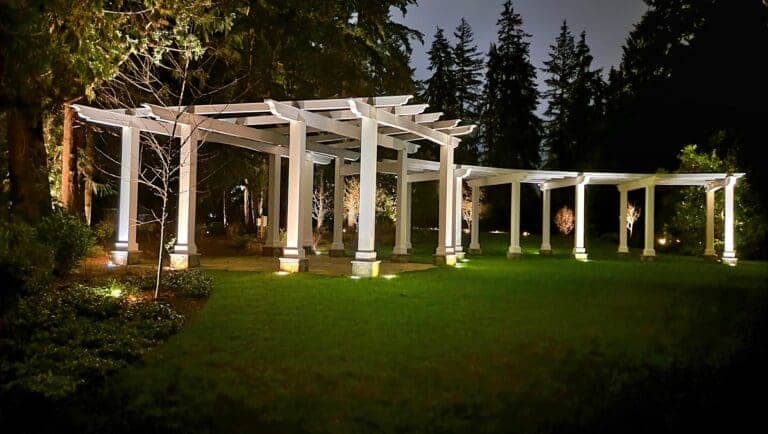
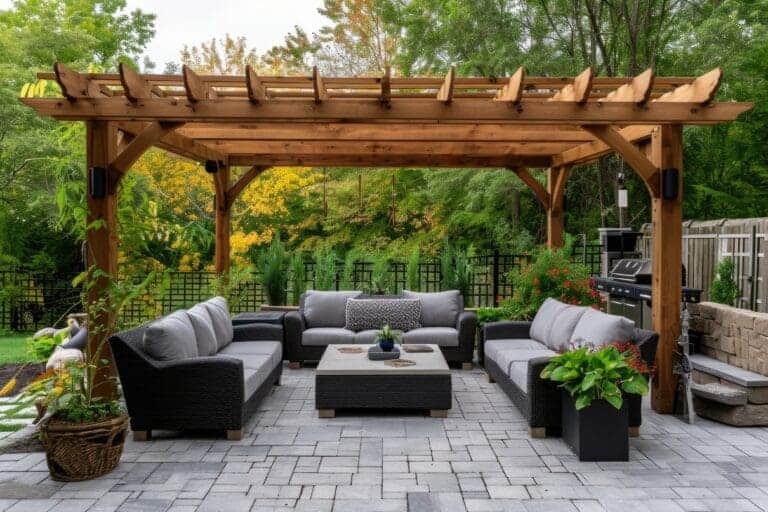
- Cedar arbor or pergola at the transition from public sidewalk to private path. Western red cedar is the climate-appropriate choice for our wet winters.
- Horizontal slat screens for partial privacy near the front door without blocking the entry’s visibility from the street.
- Stone or paver pillars flanking the entry path, often integrated with low retaining or seat walls.
The architectural element does double duty: it makes the entry feel intentional, and it gives the climbing plants (clematis, climbing hydrangea, jasmine) something to grow on.
5. Container plantings that survive PNW winters
Containers are the easiest entry upgrade to underestimate, and the easiest to do badly. The default failure is a $40 plastic container with a single annual that looks tired by August.
What works in our experience:
- Use frost-proof containers. Ceramic containers crack in our winters when freeze-thaw cycles hit saturated potting mix. Concrete, fiberglass, and high-fired stoneware survive. Lower-fired ceramic doesn’t.
- Plant for year-round structure, not just summer color. Anchor with a small evergreen (boxwood, dwarf conifer, or Pieris japonica), add seasonal layers around it (hellebores in winter, heuchera year-round, a flush of annuals in summer).
- Use real containers, not bowls. Container depth matters in our wet winters — shallow bowls drown root systems. Plant in containers at least 18 inches deep.
- Insulate the root zone in winter. Wrap large containers with burlap or move smaller containers against the house during cold snaps. Container plants freeze faster than in-ground plants because there’s no soil mass buffering temperature.
6. Hardscape unification
The single biggest entry transformation we deliver isn’t a planting change — it’s unifying the hardscape. Most older Eastside homes have a driveway in one material (poured concrete), a walkway in another (broom-finished concrete or asphalt), and a porch in a third (painted wood or pavers). The collision of materials reads as visual noise.
The fix is to bring the path materials into a single language. That doesn’t always mean replacing everything. Sometimes it’s:
- Replacing the walkway in pavers that pick up tones from the existing driveway and porch
- Adding a paver border along an existing concrete walkway to soften the transition
- Installing flagstone stepping stones through a gravel inlay to break up a long walkway
Material recommendations for PNW conditions: Belgard concrete pavers, locally quarried basalt, and bluestone hold up well to our freeze-thaw cycles. Avoid soft sandstone (spalls), polished marble (gets dangerously slick when wet), and untreated wood for walking surfaces (algae growth).
What does an entry redesign cost?
Three project tiers we see across Eastside properties:
- Plant refresh only: $3,000–$8,000. Removes failed plantings, adds layered entry palette with anchor plant, mulches and edges. Hardscape stays as-is.
- Plants + lighting + container plantings: $8,000–$18,000. Adds low-voltage LED entry path lighting and full container planting program along with the plant palette upgrade.
- Full entry redesign: $25,000–$60,000+. Includes hardscape unification (walkway, porch, sometimes driveway integration), new plantings, lighting, and any architectural elements like an arbor or stone pillars.
The hardscape decision drives most of the budget swing. A planting-and-lighting refresh delivers a strong improvement at the lower tier; a full hardscape replacement is the work that transforms how the entry reads from the street.