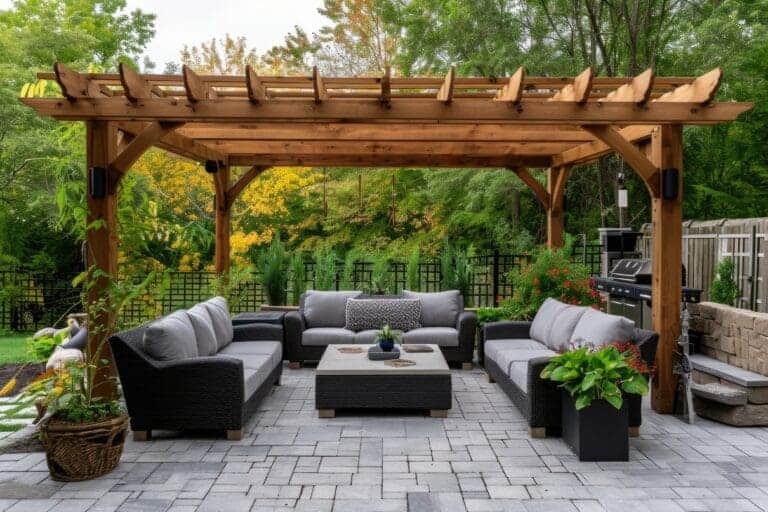
- Pacific Northwest fall sunsets move from 8:30 PM in August to 4:30 PM in December — outdoor lighting transforms the usable hours during the season of greatest outdoor evening use.
- Five functional categories cover most residential lighting: path, step/grade, accent, entry/facade, and deck/outdoor-living.
- Low-voltage LED dominates residential installations: 70-80% lower energy use than older systems, warm-white color quality that matches daylight feel, and retrofit flexibility for future additions.
- Smart-controlled transformers add WiFi integration, astronomical clock scheduling, scene control, and motion/dusk sensors — modest install cost, substantial daily usability.
- Composed lighting design follows principles: light the journey not just the destination, balance downlight with uplight, layer three brightness levels, use shadow deliberately.
- Fall is a natural installation window — visible value is obvious as sunset moves earlier, crew availability is typically better than summer, and installs complete before holiday entertaining.
- Fixture quality tiers range substantially; professional-grade brass and copper fixtures last decades while budget aluminum fixtures last 5-7 years.
Pacific Northwest fall evenings darken faster than most homeowners expect — sunset moves from 8:30 PM in August to 4:30 PM in December across the Seattle Metro Area, and the months with the most demand for outdoor living overlap exactly with the months when the lawn disappears into darkness by 5 PM. Outdoor lighting installation transforms what those hours look like: a path that’s clearly readable from the driveway to the front door, a specimen tree that becomes a sculptural focal point at night, a patio that stays usable for the evening hours that summer doesn’t offer. Modern low-voltage LED systems install cleanly into existing landscapes, run on smart-controlled transformers, and use a fraction of the energy of older systems while delivering substantially better light quality. Across residential properties, lighting is one of the highest-impact enhancements available — and the one whose visible payoff arrives immediately rather than over years.
What outdoor lighting categories matter for Seattle homes?
Five functional categories cover most residential outdoor lighting work:
Path lighting. Low-mounted fixtures along walkways, driveways, and garden paths. The function is safety and welcome — guests see where they’re going from the moment they arrive, and the path reads as defined rather than disappearing into darkness. Path lighting is the most common entry point into outdoor lighting design.
Step and grade lighting. Code-relevant for stairs, transitions between elevations, and grade changes. Integrated step lights built into risers, low-profile fixtures on adjacent walls, or stake-mounted fixtures placed to wash light across step treads. The safety function is real; the visual function defines the elevation changes architecturally.
Accent lighting. Up-lighting and down-lighting that reveals specimen plants, architectural features, or focal sculptures. A specimen Japanese maple lit from below at night becomes a major design moment that the daylight view doesn’t deliver in the same way. Accent lighting is what distinguishes a yard that’s been illuminated from a yard that’s been designed for night viewing.
Entry and facade lighting. Lighting on the home’s facade, around doors, on porch ceilings — establishing the welcome and the security signal as someone approaches. Entry lighting often integrates with the home’s electrical (line-voltage fixtures) rather than the low-voltage landscape system, though hybrid approaches work too.
Deck and outdoor-living lighting. Rail lighting along deck edges, soffit lighting under cover structures, lighting integrated into pergolas, and patio area lighting (overhead string lights, in-ground markers, fixtures on adjacent walls). These categories define the outdoor living space’s usable hours.
Most well-designed lighting installations include 3-4 of these categories rather than just one — the layered effect is what produces the composed look at night.
Why does low-voltage LED dominate residential outdoor lighting?
Three reasons low-voltage LED has become the residential standard:
Energy efficiency. Modern LED fixtures use 70-80% less energy than the halogen and incandescent fixtures they replaced. A full residential lighting system running on LED costs $5-$15 per month to operate; the same system on halogen would have run $25-$75. The energy savings cover incremental installation cost differences within a few years.
Light quality. Modern warm-white LEDs (2700K-3000K color temperature) deliver the warm welcoming light quality that older LEDs missed. The blue-white “cool” LED problem of a decade ago is solved in current residential-grade fixtures.
Retrofit flexibility. Low-voltage systems are easy to add to over time. The transformer can run additional fixtures as the design grows; new branches and fixtures install without major trenching disruption. Properties that start with path lighting can add accent lighting in a future phase without restarting the system.
The fixtures themselves come in a range of quality tiers, from budget-grade aluminum casings that may last 5-7 years to professional-grade brass and copper fixtures with 25-year lifespans. The price difference is significant; the longevity difference often justifies the premium for properties where the lighting is meant to last decades.
What does smart control add to outdoor lighting?
Modern transformers and controllers add capabilities older systems didn’t have:
WiFi or smart-home integration. The transformer connects to home WiFi and integrates with Alexa, Google Home, or Apple HomeKit. Lighting turns on and off through voice commands, app schedules, or scene presets.
Astronomical clock scheduling. The system knows local sunset and sunrise times and adjusts schedule automatically — lighting comes on at dusk regardless of season without manual reprogramming. This matters more in the Pacific Northwest than in lower latitudes because sunset times shift by four hours between summer and winter.
Scene control. Different lighting configurations for different uses — “Welcome” scene for early evening with path and entry lighting, “Dinner” scene with patio lighting active, “Late” scene with minimal security lighting only. Scenes activate by voice, app, or schedule.
Motion and dusk sensors. Selective fixtures triggered by motion (entry paths, driveways) for security; dusk-only operation for fixtures that should only run after sunset.
Smart control adds modest cost during installation and substantial day-to-day usability after. Most homeowners who experience smart-controlled outdoor lighting consider it standard rather than premium.
How does lighting design create the layered effect?
Lighting that reads as composed at night follows a few design principles that distinguish it from spotlight-everything installations:
Light the journey, not the destination. Path lighting illuminates the route to a destination — but the destination should be lit indirectly through accent lighting, not flood-lit. A patio lit by accent fixtures on surrounding trees feels welcoming; a patio lit by overhead floodlights feels institutional.
Downlight from height feels natural; uplight from ground feels staged. Light coming from above (canopy-mounted downlights, soffit lighting, rail lighting) reads as natural illumination. Light from ground level (uplights on trees, well lights in beds) reads as staged for effect. Both have uses; mixing both creates the layered look. Pure downlight reads as functional; pure uplight reads as dramatic.
Three brightness layers. Functional lighting (path, step, entry) at moderate brightness for safety. Accent lighting at higher brightness on specimen features for visual interest. Ambient lighting at lower brightness for the broader space (string lights, candles, low-level fixtures) creating mood. The contrast between layers is what creates depth.
Shadow matters as much as light. Lighting design includes deliberate dark areas — beds without uplighting, paths beyond the lit section, areas of the yard that stay quiet at night. Lighting everything equally produces a flat institutional look. Selective lighting with intentional shadow produces the composed feeling.
Across our Landscape Enhancements lighting work, those design principles are the consistent standard for the difference between a lit yard and a designed-for-night yard.
When is fall the right time for lighting installation?
Fall is one of the practical lighting install windows for a few specific reasons:
Sunset is moving earlier. The visible value of outdoor lighting becomes more apparent in October than in June. Homeowners who consider lighting in summer often don’t book it because the long daylight hours mask the need; the early October sunset highlights what the lighting would do.
Holidays are coming. Lighting installed in September or October is functional for the late-October entertaining season and ready for holiday lighting integration if planned. Many homeowners add lighting in fall partly because the timing aligns with the season of greatest outdoor evening use.
Crew availability. Outdoor lighting crews are generally more available in fall than summer, similar to other hardscape categories. Booking in summer for spring installation often runs into competing schedules; fall slots typically open earlier in the booking cycle.
Soil conditions favor trenching. Low-voltage lighting requires shallow trenching for cable runs — the soil conditions that favor fall hardscape installation similarly favor lighting installation. Spring trenching faces saturated soils that complicate cable runs and final landscape restoration.
For homeowners considering lighting, fall is a natural window — the sunset timing makes the value clear, the crew availability supports the booking, and the install completes before the holiday entertaining season starts.