- Verify any landscape contractor's Washington state registration, insurance, and bond status at lni.wa.gov/verify before signing — this takes five minutes and eliminates the riskiest operators immediately.
- A legitimate proposal specifies materials by name and size (not just "pavers" and "shrubs"), includes a drainage plan, provides line-item pricing, and establishes a realistic timeline.
- The most expensive repairs we perform across the Eastside — failed retaining walls, heaving patios, foundation drainage issues — almost always trace back to base depth shortcuts and missing drainage infrastructure during original construction.
- If one bid is 30% or more below the others, the savings are coming from thinner bases, smaller plants, skipped drainage, or inadequate insurance — costs that transfer to you within 1-3 years.
- Every scope change during construction needs a written change order with cost impact before the work happens — verbal agreements protect nobody and consistently result in billing disputes.
- These standards apply to every contractor, including Classic Landscaping — an informed homeowner asking hard questions is the best client a reputable company can have.
Over the past 15 years at Classic Landscaping, I’ve torn out and rebuilt more failed landscape projects across Seattle, Bellevue, Kirkland, and Redmond than I can count. Patios that settled within 18 months. Retaining walls that tilted because nobody installed drainage behind them. Planting beds where every shrub died because the root flare was buried four inches below grade. In almost every case, the homeowner tells me the same thing: “There were signs something was off, but I didn’t know what to look for.” This article is the field guide I wish those homeowners had before they signed. These warning signs apply to any landscape contractor you’re evaluating — including us. A reputable company won’t have any problem with you checking every item on this list, because they’ve already done the work to get these things right.
What are the biggest red flags before you even sign a contract?
The warning signs that matter most appear before any dirt gets moved. In our experience, the contractors who cut corners during construction almost always show patterns during the hiring process — if you know where to look.
No written contract or a suspiciously thin one
A handshake agreement or a one-page “proposal” with a lump-sum price and no detail is the single most common red flag we see when homeowners bring us in to repair someone else’s work. Washington state law (RCW 18.27) requires contractors to provide a written contract for any residential project over $1,000. If a contractor resists putting scope, materials, timeline, and payment terms in writing, that’s not a casual business style — it’s a liability shield that protects them and exposes you.
A legitimate contract specifies what materials will be used (by name, not “pavers” or “shrubs”), what the timeline looks like, what happens when scope changes, and what the payment schedule is.
Asking for more than 50% upfront
Washington’s contractor laws don’t cap deposits, but industry standard for reputable landscape companies in the Seattle market is typically 10-30% to secure the start date and order materials. When someone asks for 50% or more before a shovel hits the ground, it raises an obvious question: do they need your money to fund a different client’s project? That’s a cash flow problem you don’t want to be part of.
In our experience, reputable companies in the Seattle market typically structure payments around project milestones — 20–25% at signing to secure the schedule and order materials, then payments tied to completion of rough grading, hardscape, planting, and a final walkthrough. The projects I end up tearing out often had a different pattern: 50% or more upfront, with the remaining balance due “at completion” — no milestones in between. On a Redmond property where we rebuilt a failed patio and wall, the homeowner told me she’d paid $18,000 of a $30,000 project upfront. When the base started settling within six months and she called the contractor back, the calls went unreturned for weeks. By the time she reached someone, the company told her the settlement was “normal” and that repairs would be a separate charge. With 60% of the project cost already paid and no milestone documentation, she had little leverage. That’s the structural problem with front-loaded payment schedules — they remove the financial accountability that keeps a contractor invested in the quality of their work through the end of the project.
No proof of insurance or contractor license
In Washington state, every landscape contractor is required to hold a valid contractor’s registration through the Department of Labor & Industries (L&I). They need general liability insurance and a surety bond. You can verify any contractor’s license, bond status, and complaint history at lni.wa.gov/verify.
We’ve seen homeowners skip this step because the contractor “seemed professional” or “had a nice truck.” A nice truck is not insurance. If an uninsured worker is injured on your property, you could be personally liable. If unlicensed work fails, your options for legal recourse shrink dramatically.
No physical business address
A contractor who operates exclusively through a cell phone number and a P.O. box may not be around in two years when your retaining wall starts leaning. This isn’t about having a showroom — plenty of legitimate contractors work from home offices. But they should have a verifiable business address, an established web presence, and a history you can trace.
Won't provide references or a portfolio
Any contractor who has been doing quality work for more than a few years should be able to point you to completed projects in your area. Not stock photos. Not renders. Finished, in-the-ground work that’s weathered at least one Seattle winter. If they can’t or won’t share references from past clients, ask yourself why.
What should you watch for in the proposal itself?
A proposal reveals a contractor’s attention to detail before they’ve touched your property. The shortcuts that show up in construction often appear first on paper.
Vague material specifications
“Pavers” is not a specification. “Belgard Lafitt Rustic Slab in Victorian, 60mm thickness” is a specification. “Shrubs” is not a plant schedule. “3x Sarcococca ruscifolia, 3-gallon” is a plant schedule. When a proposal lists materials generically, you have no way to compare it against another bid — and the contractor has room to substitute cheaper products without technically breaking the agreement.
Across the Eastside, where I’ve been working on hardscape projects since 2011, the most common substitutions we uncover during tear-outs are thinner pavers than specified, lower-grade gravel for base material, and smaller plant sizes than discussed during the consultation.
No drainage plan
On virtually every property between Kirkland and Issaquah, clay soils create drainage challenges that need to be addressed in the construction plan — not improvised on the job site. If a proposal for a patio, retaining wall, or grading project doesn’t mention drainage at all, that’s not an oversight. That’s a cost they’re choosing not to include because it makes their bid look lower.
The consequences catch up within one to three wet seasons: patio heaving, wall displacement, standing water against foundations, and root rot in new plantings.
Lump-sum pricing with no breakdown
A single number — “$32,000 for backyard renovation” — tells you nothing about where the money goes. You can’t evaluate whether the materials are appropriate, the labor hours are realistic, or the drainage allocation is adequate. Detailed line items protect you. They also protect the contractor by creating a clear record of what was agreed to.
No timeline or an impossibly fast one
A thorough proposal includes a realistic project schedule — when the crew arrives, how long each phase takes, and what the projected completion date is. A proposal with no timeline leaves you guessing. A proposal that promises a 3-week completion for a project that realistically takes 6-8 weeks is setting up either rushed work or a missed deadline. Neither is what you want.
Verbal agreements for scope changes
“We’ll figure out the details as we go” is a phrase that should stop you cold. Every scope change — adding a pathway, swapping a plant variety, adjusting a wall height — needs a written change order with the cost impact before the work happens. Verbal agreements protect nobody, and they almost always result in a final bill that’s higher than what was discussed.
What red flags appear during construction?
Even after you’ve signed a solid contract with a licensed, insured contractor, the job site itself tells a story. Here’s what I look for when I’m evaluating someone else’s work — and what you can watch for on your own property.
Base depth shortcuts
This is the failure I repair more than any other across the Seattle metro area. The industry standard for a paver patio base in our clay soils is a minimum of 6 inches of compacted gravel — and 8 inches is better on sloped sites or areas with poor drainage. I regularly tear out patios where the base was 2-4 inches. The contractor saved a day of excavation and a few yards of gravel. The homeowner got a patio that settled, cracked, and ponded water within two years.
Last spring in Sammamish, we pulled up a 450-square-foot paver patio that had been installed roughly 18 months earlier. The homeowner called us because the east side of the patio had dropped noticeably — you could see a visible lip where it met the retaining wall, and water pooled across the low side after every rain. When we pulled up the pavers, we found the problem immediately: the base was about 3 inches of uncompacted road mix — a blend of crushed rock and fines — laid directly over native clay with no geotextile fabric separating the two layers. The clay had migrated up into the gravel, clogging the drainage paths and creating a saturated layer that heaved during freeze-thaw cycles. On the east side, where the grade sloped slightly toward the house, the surface had dropped nearly 2 inches. We excavated the entire base, installed geotextile fabric over the subgrade, built a proper 6-inch compacted gravel base in 2-inch lifts with plate compaction between each lift, added a French drain along the low side, and relaid the pavers. The tear-out and rebuild cost the homeowner roughly $16,000 — on top of the $22,000 they’d already paid for the original installation.
Last spring in Sammamish, we pulled up a 450-square-foot paver patio that had been installed roughly 18 months earlier. The homeowner called us because the east side of the patio had dropped noticeably — you could see a visible lip where it met the retaining wall, and water pooled across the low side after every rain. When we pulled up the pavers, we found the problem immediately: the base was about 3 inches of uncompacted road mix — a blend of crushed rock and fines — laid directly over native clay with no geotextile fabric separating the two layers. The clay had migrated up into the gravel, clogging the drainage paths and creating a saturated layer that heaved during freeze-thaw cycles. On the east side, where the grade sloped slightly toward the house, the surface had dropped nearly 2 inches. We excavated the entire base, installed geotextile fabric over the subgrade, built a proper 6-inch compacted gravel base in 2-inch lifts with plate compaction between each lift, added a French drain along the low side, and relaid the pavers. The tear-out and rebuild cost the homeowner roughly $16,000 — on top of the $22,000 they'd already paid for the original installation.
No compaction testing
Gravel that’s dumped and leveled but not compacted in lifts (typically 2-inch layers, each run over with a plate compactor) will settle unevenly. On a legitimate project, you should see — and hear — a plate compactor running multiple times during base preparation. If the crew spreads gravel and moves straight to laying pavers, the base isn’t properly compacted.
Missing drainage behind retaining walls
Every retaining wall needs drainage gravel and a perforated pipe behind it to relieve hydrostatic pressure — the force of water-saturated soil pushing against the back of the wall. Without it, water builds up behind the wall, the pressure increases through our wet season, and the wall starts leaning, cracking, or failing outright. I’ve seen walls that looked fine for the first dry summer and started moving by the following March.
For any wall over 4 feet in height, King County requires a building permit and typically an engineered design. If your contractor is building a wall that height without pulling a permit, they’re skipping the structural engineering that ensures the wall can handle the actual soil loads on your specific site.
Skipping geotextile fabric
Geotextile fabric separates the gravel base from the native soil below. Without it, our clay soils migrate up into the gravel over time, reducing drainage capacity and destabilizing the base. It costs almost nothing in materials and takes minutes to install. Skipping it is pure negligence.
Wrong slope or grade direction
Water should always flow away from your home’s foundation and away from hardscape surfaces. The standard is a minimum 1% slope (about 1/8 inch per foot) for patios, and positive grade away from the house for all adjacent soil surfaces. If your new patio slopes toward the house, or your new planting beds direct water toward the foundation, the contractor has created a problem that will cost more to fix than the original project cost to build.
What does poor workmanship look like up close?
Some quality indicators are visible even to homeowners who have never worked in construction.
Rough paver cuts
A wet saw produces clean, straight cuts on pavers and stone. A dry-cut angle grinder leaves chipped edges, rough surfaces, and visible cracking. If you see ragged, uneven cuts on the pavers along your patio border or around curves, the crew either didn’t have a wet saw on site or didn’t bother using it. Those chips aren’t just cosmetic — they’re entry points for water, freeze-thaw damage, and weed growth.
Sloppy mortar work
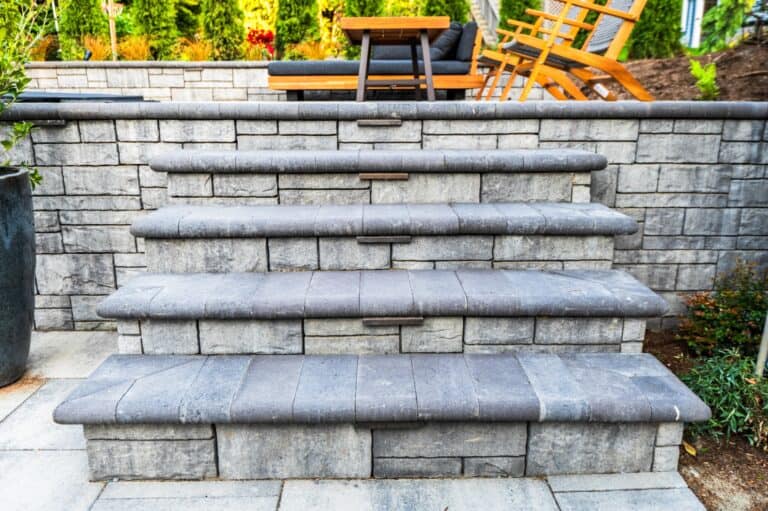
On mortared stone walls and caps, the joints should be tooled — pressed with a jointing tool to create a smooth, concave profile that sheds water. Mortar that’s been smeared on and left rough traps moisture, deteriorates faster, and looks progressively worse with each freeze-thaw cycle. In the Puget Sound region, where we cycle between freezing and thawing regularly from November through February, mortar quality matters.
Plants installed at the wrong depth
A plant’s root flare — the point where the trunk widens into the root system — needs to be at or slightly above the soil surface. We regularly find plants buried 2-4 inches too deep on properties where we’re called in for renovation work. Buried root flares lead to crown rot, girdling roots, and slow decline that doesn’t become obvious until 2-3 years after installation, when the homeowner assumes the plant just “didn’t make it.”
The plant type that suffers most visibly from improper planting depth, in our experience, is Japanese maples (Acer palmatum varieties). Their root flares are pronounced — you can clearly see the trunk taper where it transitions to the root system — and when that flare is buried, the bark stays perpetually moist against the soil. On a Kirkland renovation, we uncovered a ‘Bloodgood’ maple that had been planted 3 inches too deep. The bark at the soil line had developed a soft, darkened collar — the early stage of crown rot. Girdling roots had already begun wrapping around the buried trunk, slowly constricting the flow of water and nutrients. The tree was four years old and had been declining for two seasons; the previous company had diagnosed it as “not getting enough water.” Rhododendrons are a close second — their shallow, fibrous root systems suffocate when buried, and the decline shows as yellowing foliage and poor bloom that homeowners often attribute to nutrient deficiency rather than planting depth.
Evaluating Landscape Companies?
We're happy to answer your questions — even if you're still comparing options.
Talk to Our TeamWhat communication patterns should concern you?
Red flags aren’t limited to construction quality. How a contractor communicates during a project tells you a lot about how they’ll handle problems.
Unreturned calls and delayed responses
During an active project, your contractor should be reachable within a reasonable timeframe — same business day for calls, within 24 hours for non-urgent emails. If calls go unreturned for days during the sales process, expect worse once they have your deposit.
No project manager on site
On any project over $15,000-$20,000, there should be a designated project manager or lead who is on site regularly and serves as your point of contact. Crews working without supervision and without a clear line of communication to you are a recipe for misunderstandings, scope drift, and errors that don’t get caught until they’re buried under the next layer of work.
Scope creep without written change orders
“While we were here, we went ahead and…” followed by an additional charge is not how professional projects work. Every change to the original scope — whether it adds cost or not — should be documented in a written change order that you approve before the work happens. This protects both sides and prevents the invoice surprise that damages trust and often leads to disputes.
How do you spot a bid that's too good to be true?
When one bid comes in dramatically lower than the others — 30% or more below the average — it’s worth understanding why rather than celebrating.
The math behind a low bid
A landscape contractor’s costs include labor, materials, equipment, insurance, overhead, and profit margin. These costs don’t vary dramatically between legitimate companies in the same market. When a bid is significantly lower, the savings have to come from somewhere. In our experience, they come from thinner bases, smaller plants, cheaper materials, skipped drainage, and less experienced crews. Sometimes they come from the contractor being uninsured or unlicensed, which shifts risk directly to you.
We wrote about this dynamic in detail in The Cheapest Bid Is Rarely the Cheapest Outcome, which breaks down where the real costs hide in a low-ball landscape estimate.
Promises that skip engineering
“We don’t need a permit for that wall” or “Engineering is just extra cost — we’ve built hundreds of these” should make you pause. For retaining walls over 4 feet in King County, permits and engineering aren’t optional extras. They’re legal requirements that exist because soil loads, drainage volumes, and structural forces are site-specific. Skipping the engineering to save a few thousand dollars is a gamble on whether the contractor’s guess matches the physics of your particular hillside.
Impossibly fast timelines
A comprehensive backyard renovation — grading, drainage, retaining walls, patio, planting, irrigation — takes 4-8 weeks for a competent crew, depending on project complexity, weather, and site access. A contractor promising 2 weeks for work that legitimately takes 6 is either planning to cut corners or setting an expectation they’ll miss. Either way, the homeowner loses.
What should you do if you spot red flags mid-project?
Discovering problems during construction is stressful, but how you respond matters.
Document everything
Take dated photos of every concern — standing water, exposed soil without fabric, shallow base depth, rough cuts. Photos with timestamps are your most powerful tool if a dispute arises. Washington’s contractor dispute resolution process through L&I weighs documented evidence heavily.
Communicate in writing
Move all communication to email or text where there’s a written record. A phone conversation about a concern is easily forgotten or denied. An email with photos attached is a document.
Know your rights under Washington law
Washington state’s contractor registration law (RCW 18.27) provides homeowner protections including access to the contractor’s surety bond for incomplete or defective work. If your contractor is registered, you can file a complaint with L&I. If they’re not registered, your options are more limited — which is why verifying registration before signing is so important.
For projects where the dispute involves more than $10,000, consulting a construction attorney is generally worth the cost. Many offer free initial consultations.
Don't withhold payment as leverage without documentation
If you believe work is defective, document the specific issues in writing and provide the contractor a reasonable opportunity to correct them before withholding final payment. Washington courts generally expect good-faith effort to resolve disputes before escalating. Written documentation of defects and the contractor’s response creates a record that supports your position.
A note on what this article is — and isn't
This isn’t about bashing other companies. The landscape industry in the Seattle area includes many skilled, honest contractors doing excellent work. It also includes companies that cut corners, whether from inexperience, financial pressure, or indifference.
These red flags are patterns we’ve observed over 15 years of repairing failed projects across Bellevue, Kirkland, Redmond, Sammamish, Issaquah, and Seattle. They apply to any contractor you evaluate — and we’d encourage you to hold Classic Landscaping to every standard on this list. A company that does the work right has nothing to hide and everything to gain from informed clients.
If you’re in the process of evaluating contractors and want a framework for the conversation, our guide on 10 Questions to Ask a Landscape Company Before Hiring covers the questions that separate prepared companies from unprepared ones. And our How to Compare Landscape Proposals article walks through the line-item analysis that makes fair comparisons possible.
For a deeper look at how we approach projects from initial consultation through construction, visit our Design-Build page — it explains the single-point-of-accountability model and why we believe it produces better outcomes for homeowners.
If any of this sounds like what you’re dealing with — or if you’re trying to evaluate a situation on a project that’s already underway — we’re happy to take a look.
The Bottom Line
This isn’t about bashing other companies. The landscape industry in the Seattle area includes many skilled, honest contractors doing excellent work. It also includes companies that cut corners, whether from inexperience, financial pressure, or indifference.
These red flags are patterns we’ve observed over 15 years of repairing failed projects across Bellevue, Kirkland, Redmond, Sammamish, Issaquah, and Seattle. They apply to any contractor you evaluate — and we’d encourage you to hold Classic Landscaping to every standard on this list. A company that does the work right has nothing to hide and everything to gain from informed clients.
If you’re in the process of evaluating contractors and want a framework for the conversation, our guide on 10 Questions to Ask a Landscape Company Before Hiring covers the questions that separate prepared companies from unprepared ones. And our How to Compare Landscape Proposals article walks through the line-item analysis that makes fair comparisons possible.
For a deeper look at how we approach projects from initial consultation through construction, visit our Design-Build page — it explains the single-point-of-accountability model and why we believe it produces better outcomes for homeowners.
If any of this sounds like what you’re dealing with — or if you’re trying to evaluate a situation on a project that’s already underway — we’re happy to take a look.