- A complete landscape proposal includes at minimum seven sections: scope of work, material specifications, site preparation, timeline, payment terms, exclusions, and warranty — if any are missing, ask why before signing.
- Material specifications should name exact products, sizes, and quantities — not just categories like "natural stone" or "quality pavers." Vague material language is the most common source of post-signing cost disputes.
- The exclusions section is often more important than the scope section, because it defines the boundary of what is and is not included — a proposal without clear exclusions is a proposal with hidden assumptions.
- Pricing is fixed on the agreed scope of work; change orders arise when the scope changes or when unforeseen site conditions (buried utilities, unsuitable subgrade, undisclosed drainage problems) require adjustments.
- A one-year plant guarantee is standard among reputable Seattle-area landscape companies — shorter or missing guarantees should prompt questions about plant sourcing and installation practices.
- The payment schedule should tie to project milestones, not calendar dates — payments triggered by completed work protect both the homeowner and the contractor.
What Should the Scope of Work Section Actually Include?
The scope of work is the spine of any landscape proposal. It defines, in plain language, exactly what the contractor will build, install, or modify on your property. In a design-build proposal, the scope typically references the construction drawings — the detailed plans that show dimensions, elevations, material placements, and planting locations.
A thorough scope of work section answers three questions without ambiguity:
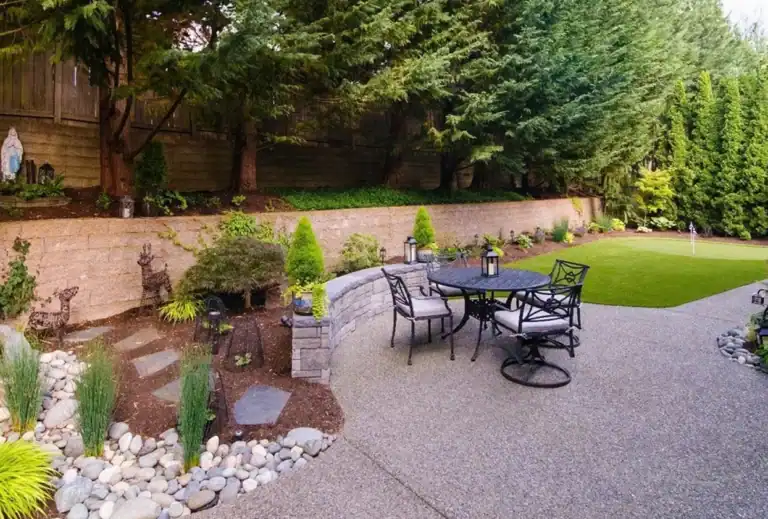
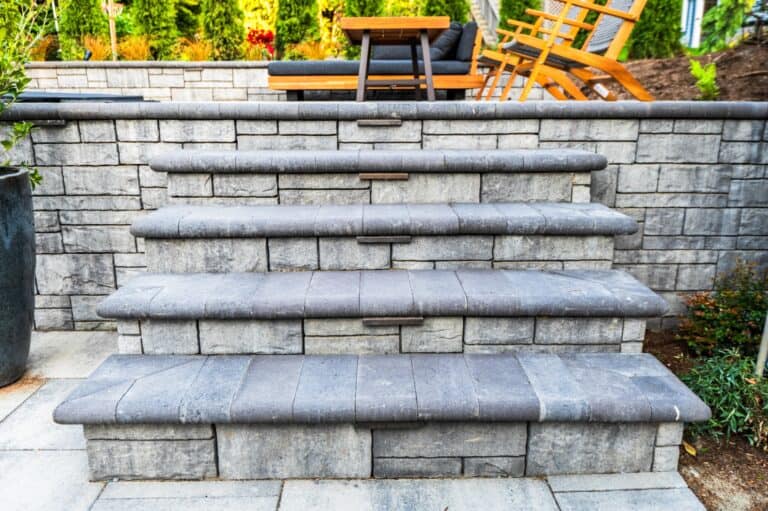
What is being built? Every element should be named and quantified. Not “a patio” but “a 400-square-foot paver patio using [specific paver name], laid in [specific pattern], with [specific edge restraint].” Not “retaining walls” but “approximately 85 linear feet of [specific block or stone type] retaining wall at an average exposed height of 30 inches, including drainage aggregate and perforated pipe behind the wall.”
What site preparation is included? This is where many proposals get thin. Excavation, grading, soil amendment, drainage routing, demolition of existing structures, stump removal, irrigation relocation — these are labor-intensive and expensive. If the scope says “prepare site for patio installation” without specifying what that means, you have no way to know whether excavating 6 inches of clay soil and hauling it off-site is included or whether that will surface as an additional charge once the crew breaks ground.
What is specifically excluded? We will cover this in detail below, but the scope section should at minimum reference the exclusions — making it clear that the scope has a defined boundary.
In Classic’s experience across more than 3,000 Seattle-area projects, the scope of work is where the gap between a thorough proposal and a vague one becomes most visible. A detailed scope protects you. A vague one protects the contractor’s ability to charge more later.
How Specific Should Material Specifications Be?
Very specific. Material specifications are where you find out whether you are comparing equivalent proposals or comparing a premium installation against a budget one that happens to use the same category words.
Here is what to look for:
Hardscape materials should specify the manufacturer, product line, color, size, and thickness. “Natural stone” tells you almost nothing. “Belgard Mega-Lafitt in Victorian, 3-piece pattern, 60mm thickness” tells you exactly what will be on your property. The difference matters because material costs can vary by 40–60% within the same general category. Two proposals that both say “paver patio” may be describing installations that differ by thousands of dollars in material quality alone.
Plants should be specified by botanical name, container size, and quantity. “Assorted shrubs” is not a specification. “Sarcococca confusa, 3-gallon, qty. 12″ is. Container size matters enormously — a 1-gallon shrub and a 5-gallon shrub are the same species but different price points, different visual impact at installation, and different timelines to maturity. On properties where clay soils and heavy tree canopy create specific growing conditions, the right cultivar selection is not decorative — it determines whether the plant thrives or struggles within the first two years.
Soil and base materials should specify type and depth. For any paver installation in Seattle’s clay-heavy soils, the gravel base depth and compaction method directly affect long-term performance. A proposal that specifies “6-inch compacted crushed rock base with 1-inch leveling course of concrete sand” is telling you something materially different from one that says “prepare base for paver installation.”
Fixtures and features — lighting, irrigation heads, water features, fire features — should include manufacturer, model, finish, and quantity. These are items where the spread between a commercial-grade fixture and a builder-grade alternative is substantial, and where the difference in longevity is even more so.
If a proposal uses generic material language, it is not necessarily a red flag — but it is an open question. Ask the contractor to specify. A company confident in its material selections will name them. One that resists specificity may be preserving flexibility to substitute lower-cost alternatives during construction.
Why Is the Exclusions Section the Most Important Part?
Because the exclusions section defines the negative space of the proposal — everything the contractor is not responsible for, not including in the price, and not guaranteeing. A proposal without a clear exclusions section is not more generous; it is more ambiguous.
Common exclusions in Seattle-area landscape proposals include:
- Permit fees and engineering. Some proposals include permit acquisition in their scope; others list it as an exclusion. Both approaches are legitimate, but you need to know which one you are looking at, because permit and engineering costs on Greater Seattle properties — particularly in Bellevue, Kirkland, and Sammamish — can be significant for projects involving retaining walls over four feet, work in critical areas, or substantial regrading.
- Unforeseen subsurface conditions. No contractor can guarantee what lies beneath your soil until excavation begins. Buried concrete, abandoned utility lines, contaminated fill, rock — these are legitimate unknowns. A reputable proposal will name these as potential change order triggers rather than padding the base price to cover every possible scenario.
- Utility relocation. If an irrigation main, gas line, or electrical conduit runs through the project area and needs to be moved, that is typically handled by the utility provider or a licensed specialist, not the landscape contractor. The proposal should say so.
- Tree removal or protection beyond the project footprint. Particularly relevant on wooded lots where significant trees may have root zones extending into the work area. Arborist assessments, tree protection fencing, and root zone management are either included or excluded — the proposal should state which.
- HOA approval. If your property is governed by a homeowners’ association, obtaining design approval is typically the homeowner’s responsibility. The proposal should note this if applicable.
Read the exclusions section line by line. Every item listed is something the contractor has thought about and explicitly placed outside the project boundary. A long exclusions section is not a warning — it is a sign that the company has done enough projects to know where scope ambiguity causes problems.
A short or missing exclusions section, on the other hand, raises a question: did the contractor think about these items and include them in the price, or did they simply not think about them?
How Should Change Orders Work?
Change orders are modifications to the original agreed scope. They are normal. They are not, by themselves, a sign of a problematic contractor or a flawed proposal. What matters is how the proposal defines the process for handling them.
Pricing in a professional landscape proposal is fixed on the agreed scope of work. The price you see is the price you pay — for exactly what is described in the scope and material specifications. Change orders arise in two situations:
You change the scope. Mid-project, you decide you want the patio extended by 80 square feet, or you want to upgrade the lighting package, or you want to add a fire pit that was not in the original design. These are owner-initiated changes. A good proposal specifies that scope changes will be documented in writing, priced before work begins, and approved by the homeowner before the crew proceeds.
Unforeseen conditions emerge. The crew excavates and discovers an abandoned concrete foundation 18 inches below grade, or the soil test reveals fill material that cannot support the designed retaining wall without additional engineering. These are not failures of planning — they are realities of working with land. The proposal should explain how unforeseen conditions are communicated, documented, and priced.
What to watch for: a proposal that includes language like “price subject to change based on site conditions” without defining what triggers a change or what process governs it. That is not a change order clause — it is an open-ended price adjustment mechanism. A clear change order process protects both sides. It gives the homeowner predictability and gives the contractor a legitimate path to address real issues without absorbing costs that were never part of the agreement.
What Should the Timeline Section Tell You?
The timeline section should give you a realistic project schedule, not a best-case fantasy. In Seattle, where weather affects nearly every phase of outdoor construction, a credible timeline accounts for seasonal realities.
Look for:
- A start window, not a fixed start date. “Construction begins the week of [date], weather permitting” is more honest than “construction begins [date].” Rain delays are not optional in western Washington.
- Phased milestones. A project that involves demolition, excavation, hardscape installation, irrigation, planting, and lighting does not happen all at once. The timeline should indicate the general sequence and approximate duration of each phase.
- Completion estimate with a range. “Estimated 4–6 weeks for construction, depending on weather” is realistic for a mid-range Greater Seattle project. A single fixed number (“done in 3 weeks”) deserves scrutiny — either the project is simpler than you think, or the timeline is more optimistic than it should be.
- Planting season considerations. If your project includes significant plantings, the proposal may note that installation is timed to coincide with optimal planting windows. In the Puget Sound region, fall planting (September through November) gives roots time to establish before summer stress. A contractor who schedules a major planting installation for July without acknowledging the watering implications is either planning to manage it or has not thought about it.
What Does the Payment Schedule Reveal About the Contractor?
The payment structure tells you how the contractor manages cash flow — and how much risk they are asking you to absorb.
A milestone-based payment schedule is the standard for reputable landscape companies. Payments are tied to completed work: a deposit upon signing, a payment when demolition and site preparation are complete, a payment when hardscape is installed, a payment when planting is finished, and a final payment upon project completion and walkthrough.
What to question:
- A deposit exceeding 10–15% of the project total — or any request for 50% upfront. Large upfront deposits may indicate cash flow problems. A well-capitalized company does not need your project deposit to buy materials for the project before yours.
- Payments that precede the work they correspond to. If the schedule asks for the hardscape payment before hardscape materials are on-site, that is an asymmetric risk allocation.
- No holdback or final payment. A final payment of 5–10% tied to a completion walkthrough gives you leverage to ensure punch-list items are addressed. If the full payment is collected before the last plant goes in the ground, your negotiating position weakens.
What Should the Warranty Section Cover?
The warranty section defines the contractor’s obligations after the crew leaves your property. In Seattle’s market, a complete warranty covers three categories:
Workmanship. The contractor stands behind the quality of their installation — paver settling, wall movement, drainage function, grading performance. The duration varies, but one to two years is common for hardscape workmanship among established companies.
Plant material. A one-year plant guarantee is the standard among reputable Seattle-area landscape companies. This means that if a plant fails within one year of installation — assuming the homeowner has followed the provided watering and care instructions — the contractor replaces it. Classic Landscaping’s one-year plant guarantee is consistent with this industry standard. Shorter guarantees or no plant guarantee at all should prompt a direct question: where are the plants being sourced, and what installation practices are being used?
Manufacturer warranties. Lighting fixtures, irrigation components, and hardscape materials carry their own manufacturer warranties. A thorough proposal either lists these or notes that manufacturer warranty documentation will be provided at project completion.
What the warranty does not cover is equally important. Normal settling, damage from owner modifications, failure to follow maintenance instructions, acts of nature — these are standard exclusions from most landscape warranties, and listing them is a sign of transparency, not stinginess.
How Do You Spot a Low-Ball Quote Disguised as a Competitive Price?
Not every low price is a low-ball. Some projects genuinely cost less because the scope is smaller, the site is simpler, or the materials are more modest. The question is whether the price reflects the full cost of what you are being promised.
Signs that a proposal may be incomplete rather than competitive:
- Vague scope + low price. If the scope is described in general terms and the price is significantly below other proposals for the same project, the contractor may be pricing a smaller version of what you discussed — leaving the difference to emerge as change orders.
- No material specifications. A low price with “TBD” or generic material descriptions means you do not actually know what you are buying. You cannot compare a number without knowing what the number includes.
- Missing exclusions. If the proposal does not list exclusions, you have no way to know whether the price includes site preparation, drainage, permit work, or any number of items that other proposals list explicitly.
- No change order process. Without a defined process for scope changes and unforeseen conditions, a low initial price can adjust upward without a clear mechanism for your approval.
- Verbal promises. “We’ll take care of that” without corresponding language in the proposal is not a commitment. If it matters, it should be in writing. If a contractor is unwilling to put a verbal commitment into the proposal, that is information worth noting.
The most reliable way to evaluate a proposal is not to compare bottom-line numbers across contractors — it is to compare what each number includes. Two proposals at $75,000 and $95,000 may describe the same project, or they may describe fundamentally different projects. The sections above give you the framework to tell the difference.
What Questions Should You Ask After Reading a Proposal?
Once you have read the full proposal, come back with questions on anything that is unclear. No reputable contractor will be bothered by a homeowner who reads carefully and asks directly. Some starting points:
- “Can you specify the exact materials for [vague section]?”
- “What triggers a change order, and what is the approval process?”
- “What happens if the project runs past the estimated timeline?”
- “Is [specific item you discussed verbally] included or excluded?”
- “What does the plant guarantee require from me in terms of care?”
- “Who is my point of contact during construction, and how are issues communicated?”
These are not adversarial questions. They are the questions that lead to a clear agreement — which is what both a good homeowner and a good contractor want. If you are comparing proposals from multiple landscape companies in the Seattle area, asking each company the same set of questions will reveal more about their process and professionalism than the price alone ever could.
If this guide has helped clarify what to look for and you are evaluating a design-build project in Greater Seattle, Classic Landscaping is happy to walk through our proposal format in detail during any consultation. Our goal — regardless of whether you hire us — is that you go into your project with a clear understanding of what you are agreeing to and what you can expect.