- In Seattle's clay soils and 37 inches of annual rain, the base preparation under your patio matters more than the surface material — a minimum 6-inch compacted gravel base is non-negotiable regardless of what you put on top.
- Concrete pavers offer the best balance of performance, design flexibility, and repairability for most Greater Seattle residential patios — plan on $18–$45 per square foot installed depending on quality tier.
- Natural stone (basalt, bluestone, flagstone) costs more upfront but ages better, provides excellent wet traction, and can last decades-to-centuries — local basalt is the most cost-effective option at $20–$35/sq ft installed.
- Poured concrete is the most affordable option ($10–$25/sq ft) but will crack in Seattle's clay soils — the question is when and where, not whether. Stamped concrete can become dangerously slick when wet.
- Moss and algae will colonize any patio surface in Seattle's climate — polymeric sand in paver joints slows it down, but annual maintenance is part of the deal regardless of material.
- Permeable pavers cost 15-25% more than standard pavers but may qualify for King County stormwater incentives and are worth considering where stormwater management is a priority.
The material you choose for a Seattle patio matters more than it would in most climates. We get 37 inches of rain per year, most of it between October and April. Your patio surface will be wet more days than it’s dry. It needs to handle freeze-thaw cycles between November and February, resist the moss and algae that thrive in our cool, damp conditions, and hold up against the naturally acidic soil and rainfall (pH 5.0–6.0) that slowly degrades certain materials. After installing hundreds of patios across Bellevue, Kirkland, Redmond, Woodinville, and Sammamish, we’ve seen how each major material performs over 5, 10, and 20 years in these conditions — and the differences are significant.
Here’s an honest comparison of the three most common patio materials in the Seattle area, with the trade-offs that matter in practice.
How do concrete pavers perform in Seattle's climate?
Concrete pavers are the most popular patio material in Greater Seattle, and for good reason. They’re manufactured under controlled conditions to produce a dense, consistent product engineered for performance rather than relying on natural stone’s variable characteristics.
What works well
Wet traction. The textured surface and joint lines between pavers provide natural grip, even after a November downpour. This matters — a smooth surface that becomes dangerously slick when wet is a liability when your patio is wet for 200+ days per year.
Freeze-thaw resistance. Quality concrete pavers are rated for thousands of freeze-thaw cycles. Because they’re individual units, they can flex slightly with ground movement rather than cracking like a monolithic slab. Greater Seattle’s freeze-thaw pattern — temperatures that hover around freezing and cycle back and forth between November and February — is well within their performance range.
Repairability. If a single paver cracks, stains, or settles, you can remove and replace it without disturbing the rest of the patio. Try doing that with poured concrete or a mortared stone installation.
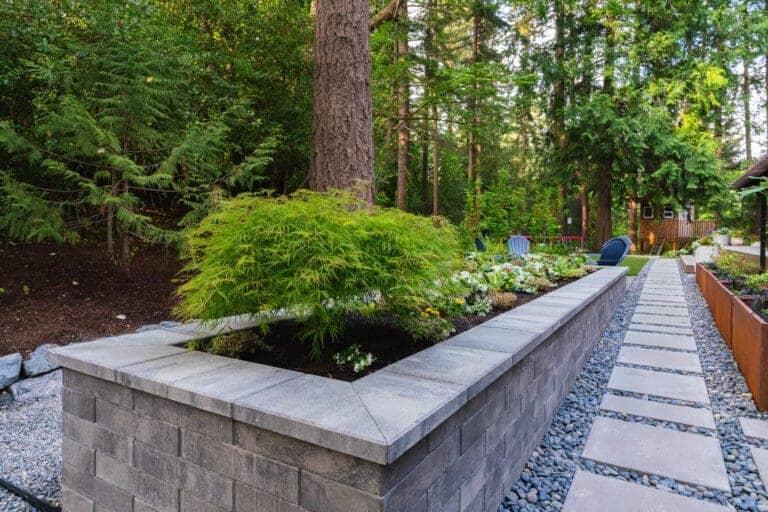
Design versatility. Running bond, herringbone, basketweave, random patterns, border accents, color mixing — pavers offer more layout options than any other material. For the Bellevue raised patio project in our portfolio, slate pavers allowed us to create a seamless transition between the main patio, the hot tub surround, and the fire pit area on different levels.
What to watch for
Moss in the joints. This is unavoidable in Seattle. Polymeric sand helps — it hardens between joints and inhibits growth — but you’ll still need to sweep or pressure-wash joints every 1-2 years, particularly on north-facing patios and areas under tree canopy.
Efflorescence. A white, chalky residue that appears on the surface during the first wet season. It’s calcium carbonate leaching from the concrete as water passes through it. It’s cosmetic, not structural, and typically fades within 12-18 months. Some homeowners find it alarming, but it’s a normal characteristic of concrete products, not a defect.
Color fading. Pigmented concrete pavers can fade over time with UV exposure. Premium manufacturers (Belgard, Pavestone, Tremron) use through-body coloring rather than surface application, which significantly improves color retention. The cheapest pavers use surface color only and will show noticeable fading within 3-5 years.
Cost range
Standard concrete pavers: $18–$30 per square foot installed, depending on pattern complexity and base preparation. A 300-square-foot patio runs $5,400–$9,000.
Premium pavers (textured, tumbled, or specialty finishes): $28–$45 per square foot installed. A 300-square-foot patio runs $8,400–$13,500.
These prices include the full installation: excavation, compacted gravel base (minimum 6 inches in our clay soils — this is non-negotiable), sand setting bed, pavers, polymeric sand, and edge restraints.
How does natural stone perform in Seattle?
Natural stone patios — flagstone, bluestone, basalt, slate — bring an organic, timeless aesthetic that’s difficult to replicate with manufactured products. In our experience, homeowners who choose natural stone tend to be making a long-term investment in a material that looks better with age rather than worse.
The most common natural stones in Seattle
Flagstone (sandstone or quartzite). The classic irregularly shaped flat stone. Comes in a range of earth tones — buff, brown, red, grey. The cleft surface provides excellent traction when wet. Sandstone-based flagstone is more porous and susceptible to moss; quartzite flagstone is denser and more resistant.
Bluestone. Dense, fine-grained sandstone with a distinctive blue-grey color that deepens when wet. Performs well in our climate — it’s dense enough to resist significant freeze-thaw damage and its natural surface provides good wet traction. It’s the premium choice for a refined, slightly formal look.
Basalt. Locally sourced from Washington state, which means lower material costs and a stone that’s naturally suited to our environment. Extremely dense — handles freeze-thaw without issue and resists moss better than most natural stones. The dark grey-to-black color works well with the Pacific Northwest palette. It’s what we see in the natural landscape here, which is why it looks native rather than imported.
Slate. Dense, layered stone with a dramatic appearance. We used it extensively in both our Bellevue raised patio project and our Kenmore lakeview remodel. It handles water well and its layered texture provides natural grip. The trade-off: some slate varieties can delaminate (layers separating) after repeated freeze-thaw cycles, so sourcing matters.
What works well
Ages gracefully. Natural stone develops a patina over time that many homeowners find more attractive than the day it was installed. Moss growing in the joints of a flagstone patio gives it a character that pavers can’t replicate — and in Seattle, that moss is going to arrive whether you invite it or not.
Naturally slip-resistant. The irregular, cleft surfaces of most natural stones provide excellent wet traction — an important quality for a patio that’s wet for the majority of the year.
Durability. Dense natural stones (basalt, bluestone, quality slate) will outlast any manufactured product. They don’t fade, they don’t chip the way concrete can, and their structural integrity is measured in decades-to-centuries, not years.
What to watch for
Cost. Natural stone costs more than concrete pavers — both the material itself and the installation labor. Each stone is unique, which means the installer must select, cut, and fit individual pieces rather than laying uniform units. This is skilled work and it takes longer.
Thickness variation. Natural stone isn’t a uniform thickness. The base preparation must accommodate this variation, either through a thicker setting bed or by individually adjusting the base height for each stone. Installers who treat natural stone like uniform pavers produce surfaces that are uneven and collect water in low spots.
Porosity. Softer natural stones (some sandstones, certain slates) absorb water, which makes them more susceptible to freeze-thaw damage, staining from tannins (a real concern under conifer and deciduous tree canopy in Greater Seattle), and moss colonization. Sealing can help but adds maintenance cost.
Sourcing and consistency. Natural stone comes from quarries, and the color, texture, and quality vary by lot. What you see in the showroom may not exactly match what arrives at your property. Working with a supplier who sources from consistent quarries — and an installer who has experience selecting and fitting stone — makes a significant difference.
Cost range
Flagstone (dry-laid on compacted gravel): $25–$40 per square foot installed. A 300-square-foot patio runs $7,500–$12,000.
Flagstone or bluestone (mortared on concrete slab): $35–$55 per square foot installed. A 300-square-foot patio runs $10,500–$16,500.
Basalt: $20–$35 per square foot installed (lower material cost due to local sourcing). A 300-square-foot patio runs $6,000–$10,500.
Flagstone (dry-laid on compacted gravel): $25–$40 per square foot installed. A 300-square-foot patio runs $7,500–$12,000.
Need Help Choosing Materials?
Our team knows which plants and materials perform best in Seattle's climate.
Schedule a ConsultationHow does poured concrete perform in Seattle?
Poured concrete — either plain, stamped, or exposed aggregate — is the most affordable option per square foot. It produces a clean, uniform surface that appeals to homeowners who prefer a modern or minimalist aesthetic. But it has limitations in our climate that are worth understanding before committing.
What works well
Cost. It’s the least expensive hard-surface patio material, which makes it the right choice for homeowners who want a durable surface without a significant design investment.
Clean lines. Poured concrete produces the sharpest edges and most uniform surfaces of any patio material. For modern or contemporary landscapes, that geometric precision is the aesthetic.
Versatility. Concrete can be colored, stamped to mimic stone or brick patterns, or finished with exposed aggregate for added texture. It can be poured to virtually any shape.
What to watch for — and this is important
Cracking. This is the single biggest issue with poured concrete in Seattle. Concrete cracks. It’s not a question of if — it’s a question of when and where. Proper control joints (cuts in the surface that guide where cracks form) can direct cracking to planned locations, but they can’t prevent it entirely. In our clay soils, where the ground expands when wet and contracts when dry, the movement beneath a concrete slab is constant. After 5-10 years, most concrete patios in Greater Seattle show at least minor cracking beyond the control joints.
Repair difficulty. Unlike pavers or dry-laid stone, a cracked concrete slab can’t be repaired invisibly. Patching is always visible. If a section settles or cracks badly, the typical remedy is to remove and repour that section — which is expensive and the new pour will never perfectly match the aged original.
Slip hazard when smooth. Standard broom-finished concrete is reasonably slip-resistant when new. Stamped concrete, however, often develops a slick surface when wet — particularly if the sealer used has a glossy finish. In a climate where the surface is wet for 200+ days per year, this is a meaningful safety concern. We’ve been called to add anti-slip treatment to stamped concrete patios installed by other companies where the homeowner found the surface dangerous when wet.
Heaving and settling. A concrete slab is a rigid monolith. When the ground beneath it moves — and in clay soils, it will — the slab can’t flex. It either cracks through or heaves (sections lifting relative to adjacent sections, creating tripping hazards). The severity depends on base preparation. In our clay soils, a minimum 6-inch compacted gravel base is essential, but even with proper base prep, movement over time is likely.
Cost range
Standard broom-finish concrete: $10–$18 per square foot installed. A 300-square-foot patio runs $3,000–$5,400.
Stamped or colored concrete: $15–$25 per square foot installed. A 300-square-foot patio runs $4,500–$7,500.
Exposed aggregate: $14–$22 per square foot installed. A 300-square-foot patio runs $4,200–$6,600.
What about permeable pavers?
Permeable pavers deserve a separate mention because they address a specific concern that’s increasingly relevant in King County: stormwater management. These pavers are designed with wider joints filled with aggregate rather than polymeric sand, allowing rainwater to percolate through the surface and into a gravel reservoir below rather than running off.
King County’s stormwater regulations have tightened in recent years, and some jurisdictions offer incentives or reduced stormwater fees for properties that install permeable surfaces. The RainWise program may apply to qualifying installations.
The trade-off: Permeable pavers cost 15-25% more than standard pavers due to the deeper gravel reservoir required beneath them. They also require periodic maintenance — the aggregate in the joints must be topped up and the surface vacuumed annually to prevent fine particles from clogging the system.
In our experience, permeable pavers make the most sense for driveways and walkways where stormwater management is a regulatory requirement or a priority for the homeowner. For patios, standard pavers with proper drainage around the perimeter typically handle water management more cost-effectively.
So which material should you choose?
There’s no single best answer — the right choice depends on your budget, your aesthetic preference, your tolerance for maintenance, and the specific conditions of your property. But here’s how we’d frame the decision after installing hundreds of each:
Choose concrete pavers if: You want the best balance of durability, design flexibility, repairability, and cost. Pavers are the workhorse of Greater Seattle patios — they perform reliably in our climate, they can match nearly any design aesthetic, and if something goes wrong, the fix is straightforward. For most residential projects in the $15,000–$50,000 range, pavers are where we start the conversation.
Choose natural stone if: You’re making a long-term investment and value a material that ages with character. You prefer an organic, one-of-a-kind look over manufactured uniformity. You’re comfortable with a higher upfront cost and don’t mind that moss in the joints is a feature, not a bug. For projects in the $40,000+ range where aesthetics are the primary driver, natural stone rewards the investment.
Choose poured concrete if: Budget is the primary constraint and you want a clean, functional surface without a significant design investment. Understand that cracking and repair limitations are part of the deal in our climate, and plan for a 15-20 year lifespan before significant maintenance is needed.
Consider combining materials. Some of our strongest patio designs use two materials together — a paver field with a natural stone border, or a poured concrete base with stone accents. This can reduce cost while preserving the design impact of premium materials.
Whatever you choose, the base preparation matters more than the surface material. In Seattle’s clay soils, a properly compacted 6-inch gravel base with adequate drainage is what determines whether your patio performs for 5 years or 25. We’ve seen beautiful stone patios fail in 3 years because the base was inadequate, and modest paver patios hold up for decades because the base was done right. The surface gets the attention, but the base does the work.
The Bottom Line
There’s no single best answer — the right choice depends on your budget, your aesthetic preference, your tolerance for maintenance, and the specific conditions of your property. But here’s how we’d frame the decision after installing hundreds of each:
Choose concrete pavers if: You want the best balance of durability, design flexibility, repairability, and cost. Pavers are the workhorse of Greater Seattle patios — they perform reliably in our climate, they can match nearly any design aesthetic, and if something goes wrong, the fix is straightforward. For most residential projects in the $15,000–$50,000 range, pavers are where we start the conversation.
Choose natural stone if: You’re making a long-term investment and value a material that ages with character. You prefer an organic, one-of-a-kind look over manufactured uniformity. You’re comfortable with a higher upfront cost and don’t mind that moss in the joints is a feature, not a bug. For projects in the $40,000+ range where aesthetics are the primary driver, natural stone rewards the investment.
Choose poured concrete if: Budget is the primary constraint and you want a clean, functional surface without a significant design investment. Understand that cracking and repair limitations are part of the deal in our climate, and plan for a 15-20 year lifespan before significant maintenance is needed.
Consider combining materials. Some of our strongest patio designs use two materials together — a paver field with a natural stone border, or a poured concrete base with stone accents. This can reduce cost while preserving the design impact of premium materials.
Whatever you choose, the base preparation matters more than the surface material. In Seattle’s clay soils, a properly compacted 6-inch gravel base with adequate drainage is what determines whether your patio performs for 5 years or 25. We’ve seen beautiful stone patios fail in 3 years because the base was inadequate, and modest paver patios hold up for decades because the base was done right. The surface gets the attention, but the base does the work.