- Site preparation and subsurface systems are about 40 percent of project cost and the most common point of failure when underbuilt. The visible elements get most of the attention; the invisible ones determine longevity.
- Drainage is the single most-skipped system on DIY projects. Clay soils don't drain on their own — every retaining wall, every patio, every bed needs a drainage strategy.
- Construction sequence is non-negotiable. Subsurface utilities go in before hardscape; rough-in before finish; softscape after hardscape. Reordering creates rework.
- Material selection drives 2–3x swings on the same square footage. Pavers vs. natural stone, cedar vs. composite, segmental block vs. engineered walls.
- Site access often costs more than the materials. Tight gates, no truck staging, and hand-carry add 30–50 percent to hardscape labor on many older Greater Seattle neighborhoods.
- Cost ranges: $15K–$50K for targeted enhancements, $50K–$150K for backyard transformations, $150K–$500K+ for whole-property design-build.
Landscape construction is the work that happens before the plants go in — and most of what determines whether a finished landscape lasts a decade or starts failing in three years. The visible elements are the patio, the retaining wall, the lighting, the irrigation, the trees and beds. The invisible elements — base preparation, drainage, soil amendment, utility routing — are usually where the project succeeds or fails.
This article walks through the major construction elements we install on Greater Seattle design-build projects in Bellevue, Kirkland, Redmond, and Sammamish. The goal isn’t to give you an exhaustive textbook list — there are plenty of those online. The goal is to show how the elements interact on a real Pacific Northwest property, where the typical cost falls, and which decisions drive most of the budget.
What does “landscape construction” actually include?
Landscape construction breaks into four buckets. Most projects involve some mix of all four.
- Hardscape — anything not living. Patios, walkways, retaining walls, fences, fire features, water features, outdoor kitchens, decks, structures.
- Softscape — anything living. Trees, shrubs, perennials, ground covers, lawns, garden beds.
- Subsurface systems — what runs underground. Drainage, irrigation, electrical conduit for lighting, gas lines, sometimes plumbing.
- Site preparation — what happens before any of the above. Demolition, grading, excavation, soil amendment, base preparation.
The mistake homeowners make most often is thinking of landscape construction as a sum of visible elements. The visible elements are about 60 percent of the cost. The site preparation and subsurface systems are the other 40 percent — and skipping or underbuilding them is the most common cause of failure we get called to repair.
What hardscape elements come up on most Greater Seattle projects?
Across our project portfolio, these are the hardscape elements that show up most often.
Paver patios
The most common single hardscape element. Concrete pavers from Belgard, Mutual Materials, and Pavestone dominate the residential market. Natural stone (basalt, bluestone, flagstone) is the upgrade option.
What matters in our climate: the base preparation. On clay soils, a 6-inch (minimum) compacted angular gravel base is the line between a patio that lasts and a patio that settles. We compact in 4-inch lifts with a plate compactor and use polymeric sand on the joints. Pea gravel base is the most common DIY mistake — it doesn’t lock together and it migrates over time.
Patio costs: $25–$45 per square foot for standard concrete pavers installed; $45–$80+ for natural stone.
Retaining walls
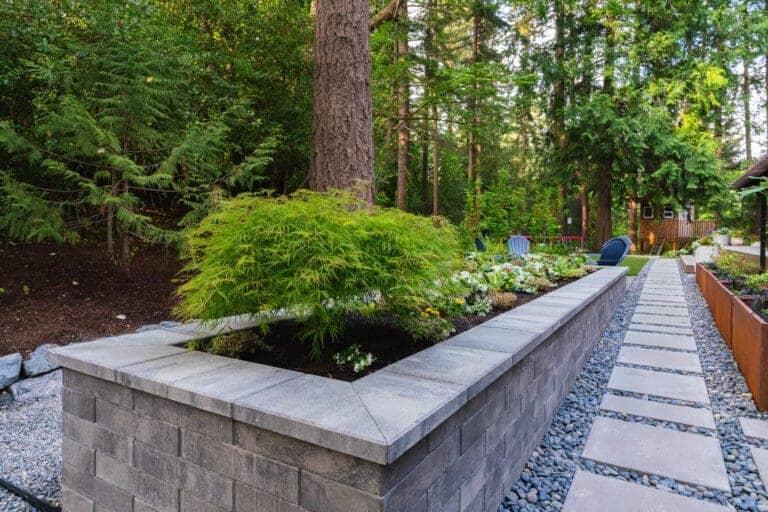
Almost every sloped Greater Seattle lot needs at least one. The typical materials are segmental concrete block (Allan Block, Versa-Lok, Belgard), poured concrete, or natural stone.
The non-negotiable on our climate: drainage behind the wall. Perforated drain pipe at the base, drainage gravel backfill, geotextile fabric to keep soil out of the gravel. We’ve inspected too many DIY walls that look fine the first summer and bow out by the third winter because water had nowhere to go.
For walls over 4 feet tall, most King County jurisdictions require an engineered design and permit.
Retaining wall costs: $40–$80 per square face foot for segmental block; $100–$200+ for natural stone or engineered walls.
Fences and gates
Cedar is the climate-appropriate default for Pacific Northwest fences. Western red cedar handles our wet winters with minimal maintenance and ages to a silver-gray that most homeowners find acceptable. Pressure-treated pine is cheaper but less attractive. Composite fencing (Trex and similar) is increasingly common but has trade-offs in heat retention and aesthetic.
Cedar fence costs: $30–$60 per linear foot for standard 6-foot privacy fencing; $80–$150+ for custom designs with horizontal slats, pillars, or premium hardware.
Decks
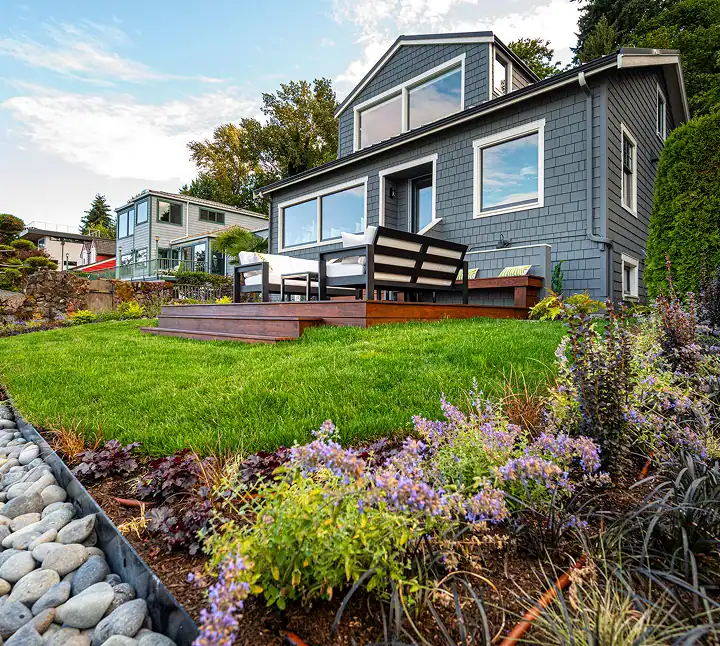
Where elevation change makes a patio impractical, decks fill in. Cedar, ipe, and composite (Trex, TimberTech, Fiberon) are the dominant materials. Pressure-treated framing is universal.
Trade-offs in our climate: cedar greys quickly and needs annual cleaning to manage moss. Ipe is the most durable but expensive. Composite eliminates the maintenance but can read as plastic and gets hot in summer sun.
Deck costs: $40–$80 per square foot for cedar; $50–$100 for composite; $80–$150+ for ipe.
Fire features
Built-in fire pits and outdoor fireplaces. Critical detail in our climate: refractory firebrick liners inside any concrete or paver shell, drainage in the base to prevent freeze damage, and proper setbacks per local fire marshal codes (typically 25 feet from structures).
Fire pit costs: $5,000–$15,000 for a built-in concrete paver pit; $15,000–$50,000+ for full outdoor fireplaces or custom natural stone designs with chimneys.
Water features
Pondless waterfalls, formal fountains, and pond installations. Our most common application is a pondless waterfall that recirculates water into a hidden basin — lower maintenance than a pond, no fish to overwinter, and the water sound carries across the yard.
Water feature costs: $4,000–$10,000 for a small pondless waterfall; $15,000–$50,000+ for koi ponds or large multi-element water features.
Outdoor kitchens
Range from a built-in grill island to full kitchens with refrigeration, sinks, and pizza ovens. The infrastructure consideration in our climate is freeze protection — water lines need to be designed for winterization, and gas lines need proper trenching depth.
Outdoor kitchen costs: $8,000–$25,000 for a basic grill-and-counter island; $40,000–$120,000+ for full outdoor kitchens with appliances, plumbing, gas, and architectural features.
What softscape elements come up on most Greater Seattle projects?
Trees
Anchor plantings that set the long-term character of a landscape. Common Greater Seattle choices: Japanese maple, vine maple, Cornus kousa dogwood, Stewartia, native conifers for screening (western red cedar, Douglas fir for larger lots).
Tree installation costs: $300–$1,500 per tree depending on size, species, and access difficulty.
Shrubs and perennials
The mid-layer that fills the bed structure. Reliable PNW performers include hydrangea (especially ‘Limelight’ and ‘Annabelle’), Pieris japonica, hellebores, Heuchera, hardy fuchsia, native vine maple as a shrub form.
Ground covers
The edge layer that finishes a bed. Sword fern and salal are the native workhorses. We avoid English ivy and vinca due to noxious weed concerns documented by the Washington State Noxious Weed Control Board.
Lawns and lawn alternatives
Where a lawn is wanted, we install fine fescue blends that handle PNW shade and moisture better than Kentucky bluegrass. Where lawn isn’t necessary, we propose alternatives — clover lawns, microclover blends, low-mow meadow mixes — that cut maintenance cost and water use.
Garden beds and mulch
Bed prep involves grade adjustment, soil amendment (compost, occasionally sand for drainage), and steel or stone edging. Mulch is fir bark or arborist chips — typically 2–3 inches for new beds, refreshed annually.
What systems run beneath the landscape?
Drainage
The most important system on most Greater Seattle projects. Clay soils don’t drain on their own. A typical residential project includes:
- Surface drainage — grading slopes water away from the house and toward catch points
- Subsurface drainage — French drains, area drains, downspout extensions
- Wall drainage — perforated pipe behind every retaining wall
- Connection to dispersal — typically a daylight outflow where grade allows, or a drywell or rain garden where it doesn’t
Drainage is the system most often underbuilt on DIY projects and the most common cause of failure across hardscape and softscape both.
This is where earns its premium — sequencing drainage, subsurface utilities, hardscape, and plantings as one project under one contract avoids the costly rework that happens when separate trades guess at each other’s intent.
Irrigation
Drip irrigation for beds, conventional spray heads or rotary nozzles for lawns. Smart controllers (Hunter, Rain Bird, Rachio) tied to weather data have become standard — they cut water use 20–40 percent compared to fixed schedules.
Irrigation costs: $2,000–$8,000 for a typical Greater Seattle residential install depending on zone count and complexity.
Outdoor lighting
Low-voltage LED on hardwired transformers, not solar. Path lights, uplights on specimen trees, downlights from structures, occasional task lighting at outdoor kitchens or stairs.
Outdoor lighting costs: $1,500–$8,000 for residential installs; $10,000+ for elaborate multi-zone systems on larger lots.
Gas lines
For fire pits, outdoor kitchens, and patio heaters. Always permitted, always installed by licensed plumbers, always pressure-tested before backfill.
What’s the typical sequence of construction?
Order matters. Skipping or rearranging the sequence creates rework.
- Demolition and clearing — remove existing hardscape, dead plantings, surface debris.
- Rough grading — establish the major elevations and drainage paths.
- Subsurface utilities — drainage trenches, gas lines, electrical conduit, irrigation main lines. Anything that runs underground goes in before hardscape covers it.
- Hardscape rough-in — base preparation, retaining walls, structural elements.
- Hardscape finish — paver installation, cap stones, joint sand, sealing.
- Softscape installation — bed prep, soil amendment, plant installation, mulch.
- Final systems commissioning — irrigation testing, lighting commissioning, drainage hose-test under flow.
- Walk-through and adjustments — inspect with the homeowner, address punch-list items, document warranty and care.
The construction sequence on a typical Greater Seattle design-build project runs 4–12 weeks depending on scope, weather, and permitting.
What drives the cost on Greater Seattle construction projects?
Three variables drive most of the budget swing.
Site access. Tight access — narrow side gates, no truck staging, hand-carry of materials — adds 30–50 percent to labor on hardscape work. We see this often in older Greater Seattle neighborhoods (Bellevue, Kirkland, parts of Redmond) where lot lines and gates were built before modern equipment was the norm.
Soil and grading conditions. Clay soils require more drainage infrastructure than sandy soils. Steep slopes require more retaining and engineering than flat lots. Existing failed work (collapsing walls, settled patios, abandoned drainage) requires demolition and disposal before new work starts.
Material selection. Concrete pavers vs. local basalt vs. imported natural stone can swing the materials cost by 2–3x for the same square footage. Cedar fencing vs. premium horizontal-slat custom designs can swing 3–5x.
What does a complete landscape construction project cost?
Across our Greater Seattle design-build portfolio:
- Targeted enhancements (one major hardscape element + supporting softscape): $15,000–$50,000
- Full backyard transformation (patio + retaining + plantings + lighting + irrigation): $50,000–$150,000
- Whole-property design-build (front + back, hardscape + softscape + structures): $150,000–$500,000+
These ranges reflect our 2026 project numbers across Bellevue, Kirkland, Sammamish, and Redmond. Smaller jurisdictions and tighter sites may run lower; lakefront and large estate sites run higher.