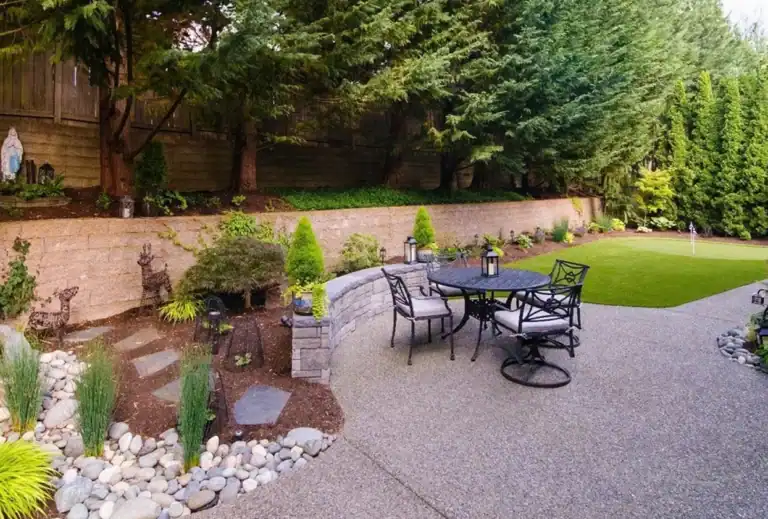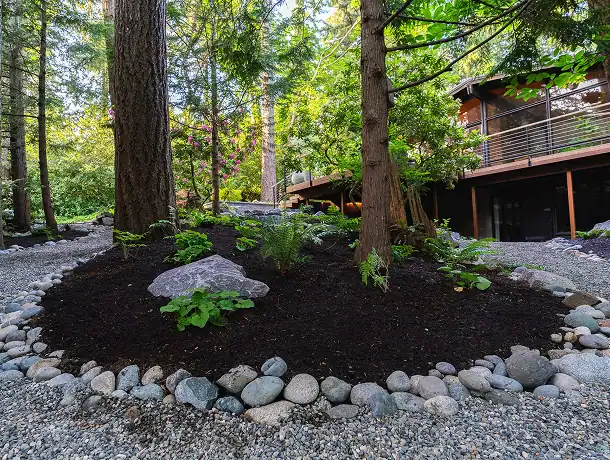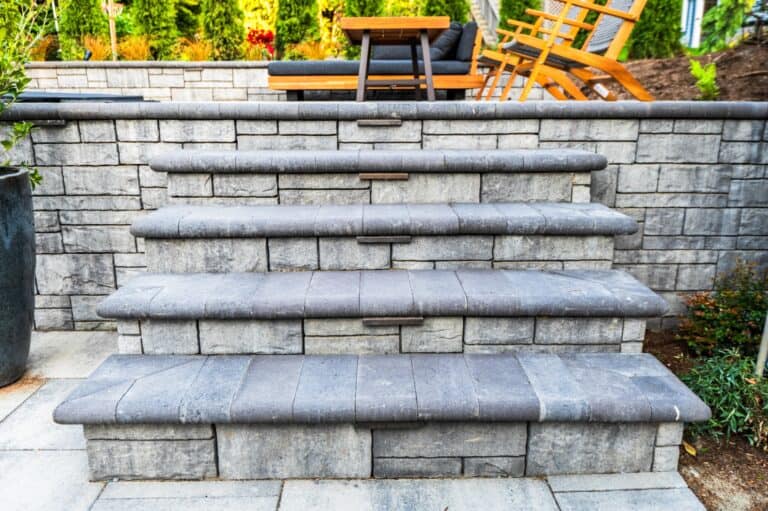
- Residential landscaping operates differently from interior remodeling — site conditions drive scope and cost, which is why responsible companies do not quote over the phone and the first consultation is a detailed site assessment
- A comprehensive design-build project on Seattle's Eastside typically ranges from $50,000 to $150,000+, and the structural work underneath the visible landscape (drainage, grading, bases, irrigation) accounts for a significant portion of that investment
- The timeline from first call to project completion is typically 4 to 8 months — not the 6 to 8 weeks many first-time clients assume — and starting the conversation in fall or winter gets you better scheduling and more design attention
- Comparing landscape proposals requires looking beyond price to specifications, base preparation, drainage provisions, plant sizes, and scope completeness — two bids that look similar on the surface can describe fundamentally different projects
- The budget conversation early in the process protects you, not the company — it ensures design work stays aligned with your actual investment range instead of producing a plan you cannot afford
- New landscapes require significant attention in their first 12 months, and planning for post-installation care during the design phase prevents plant losses and ensures the landscape establishes properly
Why Is Hiring a Landscape Company So Different from Other Home Projects?
When you hire a general contractor for a kitchen, you are typically working from a fixed floor plan with standardized materials and established price points. A landscape project starts with none of that. Your property’s grades, drainage patterns, soil conditions, sun exposure, existing trees, utility locations, and municipal setbacks all influence what can be built, where it can go, and what it costs. Two houses on the same block in Kirkland can have fundamentally different site conditions — one with well-drained sandy loam, the other sitting on compacted glacial till that holds water for days after a rain.
This is why responsible landscape companies do not give meaningful quotes over the phone. The site drives the scope, and the scope drives the cost. A company that gives you a number before visiting your property is either pricing high enough to absorb the unknowns or cutting corners you will pay for later.
### The consultation is not a sales pitch — it is a site assessment
First-time clients often treat the initial consultation like getting a bid on a car repair — show the problem, get a number, compare numbers, choose the lowest. In residential landscaping, the first consultation is closer to a medical intake. The landscape professional needs to understand your goals, walk the property, identify conditions that affect the project, and determine whether your expectations and budget are in the same range as what the site requires. The best consultations are conversations, not presentations.
If a company spends 60 to 90 minutes at your property before talking about price, that is a sign they are doing it right — not a sign they are wasting your time.
What Surprises First-Time Clients the Most About Cost?
The single biggest surprise is the gap between what residential landscaping costs and what first-time buyers assume it costs. For a comprehensive design-build project on the Eastside — one that includes hardscape, plantings, grading, drainage, irrigation, and lighting — the investment typically ranges from $50,000 to $150,000 or more, depending on site complexity and scope. Homeowners who have never been through this before often arrive expecting $15,000 to $30,000, which may cover a portion of the planting plan but not the structural work underneath it.
This is not because companies are overcharging. It is because the visible part of a landscape — the plants, the patio surface, the finished grade — represents only a fraction of the work. Underneath it is drainage infrastructure, compacted gravel bases, engineered retaining walls, irrigation lines, conduit for lighting, soil amendments, and the grading work that makes everything function. West of the Cascades, where clay soils and seasonal rainfall define the conditions, skipping the structural foundation means the visible landscape starts failing within two to three years.
### Why the budget conversation happens early
Good landscape companies bring up budget early in the process — usually during or shortly after the first site visit. This surprises many first-time clients, who feel it is too soon or too personal. But the reasoning is practical, not pushy: landscape design cannot happen in a vacuum. A designer who does not know your investment range might spend weeks developing a $120,000 plan when your comfortable range is $60,000 — or vice versa. Aligning on budget early is not about locking you into a number. It is about making sure the design work stays relevant to what you actually want to invest.
If a company never asks about budget, be cautious. It often means you will receive a proposal built to impress rather than one built to fit your situation.
How Long Does a Landscape Project Actually Take from Start to Finish?
First-time clients almost universally underestimate the timeline. A common assumption is that you call in March, get a design in April, and have a finished yard by Memorial Day. The reality on the Eastside looks more like this:
- Design phase: 4 to 8 weeks from the initial consultation to a finalized plan, depending on scope and revision cycles
- Permitting: 2 to 8 weeks in most Eastside municipalities, longer for projects involving retaining walls over 4 feet, shoreline setbacks, or critical areas. Cities like Kirkland, Bellevue, and Sammamish each have distinct permitting requirements and timelines.
- Scheduling: Once permits are approved and the contract is signed, construction may not begin for another 2 to 6 weeks depending on the company’s current backlog and the season
- Construction: 3 to 12 weeks for most residential projects, depending on scope
A project that begins as a phone call in March realistically breaks ground in July or August — and that assumes no delays in permitting or design revisions. Homeowners who begin the conversation in fall or winter consistently get better scheduling positions and more thoughtful design outcomes, because their designer is not trying to process 40 inquiries simultaneously.
### Seasonality is real and it affects your options
In the Seattle area, landscape company inquiry volume between mid-March and late May typically runs three to four times what it does in October through January. Companies that do quality work are not sitting idle waiting for your call in April. Their project calendars fill months in advance. Starting the conversation earlier — even before you are fully committed — gives you access to more design time, more scheduling flexibility, and often a calmer, more collaborative process.
What Should You Prepare Before Your First Consultation?
You do not need to arrive with a finished plan. You do not need to know which plants you want, what materials to use, or where things should go. That is what the design process is for. But there are several things that make the first conversation dramatically more productive:
### Know how you want to use the space, not what you want it to look like
Pinterest boards and magazine photos are useful for communicating aesthetic preferences, but the more valuable information is functional. How do you use your outdoor space now? How do you want to use it? Do you entertain? Do your kids need a play area that will change in five years? Do you want a space that is private from neighbors? Do you want low maintenance or are you willing to garden? These answers shape the design far more than any image collection.
### Have an honest budget range in mind
You do not need a precise number, but knowing whether you are thinking $40,000 or $100,000 changes the conversation entirely. Many first-time clients avoid the budget question because they are afraid of being upsold. A good landscape company uses your budget range to design something appropriate — not to squeeze out the maximum. If a company’s response to your budget range is to immediately suggest spending more, that tells you something about their approach.
### Understand your property’s history
If you know where utilities run, where water pools after heavy rain, what was planted previously, or what was built by a prior owner, share that information. If you bought the house recently and have limited history, say so. All of it helps the designer assess the site more accurately.
What Are the Most Common Mistakes First-Time Clients Make?
After working with thousands of homeowners across 15 Eastside cities since 1985, patterns emerge. These are the mistakes that consistently lead to frustration, wasted time, or projects that underperform.
### Comparing proposals that are not comparable
Two landscape proposals can both say “patio and plantings” while describing completely different projects. One may include a 6-inch compacted gravel base, drainage provisions, and specified plant sizes. The other may include a 3-inch base, no drainage, and generic “shrubs to be determined.” The price difference reflects real differences in scope and quality, but the proposals may look identical to someone reading them for the first time. Learning how to read a landscape proposal and what to look for is one of the highest-return investments of time a first-time client can make.
### Choosing based on price alone
The lowest bid in residential landscaping is not the best deal. It is usually the bid with the most unknowns, the fewest specifications, or the most optimistic assumptions about site conditions. A proposal that omits drainage work, specifies smaller plant sizes, or does not address grading is not less expensive — it is less complete. The red flags in landscape hiring that experienced homeowners recognize are almost always invisible to first-time buyers.
### Skipping the design phase to save money
Some first-time clients ask contractors to skip the formal design process and just “build what makes sense.” This almost always results in a landscape that functions poorly, looks disjointed, or needs to be partially redone within a few years. Design is not a luxury add-on. It is the process that ensures everything works together — grading, drainage, planting, hardscape, lighting, irrigation — before any material is ordered or ground is broken. Skipping design to save $3,000 to $8,000 upfront is one of the most expensive decisions a homeowner can make.
### Waiting until you are “ready” to start the conversation
There is no penalty for starting the conversation before you have committed. Most reputable landscape companies welcome early-stage inquiries — a homeowner who wants to understand the process, get a sense of cost range, and learn what their property needs before deciding to proceed. The opposite approach — waiting until everything feels perfectly aligned — usually means starting the process during peak season when everyone else is also “ready.”
What Should You Expect During the Design Process?
The design phase is where the most miscommunication happens between first-time clients and landscape companies. Understanding what this phase involves prevents most of the friction.
A good designer will present you with a plan that addresses your functional needs, respects your site’s conditions, and stays within your investment range. Your job is to react honestly. If something does not feel right, say so. If the plan looks more expensive than what you discussed, ask why. If you do not understand a material choice or a grading decision, ask for the reasoning.
Design revisions are normal. Most projects go through one to three rounds of revision before the plan is finalized. Each round should get closer to what you envisioned, not further away. If you feel the designer is not hearing you after two revisions, that is worth addressing directly.
One thing first-time clients often do not expect: the best designers will push back on some of your ideas. Not to be difficult, but because they have seen what works and what does not work on properties like yours. A designer who agrees with everything you say is either not experienced enough to have opinions or not confident enough to share them.
What Happens After Construction Finishes?
The project is not over when the crew leaves. First-time clients are often surprised by how much attention a new landscape needs in its first year.
New plantings need consistent watering, especially during Seattle’s dry summers from late June through September. Irrigation systems need monitoring and adjustment. New sod or seed needs care that differs from established lawns. Some perennials will not bloom their first season. Newly planted trees need staking that should be removed after 12 to 18 months.
A reputable landscape company will explain all of this at the final walkthrough and provide care instructions for the specific plants and materials installed. Many offer a plant guarantee — at Classic Landscaping, it is one year — which covers replacement if plants fail under normal care conditions.
If you are not prepared for post-installation care, or if you do not have the time for it, ask about ongoing maintenance services during the design phase. This is not an upsell — it is a practical consideration that affects which plants your designer specifies and how the landscape is built to age.