- Seattle receives 37+ inches of rain annually, but July and August together average less than 1.5 inches — plants must handle wet winters and genuine summer drought to thrive without irrigation.
- Native shrubs like Oregon grape, salal, and oceanspray are the backbone of a drought-tolerant Seattle landscape: zero irrigation once established, evergreen or semi-evergreen structure, and wildlife value.
- Mediterranean plants (lavender, rosemary, cistus) perform well in our climate but demand sharp drainage — planted directly in unamended native soil, most will rot within two winters.
- Every drought-tolerant plant still needs supplemental water during its first one to two dry seasons; fall planting (September–November) gives roots the longest establishment window before summer stress.
- Hydrozoning — grouping plants by water needs — is the single most impactful design decision for reducing irrigation: it prevents overwatering drought-tolerant plants to keep thirsty neighbors alive.
- A well-designed drought-tolerant landscape isn't sparse or desert-like — layered plantings with canopy, shrub, grass, and groundcover layers create a dense, lush garden that outperforms conventional plantings by late summer.
Seattle gets 37 inches of rain a year — more than enough to earn its reputation. But almost all of it falls between October and May. From early July through mid-September, we routinely go six to eight weeks with less than an inch of total rainfall, and daytime temperatures regularly reach the mid-80s. The result is a genuine summer drought, and plants that aren’t adapted to it either need constant irrigation or they decline. The good news: dozens of plants — native and non-native — handle this pattern beautifully, looking good through August without a sprinkler running. They’re not desert plants. They’re not gravel-and-cactus xeriscape. They’re full, textured, colorful plants that happen to have evolved for exactly this kind of wet-winter, dry-summer climate. In our experience installing and maintaining landscapes across Bellevue, Kirkland, Redmond, Woodinville, and Sammamish, the right drought-tolerant palette often looks better by late summer than a conventional garden that’s struggling to keep up with irrigation demands.
Why does Seattle need drought-tolerant plants when it rains so much?
This is the question we hear most often during consultations, and it reveals the central paradox of gardening west of the Cascades. The annual rainfall total is misleading because the distribution is so uneven. According to NOAA climate data for Sea-Tac, July averages 0.6 inches of rain. August averages 0.87 inches. Compare that to November’s 6.5 inches. Plants in our landscapes need to survive both extremes — saturated soil from November through March, and bone-dry conditions from July through September.
This dual stress is why so many conventional garden plants struggle here. Hydrangeas, for example, have shallow root systems that demand consistent moisture — they’ll wilt dramatically during a two-week dry stretch in August unless you’re watering every other day. Traditional lawn grasses (Kentucky bluegrass, perennial ryegrass) go dormant and brown by mid-July without irrigation. Most annuals simply give up.
The plants that thrive in this pattern share a few key traits: deep or extensive root systems that access moisture below the surface, leaves adapted to reduce water loss (waxy coatings, silvery hairs, narrow blades, or small surface area), and the ability to tolerate wet feet during winter. That last requirement is critical — it’s what separates a Seattle drought-tolerant palette from a true xeriscape. A plant that loves dry conditions but rots in wet winter soil is just as wrong for this climate as one that needs constant summer water.
Which native shrubs handle Seattle's dry summers best?
Native plants are the foundation of a drought-tolerant Seattle landscape. They’ve evolved over thousands of years in exactly this rainfall pattern, so once established, they require zero supplemental irrigation in a typical year.
Oregon grape (*Mahonia aquifolium*)
The state flower of Oregon, and one of the most reliable broad-leaved evergreen shrubs for Greater Seattle properties. The glossy, holly-like foliage stays green year-round, bright yellow flower clusters appear in March and April, and dark blue berries follow in summer — they’re edible and attract cedar waxwings. Oregon grape handles full sun to deep shade, tolerates the most poorly drained soil we encounter from Kirkland to Issaquah, and once established, is essentially maintenance-free through summer drought. It spreads by underground rhizomes, so give it room or plan to manage the spread. Mature height: 3–6 feet. Our design team uses it heavily for structure in naturalistic plantings — it anchors a bed the way a built element would.
Salal (*Gaultheria shallon*)
Walk through any Douglas fir or western red cedar forest in Greater Seattle and you’re walking through salal. It’s the dominant understory shrub in our native woodlands, which tells you everything about its toughness — if it can compete with mature conifers for water, your yard is easy by comparison. Leathery, dark green evergreen leaves. Pinkish-white bell flowers in spring. Dark purple berries in late summer. It excels in shade and part shade, tolerates dry shade under trees better than almost any other plant, and handles wet winter soil without complaint. The trade-off: it’s an aggressive spreader in favorable conditions. In formal landscapes, it needs containment. In naturalized areas, that spreading habit is an asset.
Kinnikinnick (*Arctostaphylos uva-ursi*)
A native groundcover that stays under 6 inches tall and spreads into a dense, evergreen mat. Small pink flowers in spring, red berries in fall. It’s exceptional on slopes and rocky areas where irrigation would be impractical — once established, it simply doesn’t need summer water. We’ve used it extensively on south-facing slopes in Sammamish and Redmond where reflected heat and dry soils challenge most plants. It does require good drainage — this is one of the few native plants that suffers more from wet winter soil than from dry summers. In heavy clay, amend the planting area with pumice or coarse sand to improve drainage.
Red-flowering currant (*Ribes sanguineum*)
One of the earliest-blooming native shrubs, with clusters of pink-to-red flowers in March that hummingbirds depend on for early-season nectar. Deciduous, growing 6–10 feet. Fully drought-tolerant once established. In our experience, it performs best in sun to part shade and handles poor soil without issue. The one thing to know: it goes summer-deciduous in full sun on dry sites, dropping its leaves by August. This is a survival strategy, not a sign of distress, but some homeowners find it alarming the first year. In a mixed border with evergreen companions like Oregon grape or salal, the bare winter stems aren’t noticeable.
Oceanspray (*Holodiscus discolor*)
Named for the cascading white flower clusters that appear in June and July — they look like ocean foam, and they’re showy enough to stop people on the sidewalk. Deciduous, 8–12 feet tall, arching habit. Completely drought-tolerant once established. The dried flower clusters persist into winter and add structure to the landscape even after the plant has dropped its leaves. We see oceanspray growing wild along every highway cut and roadside slope from Woodinville to Duvall, which is perhaps the best endorsement of its toughness — no one is watering those plants.
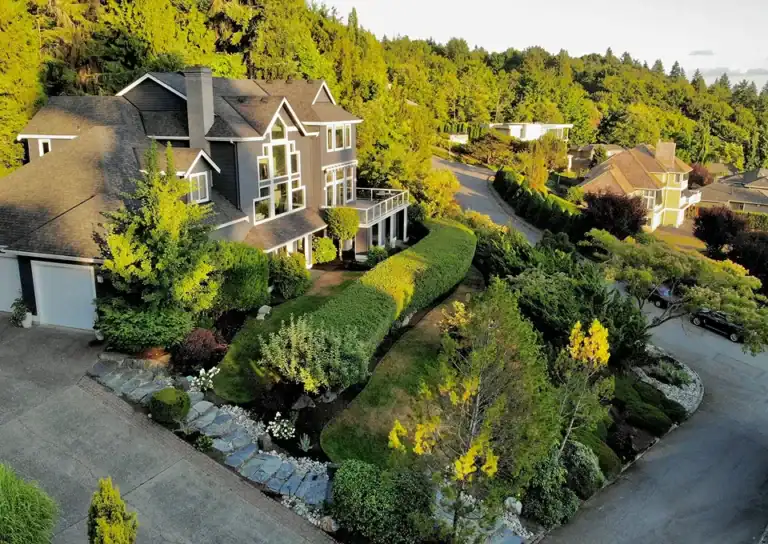
Of these native shrubs, we install Oregon grape and salal most frequently — they’re the workhorses of our low-water planting designs because they provide year-round evergreen structure, tolerate both sun and shade, and look presentable even during the driest weeks of August. On our PNW Natural Harmony project in Redmond, we combined tall Oregon grape, salal, and oceanspray along the property’s west-facing slope — a full-sun exposure with shallow soil that dries out fast in summer. Three years in, the planting is fully established with zero supplemental irrigation from July through September. During the June 2021 heat dome — when temperatures hit 108°F in parts of Greater Seattle — the salal and Oregon grape showed some leaf scorch on the most exposed south-facing plants, but recovered fully once temperatures dropped. The oceanspray dropped its flower clusters early but didn’t lose foliage. By comparison, non-native hedging on neighboring properties showed significant die-back that required replacement planting that fall.
Which native trees are drought-tolerant in Seattle?
Large trees are the most drought-tolerant plants you can put in — their root systems reach deep enough to access moisture that shrubs and perennials never touch. But the right species matters enormously.
Madrone (*Arbutus menziesii*)
The most striking native tree in our region — peeling cinnamon-red bark, glossy evergreen leaves, and clusters of white flowers followed by red berries. Madrones are supremely drought-tolerant and will grow in the thinnest, rockiest soil. The catch: they are notoriously difficult to transplant successfully. They resent root disturbance and don’t tolerate supplemental irrigation once established (overwatering actually kills them faster than drought). We typically recommend protecting existing madrones on a property rather than planting new ones, though small seedlings from specialty native plant nurseries have the highest success rate. If you have a madrone on your property, build the landscape around it — it’s irreplaceable.
Garry oak (*Quercus garryana*)
Washington’s only native oak, and a long-lived, stately tree (specimens can reach 80+ feet and live 500 years). Deeply drought-tolerant once established. Garry oaks evolved in the dry prairies and savannas of the Puget Sound lowlands, so they’re perfectly adapted to our summer drought pattern. Important note: Garry oaks are sensitive to changes in their root zone. Adding soil, irrigating, or planting under established Garry oaks can introduce root diseases like Phytophthora. If you’re planting a young Garry oak, give it space and plan for its mature canopy — this is a 50-year tree, not a quick screen.
Shore pine (*Pinus contorta var. contorta*)
A compact, wind-tolerant native conifer that grows 25–35 feet tall. It handles poor soils, salt exposure, wind, and drought — a genuine survivor. We’ve installed shore pines on exposed properties in Kenmore and Shoreline where other evergreens struggle with wind desiccation. The irregular, sculptural form adds character to a landscape in a way that the uniform cone shape of a typical nursery conifer does not.
We plant Garry oaks and shore pines regularly. Garry oaks establish well when planted as young trees (5-7 gallon containers) — they’re slow-growing but nearly indestructible once rooted in. The key is avoiding irrigation near the trunk after the first two summers; established Garry oaks are actually damaged by summer watering, which promotes root rot organisms (Phytophthora) they’d never encounter in dry conditions. Shore pines are our go-to for exposed, wind-swept sites — we’ve installed them successfully on lakefront properties in Kenmore and Shoreline where other evergreens suffered wind desiccation.
Pacific madrone is the exception — transplanting established madrones has a high failure rate (we estimate 40-50%) because they form symbiotic relationships with native soil fungi that are difficult to replicate in landscape soil. When we use madrone, we source small container-grown plants (1-gallon or less), plant them in fall, and accept that some won’t make it. The ones that establish, though, become the most striking trees on the property — the peeling cinnamon bark and glossy evergreen leaves are unlike anything else in the Pacific Northwest palette.
We plant Garry oaks and shore pines regularly. Garry oaks establish well when planted as young trees (5-7 gallon containers) — they're slow-growing but nearly indestructible once rooted in. The key is avoiding irrigation near the trunk after the first two summers; established Garry oaks are actually damaged by summer watering, which promotes root rot organisms (Phytophthora) they'd never encounter in dry conditions. Shore pines are our go-to for exposed, wind-swept sites — we've installed them successfully on lakefront properties in Kenmore and Shoreline where other evergreens suffered wind desiccation.
Which Mediterranean plants work well in Seattle?
Plants from Mediterranean climates — dry summers, wet winters — are natural partners for our native palette. The key is selecting species that tolerate our winter rainfall and wet soil, which are wetter than most Mediterranean environments.
Lavender (*Lavandula angustifolia*)
Perhaps the most popular drought-tolerant plant in Greater Seattle gardens, and for good reason when sited correctly. The cultivars ‘Hidcote’ (deep purple, compact to 18 inches) and ‘Munstead’ (lavender-blue, slightly more vigorous) are the most reliable performers in our climate. Both bloom from June into August and attract pollinators heavily.
The critical requirement: drainage. Lavender planted directly into poorly drained soil will rot at the crown within one to two winters. We always amend the planting area generously with pumice and coarse compost to ensure water moves through the root zone, and we plant slightly above grade so water never pools at the base. On heavier, slow-draining soil, a raised bed or a slope is the best insurance.
The other common mistake: pruning. Lavender needs to be cut back by one-third to one-half after flowering, every year, to prevent it from becoming leggy and woody at the base. Skip pruning for two years and you’ll have a dead center with growth only at the tips — at that point, replacement is usually more practical than rehabilitation.
Rosemary (*Salvia rosmarinus*)
Fully drought-tolerant once established, evergreen, fragrant, and useful in the kitchen — rosemary is one of the rare plants that earns its place on purely practical grounds. The upright varieties (‘Tuscan Blue’, ‘Arp’) grow 3–5 feet tall and can function as an informal hedge. Prostrate varieties (‘Prostratus’, ‘Irene’) work as groundcover on slopes and retaining wall caps. Same drainage requirements as lavender — amend heavy soil or use a raised position. Hardiness can be an issue in our area: ‘Arp’ is the most cold-hardy cultivar, surviving down to about 10°F, which covers most Seattle-area winters. The others may suffer in an unusually cold January.
Rock rose (*Cistus*)
Underused in Seattle gardens, in our view. Cistus species are tough, evergreen shrubs covered in papery flowers (white, pink, or magenta) from May through July. They demand sharp drainage and full sun — no heavy soil, no shade — but in the right spot, they’re genuinely zero-irrigation plants. Cistus x purpureus (orchid rock rose) is our most-used species: 3–4 feet tall and wide, with magenta flowers marked by dark red basal spots. It blooms prolifically and tolerates the worst dry conditions we see on south-facing slopes.
California lilac (*Ceanothus*)
Fast-growing evergreen shrubs with electric-blue flower clusters in spring. Some species are less cold-hardy in our area, but Ceanothus thyrsiflorus ‘Victoria’ and Ceanothus ‘Dark Star’ have proven reliable across most Greater Seattle properties. They flower heavily in April and May, forming mounding shrubs 4–6 feet tall. The trade-off: ceanothus is relatively short-lived (10–15 years), and established plants cannot be moved or heavily pruned — they don’t regenerate from old wood. Think of them as a medium-term planting rather than a permanent fixture.
Need Help Choosing Materials?
Our team knows which plants and materials perform best in Seattle's climate.
Schedule a ConsultationWhich ornamental grasses thrive without irrigation in Seattle?
Ornamental grasses are the workhorses of a low-water landscape. They provide movement, texture, and year-round structure with almost no maintenance beyond an annual cut-back in late winter.
Blue oat grass (*Helictotrichon sempervirens*)
A compact, steel-blue mound (2–3 feet) that holds its color through summer drought and winter rain alike. The narrow leaves catch light beautifully. We use it as a specimen plant in mixed borders and as a repeating element along pathways. It needs full sun and good drainage — in clay, amend the planting area or position it on a slight rise. Blue oat grass doesn’t spread aggressively, which makes it more predictable in a designed landscape than many other grasses.
Feather reed grass (*Calamagrostis x acutiflora* ‘Karl Foerster’)
The most widely planted ornamental grass in our region, and for good reason. Strictly upright to 5 feet, with wheat-colored seed heads that persist from June through winter. ‘Karl Foerster’ is a clumping grass — it stays put and doesn’t colonize. It tolerates heavy soil better than most grasses, handles full sun to light shade, and once established, cruises through summer drought without issue. We’ve planted thousands of these across Greater Seattle properties and rarely see one fail. The vertical form is particularly effective as a counterpoint to low, mounding shrubs and groundcovers.
Two other grasses we’ve been using successfully: Panicum virgatum ‘Shenandoah’ (switch grass) — a native prairie grass that turns a deep burgundy-red by late summer, grows 3-4 feet tall, and handles both full sun and dry conditions without any supplemental water once established. And Nassella tenuissima (Mexican feather grass) — a fine-textured grass that creates a flowing, hair-like movement in any breeze. The feather grass is borderline hardy in our zone (USDA 7b-8a) but has performed reliably on south-facing exposures in Bellevue and Kirkland for the past several years. During the 2021 heat dome and subsequent dry summers, all of our ornamental grass installations held up remarkably well — the grasses go semi-dormant during extreme heat (the foliage tips may brown), but they green up fully with the first fall rains. Of all the plant categories we install, ornamental grasses require the least intervention during drought periods.
Which drought-tolerant perennials add color to a Seattle landscape?
Perennials fill the gaps between shrubs and grasses with seasonal color and pollinator habitat. These are the most reliable performers we’ve observed in summer-dry conditions.
Stonecrop (Sedum) — Low-growing and virtually indestructible. Sedum ‘Autumn Joy’ is the classic: succulent gray-green foliage all summer, followed by pink-to-rust flower heads in September and October that provide late-season color when most other perennials are winding down. Tolerates full sun, poor soil, and extended drought. Excellent for green roof applications, retaining wall crevices, and border edges.
Penstemon — Native species like Penstemon cardwellii and Penstemon fruticosus produce tubular flowers in shades of purple, blue, and pink that hummingbirds actively seek out. They need full sun and sharp drainage. In our experience, penstemons perform better in lean, well-drained soil than in rich, amended beds — too much fertility produces leggy growth and fewer flowers.
Sea holly (Eryngium) — Architectural, thistle-like plants with metallic blue or silver flower heads that persist for weeks. Eryngium planum ‘Blue Glitter’ is our go-to: 2–3 feet tall, deeply drought-tolerant, and striking in both the garden and in cut-flower arrangements. It thrives in the well-drained, slightly gravelly conditions that would stress most perennials.
Coneflower (Echinacea) — Echinacea purpurea ‘Magnus’ produces large pink-purple daisy flowers from July through September. It tolerates moderate drought once established, though it performs best with occasional deep watering during the driest weeks of August. The seed heads attract goldfinches in fall and winter if you leave them standing — a practical reason to delay the fall cleanup.
What should you avoid planting if you want a low-water landscape?
Knowing what not to plant is as important as knowing what to plant. These are the common choices that will lock you into supplemental irrigation every summer:
Traditional lawn grasses. Kentucky bluegrass and perennial ryegrass need 1–1.5 inches of water per week during July, August, and early September to stay green. Without irrigation, they go dormant and brown. They’ll recover when the rains return in October, but if a green lawn matters to you during the months you actually use your yard, you’re committed to watering. Fine fescue mixes are more drought-tolerant if lawn is non-negotiable.
Hydrangeas in full sun. Hydrangea macrophylla (the big-leaf hydrangea) has large leaves that lose moisture rapidly. In full sun on a south-facing exposure — common in newer developments where tree canopy has been removed — they’ll wilt visibly by mid-afternoon on any day above 80°F. They can work in shaded, north-facing positions where moisture is retained, but they’re never truly drought-tolerant.
Japanese maples in full sun. These are exceptional trees in the right conditions, but full sun and dry soil is not it. The delicate foliage scorches, particularly on laceleaf varieties (Acer palmatum var. dissectum). Leaf margins turn brown and crispy by August. Japanese maples belong in dappled shade with consistent moisture — or accept that you’ll be supplementing water all summer.
Most annuals. Petunias, impatiens, marigolds — they produce fast, continuous color because they’re burning through resources at an unsustainable rate. They have shallow root systems and high water demands. In a waterwise garden, redirect that bed space and budget toward perennials and shrubs that build presence over time.
How long before drought-tolerant plants can survive without irrigation?
This is the most important thing to understand about drought-tolerant landscaping: every plant — even the toughest native — needs supplemental water during its establishment period. In our climate, that means the first one to two full dry seasons after planting.
During the first summer, water deeply (not frequently) once or twice per week, depending on soil type and exposure. The goal is to encourage roots to grow deep into the soil profile, seeking moisture rather than staying at the surface. Shallow, daily watering produces shallow roots — exactly the opposite of what you want.
By the second summer, reduce watering to once every 7–10 days during the driest weeks. By the third summer, most well-established drought-tolerant plants can handle our typical July-September dry period with no supplemental water at all, unless we get an extended heat wave like the 2021 event (108°F in Seattle — even established natives showed stress).
Fall planting (September through November) gives plants a significant advantage. They get five to six months of natural rainfall to establish roots before their first dry summer. Spring planting works too, but the establishment window before summer stress arrives is shorter.
Does soil preparation affect drought tolerance?
Significantly. Much of the soil here is slow to drain in winter and bakes hard in summer. Both conditions stress plants, and improving soil structure directly improves drought performance.
For plants that need drainage (lavender, rosemary, cistus, kinnikinnick, ornamental grasses), amend the planting area with pumice, coarse sand, or aged bark fines to break up clay and create air pockets. We typically amend a bed to 12–18 inches deep rather than just the planting hole — amending only the hole creates a bathtub effect where water collects in the amended zone and saturates the roots.
For plants that tolerate clay (Oregon grape, salal, red-flowering currant, Karl Foerster grass), amending is less critical, but a 3-inch layer of arborist wood chip mulch over the root zone makes a substantial difference. Mulch moderates soil temperature, retains moisture, and breaks down over time into the organic matter that our native soils often lack.
Hydrozoning — grouping plants by water needs — is perhaps the single most impactful design decision for a low-water landscape. Put your drought-tolerant plants together in one zone, your moderate-water plants together in another, and your thirsty plants (if you must have them) in a third zone near a water source. This avoids the common problem of overwatering drought-tolerant plants to keep their thirsty neighbors alive — which causes root rot and early death in the plants that didn’t need the water in the first place.
On our PNW Natural Harmony project in Redmond, hydrozoning reduced the irrigated area by roughly 60% compared to a conventional mixed planting approach. The property’s front slope and side beds are planted entirely with drought-tolerant natives and Mediterranean species that receive zero supplemental irrigation after the second summer. Only the small lawn area and a few showcase plantings near the entry receive scheduled irrigation. The homeowner’s summer water use dropped noticeably compared to their previous landscape, which had been a conventional mix of thirsty ornamentals that required 3-4 days per week of irrigation from June through September.
For soil amendment in heavy native soil, we use a consistent approach for drought-tolerant beds: 3-4 inches of coarse compost (we prefer a composted bark/soil blend from local suppliers) tilled into the top 8-10 inches of native soil, plus 1/4-inch pumice or perlite mixed in at roughly a 15-20% ratio by volume. The pumice permanently improves drainage in the clay without breaking down over time the way organic amendments do. After planting, a 3-inch layer of arborist wood chip mulch goes on top — it moderates soil temperature, retains moisture during establishment, and feeds soil biology as it decomposes. By the second year, most drought-tolerant species have rooted below the amended zone into the native clay, where they access moisture that stays available well into the dry season.
How do you design a drought-tolerant garden that doesn't look sparse?
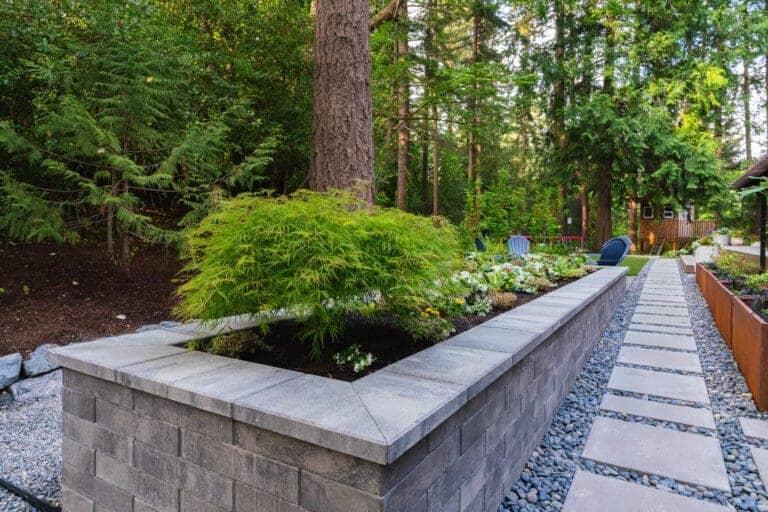
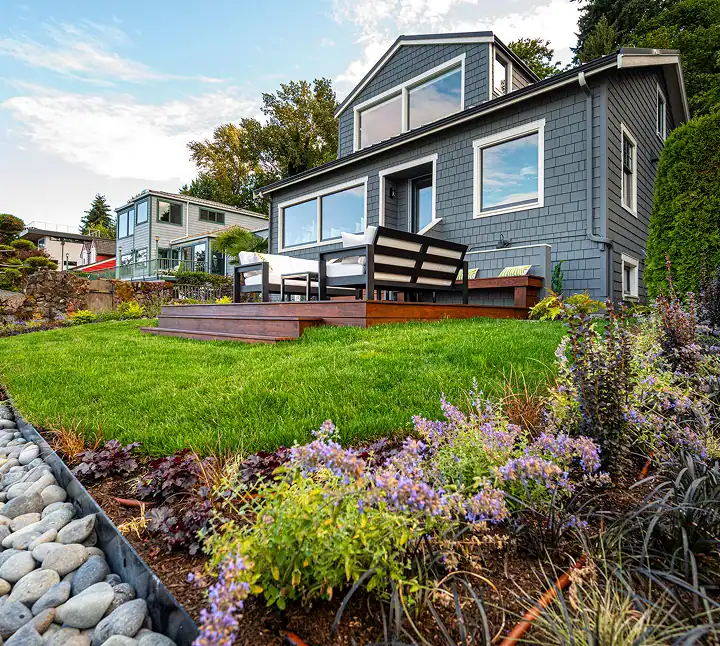
The assumption that drought-tolerant equals bare, dry, and desert-like is the biggest misconception we encounter. Our PNW Natural Harmony project in Redmond is a direct counter-example — a landscape built predominantly with native and adapted plants that is dense, layered, and lush year-round without a conventional irrigation system running through summer.
The key is layering. A well-designed drought-tolerant planting bed has:
- A canopy layer — shade from a native tree (Garry oak, shore pine) or an adapted tree (Japanese stewartia, which is moderately drought-tolerant once established)
- A shrub layer — Oregon grape, oceanspray, ceanothus, or cistus providing mass and structure at 3–8 feet
- A grass and perennial layer — Karl Foerster grass, blue oat grass, sedum, echinacea providing texture and seasonal color at 1–4 feet
- A groundcover layer — kinnikinnick, creeping thyme, or native strawberry (Fragaria virginiana) covering bare soil and suppressing weeds
This layered approach mimics the structure of native plant communities — which is why it looks natural rather than sparse. It also creates its own microclimate: the canopy and shrub layers shade the soil, reducing evaporation and keeping root zones cooler during heat events.
Combine this structure with 3 inches of wood chip mulch over all exposed soil, and you have a landscape that retains moisture far more effectively than a conventional garden with scattered plantings and bare, baked soil between them.