- Washington State requires contractor licensing, bonding, and insurance — but does not mandate any warranty on landscape workmanship, plants, or hardscape. Everything beyond the licensing baseline is voluntary.
- A written warranty with specific terms for plants, hardscape, irrigation, and drainage is the strongest signal that a contractor stands behind their work — verbal promises provide no enforceable protection.
- Plant guarantees typically require the homeowner to maintain adequate watering and basic care during the establishment period; neglect is universally excluded from coverage.
- Design-build companies provide unified warranty accountability — the same company that designed the plan warranties the outcome, eliminating the "the designer said / the builder followed" gap.
- Ask for the warranty document before signing the contract, not after. A company's willingness to put specific terms in writing tells you more about their confidence than any sales presentation.
- Classic's warranty process starts with a brief review — the intent is to resolve quickly, not create obstacles. Most warranty interactions are resolved with one site visit and a scheduled correction.
What Does Washington State Actually Require From Landscape Contractors?
Washington’s contractor registration law (RCW 18.27) establishes the baseline. Every landscape contractor performing work over $600 must be registered with L&I, carry a surety bond (minimum $12,000 for general contractors), and maintain liability insurance. This registration is searchable on L&I’s public database — and checking it before signing any contract is one of the simplest ways to screen a landscaper.
But registration protects you from fraud and abandonment, not from poor outcomes. If a contractor takes your money and vanishes, the surety bond provides a recovery mechanism. If they damage your neighbor’s property during construction, liability insurance covers it. None of this addresses what happens when a $3,000 planting bed dies within six months, or when a retaining wall starts leaning 18 months after installation.
For those outcomes, you are relying entirely on whatever warranty the contractor voluntarily includes in their contract — or doesn’t.
### The implied warranty gap
Washington does recognize implied warranties under general contract law. If you pay for a functional retaining wall and it fails within a reasonable timeframe due to workmanship, you may have legal recourse even without a written warranty. But “reasonable timeframe” and “workmanship defect” are terms that lawyers argue about, not terms that get your wall fixed quickly. A written warranty with specific terms, durations, and response commitments eliminates that ambiguity before it becomes a dispute.
What Do Reputable Landscape Companies Typically Warrant?
The warranty landscape across Bellevue, Kirkland, Redmond, and the broader Eastside varies significantly. Some contractors offer nothing beyond a verbal promise. Others provide detailed written warranties that cover plants, hardscape, irrigation, and drainage separately — because each element has different failure modes, different timelines, and different causes.
Here is what a comprehensive landscape warranty typically includes from a company that takes accountability seriously.
### Plant guarantees
A plant guarantee covers replacement of trees, shrubs, perennials, and groundcovers that die within a specified period after installation — typically one year. Classic offers a 1-year plant guarantee, which covers replacement of any plant material that fails to establish under normal conditions.
The critical detail is what “normal conditions” means. No reputable plant guarantee covers neglect. If a homeowner turns off the irrigation system for three weeks in August, or never waters newly installed trees during their first summer, plant death is a maintenance failure, not an installation defect. A well-written plant guarantee specifies the homeowner’s care obligations — typically adequate watering and basic seasonal maintenance — as conditions for coverage.
What a plant guarantee should also address:
- Which plants are covered and which are excluded — annuals and seasonal color are typically excluded; trees, shrubs, and perennials are typically included
- The replacement standard — same species and size, or closest available equivalent
- The response process — how to report a failure and the expected timeline for replacement
- Whether replacement plants carry their own guarantee period — some companies restart the clock on replacements, some do not
### Hardscape structural warranties
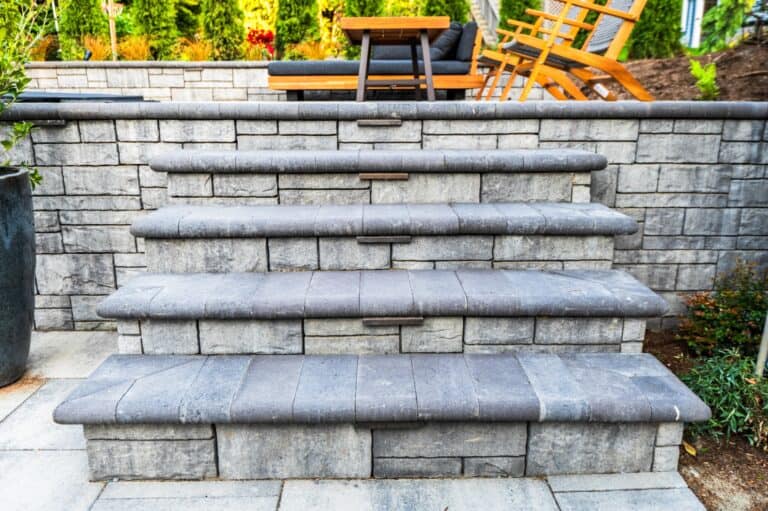
Hardscape — patios, retaining walls, steps, walkways, driveways — involves structural performance over years, not just an establishment period. A paver patio should not settle unevenly within two years. A retaining wall built to engineering specifications should not shift or crack within a decade.
Reputable design-build companies typically offer hardscape workmanship warranties ranging from two to five years. These cover settling, shifting, cracking, and drainage failures attributable to installation defects — problems caused by inadequate base preparation, poor drainage behind walls, or incorrect compaction, not problems caused by tree root growth or third-party excavation.
Some contractors extend separate manufacturer warranties on specific materials — paver manufacturers like Belgard and Mutual Materials offer product warranties of 25 years or more on the material itself. But a manufacturer’s warranty on the paver does not cover the installation. If the paver is fine but the base underneath it was improperly prepared, the manufacturer’s warranty is irrelevant. That is a workmanship issue, and only the installer’s warranty covers it.
### Irrigation system warranties
Irrigation warranties typically cover parts and labor for one to two years after installation. Controllers, valves, heads, and pipe connections are covered against defect and installation error. Winterization damage — cracked pipes from water left in the system over a freeze — is generally not covered, because winterization is the homeowner’s maintenance responsibility (or the responsibility of whichever company handles their ongoing maintenance program).
### Drainage performance
Drainage systems are among the most consequential elements a landscape contractor installs, particularly on Eastside properties where clay soils, slopes, and heavy winter rainfall create persistent challenges. A drainage warranty should specify what the system is designed to handle and commit to correcting failures attributable to installation.
The honest caveat: no drainage warranty can cover events beyond the system’s design capacity. A French drain designed for typical seasonal runoff is not designed to handle a 100-year storm event or a new uphill neighbor’s grading project that redirects water onto your property. A good warranty is specific about what it covers.
What Do Warranties Typically Exclude?
Understanding exclusions is as important as understanding coverage. Warranty disputes in landscaping almost always involve disagreements about whether a failure falls under a covered cause or an excluded one.
### Common exclusions across most landscape warranties
- Homeowner maintenance failures — failure to water, failure to maintain irrigation, failure to address pest issues that were flagged, removal of mulch or protective materials
- Acts of nature — windstorms, ice storms, floods, unusually severe weather events outside historical norms
- Unauthorized modifications — digging in planting beds, adding soil or hardscape over drainage systems, relocating irrigation heads, cutting roots of guaranteed plants
- Third-party damage — utility company trenching through a drainage line, a neighbor’s tree falling on a planting bed, contractor work by others affecting the warranted area
- Normal wear and weathering — gradual color change in pavers, moss growth on stone surfaces, minor settling within industry tolerances
- Deer, rabbit, or pest damage — browsing damage from wildlife is not an installation defect
### The exclusion that catches homeowners off guard
The single most common warranty gap Classic sees on projects that come to us after another contractor’s work has failed: no warranty on the design itself. A contractor may warranty their workmanship — that the wall was built to spec — but if the design called for a wall in the wrong location, undersized drainage, or plants unsuited to the site’s conditions, the workmanship warranty does not help. The work was done correctly according to a flawed plan.
This is one of the reasons the design-build model exists. When the same company designs and builds, warranty accountability cannot be split between “the designer said to do it this way” and “the builder just followed the plan.” A design-build company owns the outcome — design and execution — and the warranty reflects that unified accountability.
What Should a Warranty Document Actually Look Like?
A handshake and a verbal “we’ll take care of it” is not a warranty. A warranty is a written document, typically included as an attachment or section of the installation contract, that specifies terms clearly enough that both parties know exactly what is covered, what is excluded, how claims are handled, and how long coverage lasts.
### Elements of a credible written warranty
- Duration per category — plants, hardscape, irrigation, and drainage may each carry different timelines
- Covered failure modes — what specific problems trigger warranty service
- Exclusions list — specific and reasonable, not so broad it renders coverage meaningless
- Homeowner obligations — what maintenance requirements the homeowner must meet for coverage to remain valid
- Claim process — how to report an issue, expected response time, and what the resolution looks like
- Transferability — whether the warranty transfers if you sell the property within the coverage period
At Classic, the warranty process starts with a brief review — the intent is to resolve quickly, not create obstacles. When a homeowner contacts us about a plant failure or a hardscape concern within the warranty period, we assess the situation, determine whether it falls within coverage, and schedule the correction. The goal is to maintain the relationship, not to find reasons to deny a claim.
Six Questions to Ask About Warranties Before You Commit
When you are evaluating landscape proposals and the conversation turns to warranties — or doesn’t, which is itself telling — these are the questions that separate a meaningful commitment from a vague assurance.
### 1. Is the warranty in writing and part of the contract?
If the warranty is verbal, it functionally does not exist. Washington State’s legal framework for warranty enforcement depends on documented terms. A verbal “we stand behind our work” may be sincere, but it provides no enforceable commitment.
### 2. What specific failures does it cover, and what is excluded?
The more specific a warranty is about both coverage and exclusions, the more credible it is. A one-sentence warranty — “all work guaranteed for one year” — leaves everything open to interpretation. A warranty that specifies covered and excluded conditions for each category (plants, hardscape, irrigation, drainage) tells you the company has thought through what can go wrong and is committing to a defined standard.
### 3. What are my maintenance obligations under the warranty?
Every legitimate plant guarantee requires some level of homeowner care — particularly watering during establishment. If a warranty has no maintenance requirements, it is either extraordinarily generous or it has exclusion language broad enough to deny almost any claim. Ask specifically: what watering schedule, what seasonal maintenance, what am I responsible for?
### 4. How do I file a claim, and what is the typical response time?
A company that has a clear process for warranty claims — a phone number or email, a defined response window, a site visit protocol — is a company that handles claims regularly and has systematized the process. A company that hesitates when asked this question may not have handled many claims, or may not intend to.
### 5. Does the warranty cover the design, or only the installation?
This question matters most on complex projects. If the design was flawed — wrong plant for the exposure, inadequate drainage capacity, retaining wall undersized for the load — and the contractor only warranties their installation workmanship, you have a finished project that was built correctly to an incorrect specification. Ask who is accountable for the design’s performance, not just the installation’s execution.
### 6. What happens after the warranty period ends?
The best landscape companies maintain ongoing relationships with their clients — through maintenance programs, seasonal check-ins, or simply being available for questions and adjustments. A warranty is a minimum commitment. The willingness to support a project beyond the warranty period says something about a company’s confidence in its work and its investment in the client relationship.
How Does Classic Handle Warranties?
Classic provides a 1-year plant guarantee on all plant material installed as part of a landscape project. This covers trees, shrubs, perennials, and groundcovers that fail to establish under normal growing conditions when the homeowner maintains basic care — primarily adequate irrigation during the establishment period.
For hardscape, Classic’s workmanship warranty covers structural integrity of installed elements — patios, walls, steps, and drainage infrastructure. If a base settles, a wall shifts, or drainage fails due to an installation deficiency, we address it.
The approach is straightforward: when a homeowner raises a warranty concern, we conduct a brief review, determine whether the issue falls within coverage, and resolve it. The intent is to address problems quickly — not to create obstacles or find technicalities. In Classic’s experience across 2,000+ Eastside landscapes, the vast majority of warranty interactions are resolved with a single site visit and a scheduled correction. Warranty service is not adversarial. It is part of the accountability that comes with standing behind a finished project.