- A $35K patio that fails in 3 years costs $50K–$55K once you add tear-out and rebuild — more than the $47K bid that would have lasted 25 years.
- The most common places low bids cut costs are base depth (4" vs. 6–8"), drainage behind retaining walls, plant sizes (1-gallon vs. 5-gallon), and soil amendment — all invisible on installation day.
- A company bidding 25–40% below competitors for the same scope is either operating without proper insurance/licensing or has reduced the specifications in ways the proposal may not make obvious.
- Always ask for specific numbers: base depth in inches, plant sizes by container, drainage plan details, and contractor's license and insurance certificate. Vague answers to specific questions are the clearest warning sign.
- Lower overhead or less experience can legitimately produce a lower bid — the key is whether the specifications and materials match, not just whether the total is lower.
A $35,000 patio that fails in three years doesn’t cost $35,000. It costs $35,000 plus another $15,000–$20,000 to tear it out and rebuild — assuming you can find a company willing to rip out someone else’s work and start over. That $50,000–$55,000 total was never cheaper than the $45,000 bid you turned down. We see this pattern play out across Bellevue, Kirkland, Redmond, and Sammamish multiple times a year: a homeowner chose the lowest bid, the work looked fine for 12 to 18 months, and then the patio started settling, the retaining wall began leaning, or half the plantings died through their second summer. The low bid wasn’t a bargain — it was a down payment on doing the work twice. This isn’t an argument against being cost-conscious. It’s an explanation of where the money actually goes and why some bids are lower than others.
Where do cheap landscaping bids actually cut corners?
Not every low bid is dishonest. Some companies genuinely operate with lower overhead or smaller margins. But when a bid comes in 25–40% below the others for the same scope of work, something in the specifications has changed — whether the proposal says so or not.
Here’s where we most commonly see costs reduced in ways that create problems later.
Base depth under patios and walkways
This is the invisible difference, and it’s the one that causes the most expensive failures. In the clay-heavy soils that dominate the Eastside — Bellevue, Issaquah, Sammamish, and most of Kirkland — a paver patio needs a minimum 6-inch compacted gravel base. In areas with particularly poor drainage or heavy clay, we often go to 8 inches.
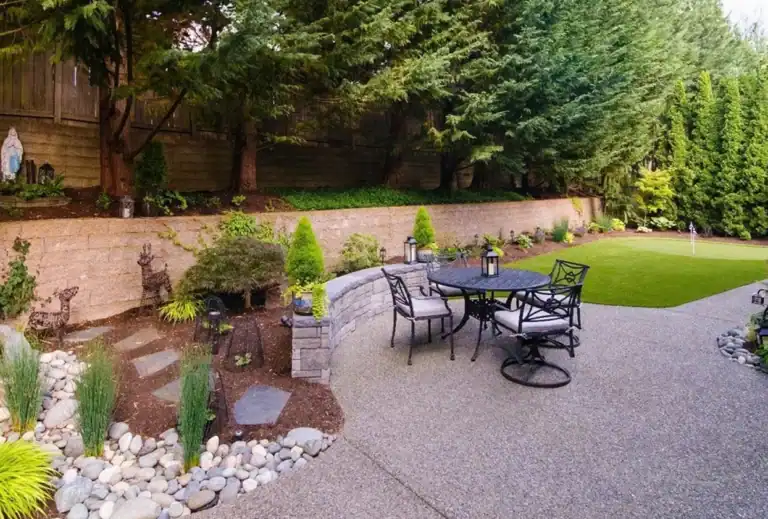
A company bidding 4 inches of base instead of 6 can save $2,000–$4,000 on a 400-square-foot patio. That savings disappears the first time the ground freezes, thaws, and the inadequate base allows the pavers to heave and settle unevenly. Within two to three Seattle winters — where we get enough freeze-thaw cycles to stress a thin base without being cold enough to make the problem immediately obvious — the surface develops lips, gaps, and pooling.
A Bellevue homeowner called us about a 380-square-foot paver patio installed two years earlier by another company. The original bid had been $28,000 — roughly $12,000 less than ours for the same scope. By the second winter, the patio had developed a visible dip along the center where the base had settled, and several pavers along the north edge had heaved above the surrounding surface, creating trip hazards. When we pulled up the pavers, the base was 3.5 inches of poorly compacted gravel sitting directly on clay — no geotextile fabric, no drainage consideration. The gravel had mixed with the clay below, creating a dense, water-holding layer that froze and expanded each winter. We excavated down to stable subgrade, installed geotextile fabric, built a 7-inch compacted base in lifts, added a drain line to route water away from the foundation, and relaid the pavers with proper edge restraint and polymeric sand. The rebuild cost $17,500. The homeowner’s total investment in that patio was now $45,500 — for a result they could have had for $40,000 if they’d gone with a properly specified bid the first time.
Drainage behind retaining walls
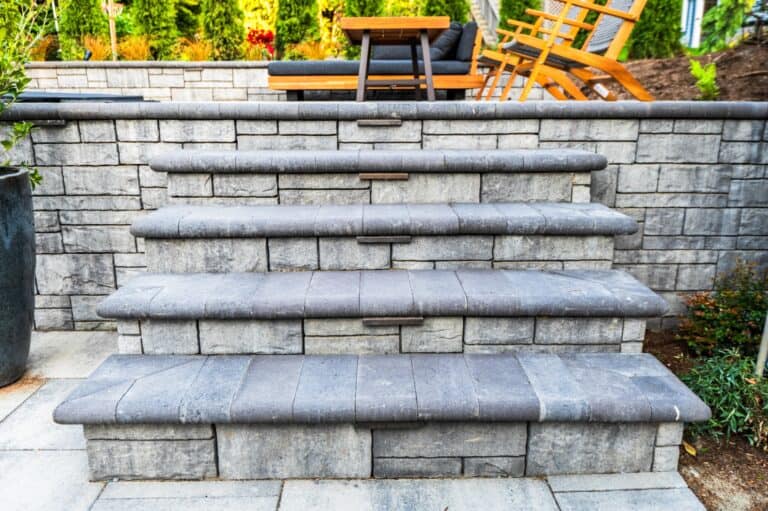
A retaining wall is a structural element, not a decorative one. It’s holding back soil, managing hydrostatic pressure, and dealing with water that moves through the ground behind it. Proper wall construction requires a drainage aggregate layer behind the wall, a perforated drain pipe at the base, filter fabric to prevent soil migration into the gravel, and — on walls over 3 to 4 feet — engineered geogrid reinforcement anchored back into the hillside.
Every one of those elements costs money. A company that omits the drainage aggregate saves on materials and labor. A company that skips the geogrid on a 4-foot wall cuts the installation time significantly. The wall looks identical on day one.
Two to four years later, water pressure builds behind the wall because it has nowhere to go. The wall starts leaning, the cap stones shift, and in the worst cases we’ve seen, the wall fails outright — dumping soil, gravel, and sometimes irrigation lines down the slope. The rebuild costs more than the original wall because the failed material has to come out first, and the hillside has to be re-excavated and stabilized.
On a Kirkland hillside, we were called in to assess a 4.5-foot retaining wall that had developed a 3-inch lean toward the downhill side within three years of construction. The wall had been built without a building permit — which is required in King County for walls over 4 feet — and without an engineered design. When we excavated behind it, we found the problem: no drainage aggregate, no perforated pipe, and no geogrid reinforcement tying the wall back into the hillside. The soil behind the wall was saturated clay, and three wet seasons of hydrostatic pressure had been pushing against a wall that had no way to relieve it. The original wall had cost the homeowner approximately $9,500. Our remediation required a full tear-out, geotechnical engineering review, a new footing with proper depth for the soil conditions, drainage aggregate and perforated pipe behind the wall, three courses of Tensar BX geogrid anchored 6 feet into the hillside, and a King County building permit with inspection. The rebuild cost $24,000. The homeowner’s total investment in that wall was now $33,500 — for work that would have cost roughly $18,000–$22,000 if it had been built correctly the first time.
Plant sizes and soil preparation
This is the difference homeowners notice fastest — though not always in the way they expect.
A 1-gallon shrub costs a landscape company $12–$18 at wholesale. A 5-gallon specimen of the same species runs $35–$65. When a planting plan calls for 50 shrubs, that gap is $1,150–$2,350 in plant material alone. A low bid often specifies smaller sizes, or — more commonly — doesn’t specify sizes at all.
The cost difference goes beyond appearance. Smaller plants take two to three years to fill in and establish a root system strong enough to survive a dry Seattle summer without supplemental irrigation. Larger plants establish faster and are more resilient through that critical first year. In our experience, the failure rate on 1-gallon material installed without soil amendment in Eastside clay soils runs significantly higher than 5-gallon material installed in properly amended beds.
And soil amendment is the other place costs disappear. Tilling in 3–4 inches of compost before planting costs $800–$2,000 depending on bed size. Skipping it saves that money and puts every plant into the dense, poorly draining clay that sits below the topsoil across most of Bellevue, Redmond, and Woodinville. The plants struggle. Some die. The ones that survive grow slowly and never develop the root depth they need.
Licensing, insurance, and labor
This is the corner-cutting that’s hardest to see and carries the most risk. Washington state requires landscape contractors to carry a contractor’s license, L&I (Labor & Industries) coverage for their workers, and general liability insurance. These aren’t optional — they protect you.
A licensed, insured company in the Seattle market carries roughly $15,000–$25,000 per year in insurance premiums alone, depending on crew size and project volume. L&I coverage adds another significant cost per employee. These expenses are embedded in every bid.
A company operating without proper coverage — or using uninsured subcontractors — can underbid by 15–25% simply because their overhead is lower. If a worker is injured on your property and the company doesn’t carry L&I coverage, you may be personally liable. If the work causes damage — a retaining wall collapse, a broken irrigation main, flooding from improper grading — and the company has no general liability insurance, you’re paying for the damage out of pocket.
A Woodinville homeowner shared this with us when we took over their project: they had hired an unlicensed crew found through a neighborhood social media group to install a paver walkway and small patio. Partway through the project, a crew member broke an irrigation mainline while excavating, sending water into the crawl space of the house. The crew had no general liability insurance. The homeowner filed a claim through their own homeowner’s insurance to cover the water damage remediation — roughly $6,500 — and their premium increased the following year. When they tried to recoup the cost from the contractor, they discovered the company wasn’t registered with L&I, had no surety bond, and the “business name” was essentially one person’s side operation. There was no bond to claim against, no insurance to file against, and no practical legal avenue worth pursuing for the amount involved. The homeowner absorbed the loss, hired us to finish the project properly, and told us it was the most expensive lesson they’d learned as a homeowner.
A licensed, insured company in the Seattle market carries roughly $15,000–$25,000 per year in insurance premiums alone, depending on crew size and project volume. L&I coverage adds another significant cost per employee. These expenses are embedded in every bid.
What does the math actually look like?
The most persuasive argument against choosing the cheapest bid isn’t theoretical — it’s arithmetic.
Here’s a scenario we’ve seen variations of across Eastside properties:
The patio project:
| | Low Bid | Thorough Bid | |—|—|—| | Base depth | 4 inches | 6–8 inches | | Drainage included | No | Yes — French drain + catch basin | | Plant sizes | 1-gallon, no soil amendment | 5-gallon, beds amended with compost | | Wall drainage | Gravel only, no pipe | Aggregate + perforated pipe + filter fabric | | Geogrid on 4-ft wall | No | Yes, 3 courses | | Licensed/insured | “Yes” (unverified) | License #, insurance certificate provided | | Total | $35,000 | $47,000 |
At signing, the low bid saves $12,000. That’s real money, and the temptation to take it is completely understandable.
Three years later:
| Repair | Estimated Cost | |—|—| | Tear out and rebuild settling patio (400 sq ft) | $15,000–$20,000 | | Replace failed plantings (30 of 50 shrubs) | $2,500–$4,000 | | Add drainage that should have been installed originally | $3,500–$6,000 | | Repair leaning retaining wall section | $5,000–$12,000 |
Not every low-bid project fails in every category. But even one of these repairs erases the initial savings and then some. The $47,000 project that’s still performing perfectly after year five was always the less expensive option — it just didn’t look that way on the day the bids arrived.
Why can some companies honestly bid lower?
It’s worth acknowledging that not every lower bid is hiding problems. Some legitimate reasons a company bids below competitors:
- Lower overhead: A smaller company working out of a home office with fewer trucks has genuinely lower fixed costs than a company running a shop, multiple crews, and administrative staff.
- Newer to the market: Companies building their portfolio sometimes price aggressively to win work and build a reputation. The work quality may be fine — but the experience handling unexpected site conditions may be limited.
- Different scope: The most common reason for a price gap is that the lower bid simply includes less. Fewer plants, smaller sizes, thinner base, no drainage, limited warranty. This isn’t dishonest if it’s clearly stated in the proposal — but many homeowners don’t catch what’s missing until the work is underway.
The distinction that matters is between a company that bids lower because they’ve found legitimate efficiencies and a company that bids lower because they’ve removed the things your project actually needs. The only way to tell the difference is to read the specifications — not just the total.
We wrote a detailed framework for doing exactly that in our guide on how to compare landscape proposals. If you’re holding multiple bids right now, that comparison process will save you more money than any negotiation.
How do you evaluate whether a low bid is fair or risky?
You don’t need to be a contractor to spot the differences. You need to ask specific questions — and pay attention to how detailed the answers are.
Ask about base depth
“What base depth are you specifying for the patio, and why?” A company that can explain their base specification in terms of your site’s soil conditions — not just “industry standard” — understands what they’re building on. In Eastside clay soils, any answer less than 6 inches of compacted gravel should prompt a follow-up conversation.
Evaluating Landscape Companies?
We're happy to answer your questions — even if you're still comparing options.
Talk to Our TeamAsk about drainage
“What’s your drainage plan for behind the retaining wall?” If the answer is vague or the proposal doesn’t mention drainage at all, that’s a significant omission. Water management behind a retaining wall isn’t optional — it’s structural.
Ask about plant sizes
“What container sizes are you specifying for the plantings?” A company that can tell you “5-gallon Sarcococca confusa along the foundation, 3-gallon Hakonechloa macra ‘Aureola’ in the shade beds” is planning at a different level than one that lists “assorted shrubs and groundcovers.”
Ask about licensing and insurance
“Can you provide your contractor’s license number and a certificate of insurance?” This should be the easiest question any legitimate company answers. If there’s hesitation, that tells you something important.
Ask about warranty
“What’s your warranty on plant material? On hardscape? On drainage?” A company that offers a 1-year plant guarantee backed by follow-up checks is absorbing real cost. A company that offers 90 days or no guarantee is pricing accordingly — and transferring the risk to you.
For a complete list of questions that reveal how a company operates, see our guide on the 10 questions to ask a landscape company before hiring.
What does a fair landscape price actually reflect?
When we put together a proposal at Classic Landscaping, the price reflects everything the project needs to perform for 15, 20, 25 years — not just look good on installation day.
That includes:
- Proper materials at proper depths. A 6- to 8-inch compacted gravel base, geotextile fabric, polymeric sand, and a drainage system sized for the site’s water volume.
- Plants sized for success. We install 5-gallon material as standard because it establishes faster, survives its first dry summer more reliably, and gives homeowners a landscape that looks proportional to their investment from day one.
- Soil amendment. Every planting bed gets compost incorporation. In the clay soils across Bellevue, Redmond, Kirkland, and Woodinville, plants installed without amendment struggle — and many fail outright.
- Experienced crews. Our construction team, led by Eric Lemus with 15+ years of hardscape and masonry experience, understands how water moves through Eastside soils and how to build structures that account for it. That experience costs more per hour than a first-year crew — and prevents the callbacks and failures that cost far more than the hourly rate difference.
- Full licensing and insurance. Every worker covered by L&I. General liability insurance in place. Contractor’s license current. These costs protect you, and they’re reflected in the bid.
- A real warranty. Our 1-year plant guarantee means we come back if something fails. That guarantee has a cost, and we build it into the price because we believe standing behind the work is part of the work.
None of these line items are luxuries. They’re the components that determine whether your landscape investment compounds in value over time or depreciates.
How do we handle it when our bid isn't the lowest?
Honestly? We lose bids to cheaper competitors. It happens regularly. And some of those homeowners get excellent results from the company they chose — genuinely well-built projects at a lower price point. We don’t assume every competitor who bids below us is cutting corners.
But enough of those homeowners call us back — two years later, three years later — that we’ve learned to have a specific conversation when a client tells us our bid is significantly higher than another they received.
We don’t try to match the lower number. Instead, we walk through the proposals side by side and identify where they differ. Usually, the differences are in the categories we’ve outlined here: base depth, drainage, plant sizes, soil prep, warranty scope. Sometimes the scope is genuinely different — one proposal includes lighting and the other doesn’t. Sometimes the materials are different grades. Occasionally, the other company is simply operating at lower overhead with thinner margins.
What we don’t do is cut the specifications to hit a number. We’d rather lose the bid at $47,000 than win it at $35,000 with a 4-inch base and no drainage, knowing we’ll be back in three years to fix what failed.
A Sammamish homeowner invited us to review their proposals after getting three bids: $34,000, $42,000, and ours at $49,000. We sat at her kitchen table and built a comparison spreadsheet — every line item, every material, every plant size. The $34,000 bid specified a 4-inch base (ours was 6 inches), listed no drainage plan (ours included a French drain and two catch basins at $4,800), specified 1-gallon plants with no soil amendment (ours specified 5-gallon material in compost-amended beds), and offered a 90-day plant guarantee (ours is one year). When we added the cost of the missing items to the low bid at fair market rates, the $34,000 bid became a $46,000 project — $3,000 less than ours, but with a thinner base and a shorter warranty. The homeowner told us later that the side-by-side changed how she read the numbers entirely. She went with the $42,000 company, which had specifications closer to ours at a slightly lower price point. We didn’t win that project — but she made an informed decision, and that’s the outcome we’d rather see than a homeowner choosing a number that doesn’t include what their property actually needs.
If you’re comparing bids right now and the spread feels uncomfortable, we’re happy to take a look — even at a competitor’s proposal. We’d rather help you make an informed decision than watch a preventable failure happen. If this is something your property is dealing with, we’re happy to take a look.
The Bottom Line
Honestly? We lose bids to cheaper competitors. It happens regularly. And some of those homeowners get excellent results from the company they chose — genuinely well-built projects at a lower price point. We don’t assume every competitor who bids below us is cutting corners.
But enough of those homeowners call us back — two years later, three years later — that we’ve learned to have a specific conversation when a client tells us our bid is significantly higher than another they received.
We don’t try to match the lower number. Instead, we walk through the proposals side by side and identify where they differ. Usually, the differences are in the categories we’ve outlined here: base depth, drainage, plant sizes, soil prep, warranty scope. Sometimes the scope is genuinely different — one proposal includes lighting and the other doesn’t. Sometimes the materials are different grades. Occasionally, the other company is simply operating at lower overhead with thinner margins.
What we don’t do is cut the specifications to hit a number. We’d rather lose the bid at $47,000 than win it at $35,000 with a 4-inch base and no drainage, knowing we’ll be back in three years to fix what failed.
A Sammamish homeowner invited us to review their proposals after getting three bids: $34,000, $42,000, and ours at $49,000. We sat at her kitchen table and built a comparison spreadsheet — every line item, every material, every plant size. The $34,000 bid specified a 4-inch base (ours was 6 inches), listed no drainage plan (ours included a French drain and two catch basins at $4,800), specified 1-gallon plants with no soil amendment (ours specified 5-gallon material in compost-amended beds), and offered a 90-day plant guarantee (ours is one year). When we added the cost of the missing items to the low bid at fair market rates, the $34,000 bid became a $46,000 project — $3,000 less than ours, but with a thinner base and a shorter warranty. The homeowner told us later that the side-by-side changed how she read the numbers entirely. She went with the $42,000 company, which had specifications closer to ours at a slightly lower price point. We didn’t win that project — but she made an informed decision, and that’s the outcome we’d rather see than a homeowner choosing a number that doesn’t include what their property actually needs.
If you’re comparing bids right now and the spread feels uncomfortable, we’re happy to take a look — even at a competitor’s proposal. We’d rather help you make an informed decision than watch a preventable failure happen. If this is something your property is dealing with, we’re happy to take a look.