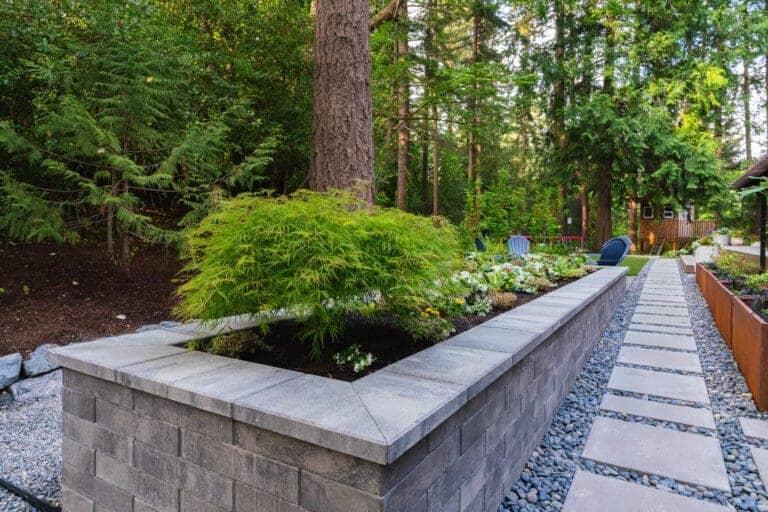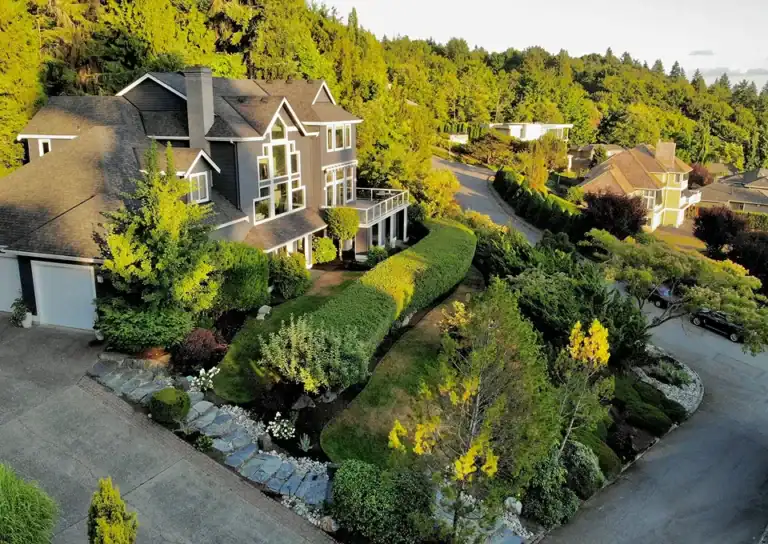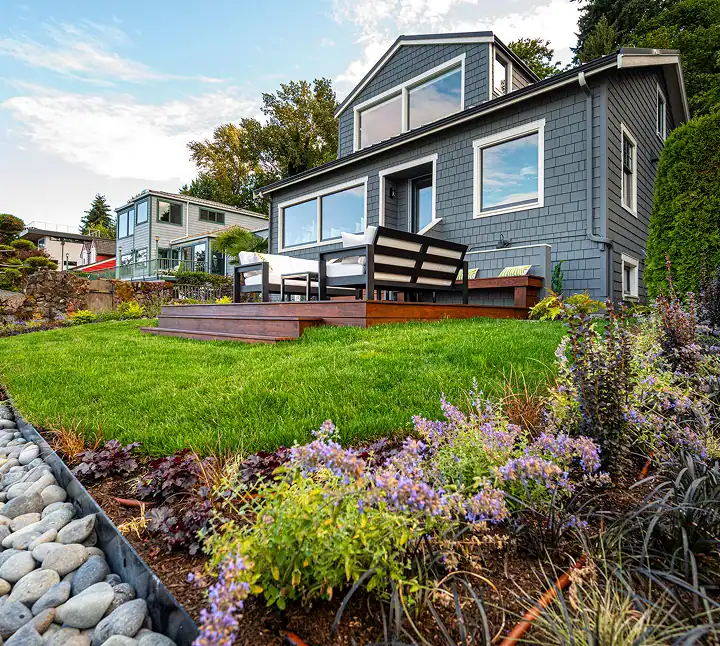
- Identify your shade type first. Dry shade under conifers needs different plants than moist shade along a north foundation. Same "shade" label, very different performance.
- Native ground covers establish faster than imports because they're adapted to our acidic soil, rainfall pattern, and freeze-thaw cycle.
- Sword fern is the single most reliable shade ground cover for dry conifer shade — install at 18–24 inch spacing for fastest fill-in.
- Avoid English ivy, vinca, and lily-of-the-valley even when nurseries sell them. The long-term ecological and maintenance cost outweighs the short-term coverage.
- Year 1 looks sparse, year 3 looks mature. Mulch heavily between plants for the first two seasons to suppress weeds while ground covers fill in.
- Plant cost is rarely the budget driver. Soil prep, removal of failed existing plantings, and grading drive most of the project cost.
The most reliable shade ground covers for Pacific Northwest yards are sword fern, salal, wild ginger, Cascade Oregon grape, and Pacific bleeding heart — all natives that evolved under the same Douglas fir canopy that’s shading your yard. Add Vancouveria for spreading texture and Heuchera for foliage color, and you have a planting palette that fills in within two to three seasons, suppresses weeds, and costs less to maintain than the lawn it’s replacing.
The catch — and the reason most shade ground cover installations underperform — is that “shade” is not one condition. The ground under a Douglas fir on a Kirkland Finn Hill lot is dry shade. The ground along a north-facing Bellevue foundation is moist shade. The ground at the base of a Sammamish maple is somewhere in between, and the soil character changes by the season. Picking plants for the right kind of shade matters more than picking from a generic “best of” list.
This article covers the ground covers we actually plant on Greater Seattle properties, sorted by the shade type they handle, with the failure modes we’ve watched homeowners walk into.
Why most shade ground cover installs underperform
The pattern we see when we get called to fix a struggling shade bed is almost always the same: someone planted a generic “shade” list — usually heavy on hostas — into dry shade under a conifer, and the plants spent three years failing to fill in.
Hostas need consistent moisture. Under an established Douglas fir, the tree wins every contest for water, and the soil dries out 6 inches deep by mid-July even in our climate. The hostas survive, but they sulk. The bed never fills. Weeds move into the bare soil. By year four, the homeowner gives up and the area gets mulched over.
The fix isn’t more water or more soil amendments. It’s choosing plants that evolved under exactly these conditions. Sword fern thrives where hostas struggle because sword fern is what’s growing on the forest floor 10 feet away from the same Douglas fir. The native plant palette that surrounds Greater Seattle neighborhoods is the cheat sheet for what to plant under the trees in those neighborhoods.
What’s the difference between dry shade and moist shade?
Walking the site is the only way to know which kind of shade you’re dealing with, but a few signs help.
Dry shade is most often under conifer canopy — Douglas fir, western hemlock, western red cedar — where the trees pull water out of the soil aggressively year-round. Soil is often acidic from fallen needles. The ground stays damp briefly after rain, then dries out. Most “shade” plants from generic lists fail here.
Moist shade is most often along north-facing foundations, between buildings, or in low spots where water collects. Soil tends to stay damp through most of the year. Hostas, ferns, and astilbes that look great in catalog photos work here.
Mixed shade is the most common Greater Seattle condition — under a deciduous tree like a big-leaf maple where light reaches the ground in winter and spring but the canopy closes in by June. Plants that handle this need to tolerate seasonal swings.
The simplest test: dig 6 inches into the soil in late July. Damp = moist shade. Powder-dry = dry shade. Somewhere between = mixed.
Which native ground covers do we use most in Greater Seattle yards?
These five natives carry the bulk of our shade ground cover installations across Bellevue, Kirkland, Sammamish, and Redmond. They establish faster than imports because they’re already adapted to our soil chemistry, rainfall pattern, and the freeze-thaw cycle of our winters.
Sword fern (Polystichum munitum)
The default choice for dry shade under conifers. Evergreen, 2 to 4 feet tall, slowly clumping. Once established, it tolerates drought, deer browse, and heavy needle drop. Plant 18–24 inches apart in fall for spring fill-in. Cut back winter-burned fronds in early March to make room for new growth.
In our experience, sword fern is the single most reliable shade plant on Greater Seattle properties. We’ve installed it on slopes under fir canopy that no other plant could hold, and three years later the fronds have closed the gap and the soil underneath stays in place.
Salal (Gaultheria shallon)
Evergreen shrub, 1–3 feet tall in shade (taller in part sun), spreads via underground rhizomes. Glossy oval leaves, urn-shaped pink flowers in spring, edible dark purple berries that feed birds and bears. Tolerates dry to moist shade. Excellent for stabilizing slopes — the rhizome network creates a soil mat.
Trade-off: salal spreads. In a small bed it can need annual edging. In a large bed under conifers, that spread is the feature.
Wild ginger (Asarum caudatum)
Low-growing (4–8 inches), heart-shaped evergreen leaves, slow-spreading. Best in moist shade with rich soil — common along streams and in the duff layer of mature forests. Maroon flowers hide under the leaves in late spring. Roots smell faintly of ginger when crushed.
This is the plant we reach for when the shade is deep and the homeowner wants something that reads as “forest floor” rather than “garden bed.”
Cascade Oregon grape (Mahonia nervosa)
Holly-like evergreen leaves, bright yellow spring flowers, dusky blue summer berries. 1–2 feet tall, slowly spreading colonies. Tolerates dry shade better than most broadleaf evergreens. Deer-resistant — the leaves are too prickly to be browse-worthy.
Pacific Horticulture and OSU Extension both list this as one of the most underused PNW natives for residential landscapes. We agree.
Pacific bleeding heart (Dicentra formosa)
Deciduous, 12–18 inches tall, ferny gray-green foliage, pink heart-shaped flowers from late spring through summer. Spreads slowly via rhizomes. Goes dormant in late summer and reappears in spring. Plant with sword fern to hide the dormant gap.
This is the native answer to the imported old-fashioned bleeding heart (Lamprocapnos spectabilis) — looser, more delicate, longer bloom season.
Which non-natives perform reliably here?
Three non-natives pull their weight in PNW shade beds. Most others are either too fussy, too aggressive, or duplicate what natives already do better.
Epimedium (barrenwort). Multiple species and cultivars. Heart-shaped leaves with bronze new growth. Tiny spider-like flowers in spring. Specifically designed by evolution for dry shade — that’s where it grows in the wild. Slow but unstoppable once established.
Hellebores (Helleborus orientalis, H. niger). Winter and early spring blooms in deep purple, white, pink, yellow. Evergreen leathery foliage. Tolerates a wide range of shade conditions. The bloom timing is the magic — flowers from January through March when nothing else is awake.
Heuchera (coral bells). Evergreen mounding foliage in dramatic colors — burgundy, lime, copper, near-black. The ‘Marmalade,’ ‘Obsidian,’ and ‘Caramel’ cultivars perform best in our climate. Use for color anchor points in a green-dominated shade palette.
What we plant carefully or not at all
Three plants get recommended on generic lists that we either plant with caution or refuse:
- English ivy (Hedera helix) — listed as a Class C noxious weed by the Washington State Noxious Weed Control Board. It escapes residential plantings into urban forests and smothers native understory. We don’t plant it.
- Vinca (Vinca minor, V. major) — aggressively spreads, hard to remove, escapes to greenbelts. The “evergreen, blooms in spring, easy” pitch is real, and the long-term consequences are real too. Many King County jurisdictions discourage it for the same reason as ivy.
- Lily-of-the-valley (Convallaria majalis) — beautiful, fragrant, and aggressive in our soils. It will jump bed edges and eat its neighbors. Acceptable in contained beds, problematic when planted as a “fill in everywhere” ground cover.
How long does it take for ground cover to fill in?
Realistic expectations from our installs:
- Year 1: Plants survive and put on root growth. Ground cover looks sparse. Bare soil between plants is normal — mulch generously to suppress weeds.
- Year 2: Visible spread. Most installs fill 50–70% of the bed.
- Year 3: Mature coverage. Bed reads as established. Weeds get crowded out.
This timeline is shorter for fast-spreaders like salal and longer for slow-spreaders like wild ginger. We typically tell homeowners that years 1 and 2 will look thinner than they expect, and year 3 will look better than they expected.
What does it cost to replace a shade problem area with ground cover?
Three cost tiers we see on Greater Seattle projects:
- Plants only (homeowner installs): $300–$800 for a 100 sq ft bed planted at proper density with native ground covers. Doesn’t include soil amendment, mulch, edging, or removal of failed existing plants.
- Soil prep + installation by professional crew: $2,500–$5,000 for the same 100 sq ft bed including soil amendment, plant supply, installation, mulch, and irrigation tie-in.
- Full design-build solution for a problem shade area: $8,000–$25,000 when the area also needs grading, drainage correction, removal of mature roots and existing failures, hardscape edging, and a full plant palette beyond just ground cover.
The plant cost is rarely the deciding factor. Soil prep and removal of what’s already there usually drives the budget.
For a single shade problem area, this is a straightforward enhancement project. Our include the soil prep, drainage check, and species-appropriate planting that determine whether ground covers actually establish — not just survive the first season.